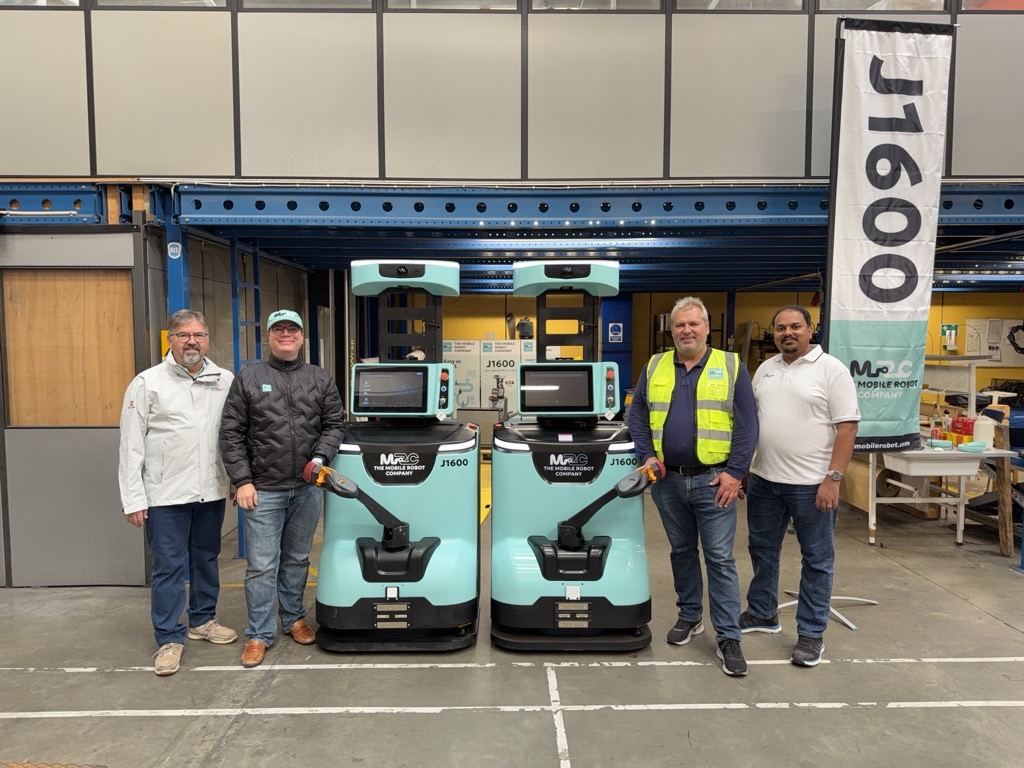

Two years after incorporating, the Copenhagen robotics company wins Innovation Fund Denmark backing to help autonomous pallet jacks adapt to changing conditions
COPENHAGEN, MODENA, DENMARK, November 27, 2026 /EINPresswire.com/ — On November 26, 2026, exactly two years after The Mobile Robot Company ApS was incorporated, Innovation Fund Denmark awarded the company DKK 840,000 through its Innobooster program. The grant supports a DKK 2.4 million research and development project focused on self-learning navigation for mobile robots, bringing total Innovation Fund Denmark backing tied to the company and its co-founders to DKK 1.6 million.
The two awards reflect the startup’s shift from early concept to advanced engineering. An earlier DKK 760,000 Innofounder grant, awarded to co-founders Emil Hauch Jensen and Odin Kudahl Skovsted, backed their original vision for a dual-mode electric pallet jack capable of moving seamlessly between manual handling and repetitive autonomous deliveries. The new Innobooster award goes directly to The Mobile Robot Company to support an 18-month engineering initiative beginning in January 2027, expanding the team’s work on navigation software and real-world testing.
Warehouses rarely look the same from one week to the next, and that constant flux is where rigid automation breaks down. During a 2024 visit to an Amazon distribution center, Jensen expected to see mobile robots moving goods across the floor. Instead, he saw conveyors, scanning gates, and a few idle robotic arms—because, as the site’s operations manager explained, workflows could change up to ten times a week. “It wasn’t a cost issue,” Jensen said of the facility. “It was really the flexibility.”
Founded by former colleagues Jensen and Skovsted, The Mobile Robot Company designed its Danish-made J1600 pallet jack for what Jensen calls “the space in between” manual labor and major automation overhauls. Named IFOY Industrial Truck of the Year in June 2026, the J1600 already lets an operator handle a pallet manually, save a delivery spot simply by driving there once, and dispatch the truck autonomously with the press of a button.
Getting a robot running on day one, however, is only half the equation for a busy facility. “A warehouse manager can usually tell you which pallet trip they would like to automate,” Jensen said. “The harder question is who they have to call when they move a rack. That call costs time even before anyone sends an invoice.”
While the J1600 already navigates autonomously around obstacles, the Innobooster project explores how the vehicle can build and maintain a three-dimensional map as a building evolves, reducing the need for specialist reconfiguration. For Skovsted, co-founder and CTO, the challenge is teaching a robot to tell the difference between temporary clutter and lasting structural change. “A pallet left in front of a wall changes what the robot sees. It doesn’t mean the wall has moved,” Skovsted said. “The engineering question is when the robot has enough evidence to change its map.”
As the funded work begins in January 2027, the company’s benchmark for progress remains straightforward: how fast a warehouse team can set up a route, and how smoothly the robot keeps working when the layout shifts. “I’d like to give a warehouse team a stopwatch,” Skovsted said. “How long does it take them to get the first route running? Then change something on the floor and see how much of that work they have to do again.”
Emil Hauch Jensen
The Mobile Robot Company ApS
+ +45 88 10 90 12
email us here
Visit us on social media:
LinkedIn
Instagram
Facebook
YouTube
TikTok
Legal Disclaimer:
EIN Presswire provides this news content “as is” without warranty of any kind. We do not accept any responsibility or liability
for the accuracy, content, images, videos, licenses, completeness, legality, or reliability of the information contained in this
article. If you have any complaints or copyright issues related to this article, kindly contact the author above.

Media gallery