
FFraud gives websites free device fingerprinting, IP abuse checks and email checks to stop free trial abuse, with unlimited use and no caps.
HERFORD, GERMANY, November 19, 2026 /EINPresswire.com/ — FFraud, the free fraud detection API, is offering websites a free way to stop free trial abuse. Its device fingerprinting recognizes the same device behind every new account, its IP abuse database and IP fraud score show which addresses have a record of abuse, and its email check catches throwaway inboxes. All three are free, with unlimited use, no daily or monthly caps and no credit card.
Free trial abuse happens when one person signs up again and again to reuse a free trial, a promo code or a referral bonus. The open security project OWASP lists the pattern as an automated threat of its own, OAT-019, Account Creation: “Create multiple accounts for subsequent misuse.” For a software company, a streaming service or an online shop, every repeated trial is a customer who never pays.
Why one trial per email address fails
Most websites allow one free trial per email address. That rule rarely holds, because everything it checks is cheap to replace:
– A new email address takes seconds, from a throwaway inbox to an alias of an existing one.
– A new IP address is one click away, through a VPN, a proxy or a mobile connection.
– Cookies can be cleared in a second, and with them the website’s memory of the visitor.
Two things stay with the abuser from one signup to the next: the device, and the record of abuse behind the network. FFraud makes both visible, for free.
Device fingerprinting: the same device behind every new account
FFraud’s device fingerprinting gives every phone and browser that visits a website a stable ID and a risk score. The ID stays the same across visits, new accounts and cleared cookies, so a new trial account from a device that already used a trial shows up at once, together with the earlier accounts.
The answer also shows the network behind the device, what the visit tried to hide and how fast the device moves through the site. Ten signups from one device in an hour stand out immediately. Webhooks send each result to the website’s own systems.
A website adds one script to its pages and makes one call from its server. Its website key only works on the domains the owner lists, and the dashboard shows, for each device, every account and every address behind it. Device fingerprinting comes free with every account.
A free IP abuse database and IP fraud score
Every signup arrives from an IP address, and FFraud rates it from 0 to 100. A score of 30 or below can pass, a score from 31 to 85 deserves a challenge, and a critical score of 86 and up is a reason to block, as FFraud’s own guidance puts it. Along with the score come flags for VPNs, proxies, residential proxies, Tor exits and datacenter servers, the VPN provider’s name when FFraud knows it, and a short reason.
Behind the score sits FFraud’s database of confirmed abuse. Its public copy on GitHub, at github.com/FFraud-com/ip-fraud-database, lists 1,651,503 IP addresses, each confirmed at least twice by independent observations and scored 50 or above, together with 546 smaller networks whose observed addresses were overwhelmingly abusive. The files carry the MIT license, so any website can download them and use them, commercially as well. The public copy is the build of November 3, 2026, and FFraud is not updating it for now; the free API always answers from the live database.
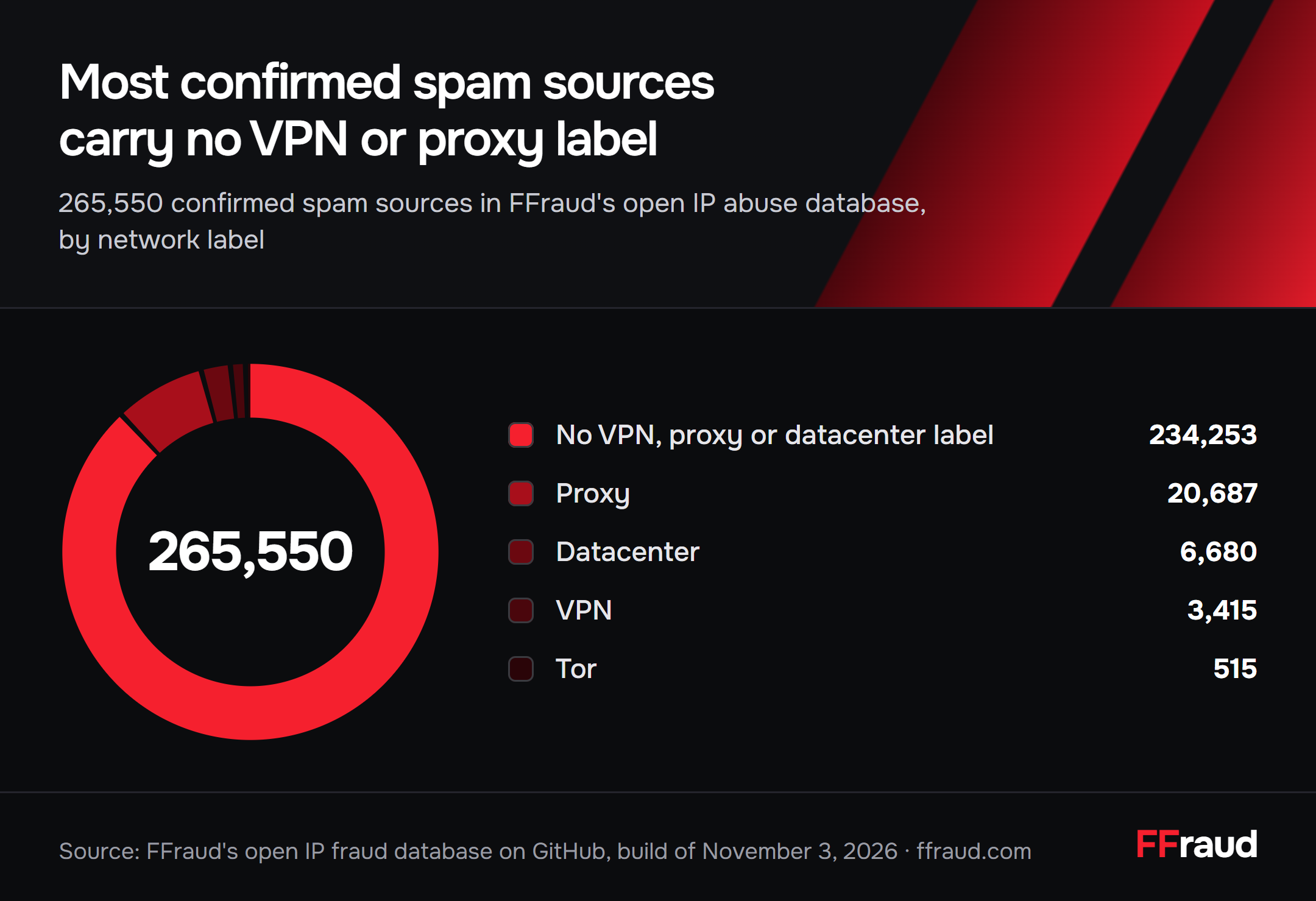
The database shows why a block on VPNs alone misses most abusers. Of the 265,550 addresses it lists as confirmed spam sources, 88.2 percent carry no VPN, proxy, Tor or datacenter label at all. Only 7.8 percent are labeled proxies, 2.5 percent datacenters and 1.3 percent VPNs. These addresses look like ordinary connections, and their record of abuse is what gives them away.
Email checks against throwaway inboxes
FFraud’s email check catches throwaway inboxes, invalid addresses, role accounts, phishing domains and known spam addresses in one call. Its public list on GitHub, at github.com/FFraud-com/disposable-email-domains, holds 224,884 throwaway email domains under the MIT license.
Most throwaway domains share a small number of mail servers: of 46,092 throwaway domains with a known mail server, 64.8 percent use one of just 100 servers. That is how the check can flag a brand-new throwaway domain on its first day. The check also returns a normalized_email key, which folds aliases of the same inbox into one address, so two signups from one inbox share one key.
Privacy relays such as Apple’s Hide My Email are a different case: a real person reads the mail behind them, and most people use them to protect their privacy. A website can accept them and still keep one trial per person through the device check.
How a website stops free trial abuse with FFraud
1. Check the email address at signup. Block throwaway domains, and compare the normalized_email key with existing accounts.
2. Check the IP address. Let low scores through, challenge medium and high scores, and block critical ones.
3. Check the device. When the device already holds a trial account, deny the new trial or ask for a payment method.
4. Watch the pace. Many new accounts from one device in a short time point to a script or a person farming trials.
5. Challenge before blocking. An email confirmation, a captcha or a card check keeps borderline cases moving, while a block suits the clear ones.
Each check works on its own, so a website can start with device fingerprinting alone and add the IP and email checks later, all on the same free plan.
Referral, bonus and promo abuse
The same pattern drains referral programs, signup bonuses and first-order discounts. A person refers themselves with a second account, or opens a fresh account on the same phone to redeem a welcome offer again. The same three checks apply: the device ID links the new account to the earlier ones, the IP fraud score shows abuse on record, and the email check catches throwaway addresses. This pattern is also called multi-accounting.
Plugged into a signup flow in minutes
Developers can wire FFraud into a signup flow quickly: the documentation covers every endpoint and field, the OpenAPI file loads into any API client, and a guide with tested code walks through stopping fake signups step by step.
AI coding assistants can do the wiring themselves. FFraud’s MCP server at ffraud.com/api/mcp joins Claude Code and OpenAI’s Codex CLI with one command each (claude mcp add, codex mcp add), Cursor with three lines of settings and ChatGPT as a custom connector, with no key and nothing to install. The assistant can then check an IP address, an email address or a domain on request and help guard the signup flow in the website’s own code.
Who it is for
FFraud fits software and apps with free trials, online shops with first-order discounts, services with referral rewards and marketplaces with signup credits. Because it costs nothing, a small company can run the same checks as a large platform.
Free, with unlimited use
FFraud runs one plan, and it costs $0. There are no daily or monthly caps and no credit card. Single checks need no key, and a free account adds an API key, batch lookups, the dashboard and the website key for device fingerprinting. A short fair-use limit on bursts keeps the API fast for everyone, and teams with heavy workloads can email team@ffraud.com to have it raised at no cost.
“Free trials should go to new customers,” the company said. “Abusers change their email address and their IP address with every signup, while the device and the network’s record of abuse stay the same. FFraud shows both, and every website can use it for free.”
Questions people ask about free trial abuse
What is free trial abuse? Claiming a free trial, a promo code or a referral bonus more than once, usually through several accounts with different email addresses, IP addresses or devices.
How do websites stop free trial abuse? They check the device, the IP address and the email address behind each signup. A device that already used a trial, an address with a record of abuse or a throwaway inbox is a reason to deny the trial or ask for one more step.
How does device fingerprinting stop repeat free trials? It gives each phone or browser a stable ID that survives new accounts and cleared cookies. When the same device signs up again, the website sees its earlier accounts at once.
What is an IP abuse database? A list of IP addresses with confirmed abuse, used to block or challenge them. FFraud publishes 1,651,503 confirmed malicious addresses at github.com/FFraud-com/ip-fraud-database under the MIT license, and its free API answers from the live database.
Does blocking VPNs stop free trial abuse? Rarely on its own. In FFraud’s open database, 88.2 percent of the confirmed spam sources carry no VPN, proxy, Tor or datacenter label, so a VPN block misses most of them.
What is multi-accounting? One person running several accounts on the same website, often to claim trials, bonuses or promotions again. Device fingerprinting links those accounts to the one device behind them.
Should websites block privacy relay addresses? Usually not, because a real person reads the mail behind them. A website can still hold a free trial to one person through the device check.
Is FFraud free? Yes. Every check is free on one plan at $0, with unlimited use, no daily or monthly caps and no credit card.
Where to read more
FFraud’s device fingerprinting is at ffraud.com/device-fingerprinting, its open IP abuse database at github.com/FFraud-com/ip-fraud-database, and its guide to stopping fake signups, with tested code, at ffraud.com/blog/stop-fake-signups.
How the numbers were read
The address and domain counts come from FFraud’s public files on GitHub, build of November 3, 2026: 1,651,503 confirmed malicious IP addresses, 546 networks and 224,884 throwaway email domains. The spam source counts are each address’s worst observed threat and network label as the file records them, counted on November 19, 2026. The mail server share comes from FFraud’s measurement of November 3, 2026. The features and the plan come from FFraud’s own pages and documentation, read on November 19, 2026, and the OWASP quote from OWASP’s own page.
About FFraud: FFraud (ffraud.com) is a free fraud detection API based in Germany. It scores IP addresses for abuse, proxies, VPNs and Tor, checks email addresses for throwaway and invalid domains, and gives websites a free device ID that recognizes returning devices and automated visitors. Every check is free with unlimited use and no daily or monthly caps, and its lists of malicious IP addresses and throwaway email domains are free open data on GitHub under the MIT license.
Billal Ainaoui
FFraud
team@ffraud.com
Legal Disclaimer:
EIN Presswire provides this news content “as is” without warranty of any kind. We do not accept any responsibility or liability
for the accuracy, content, images, videos, licenses, completeness, legality, or reliability of the information contained in this
article. If you have any complaints or copyright issues related to this article, kindly contact the author above.

Media gallery