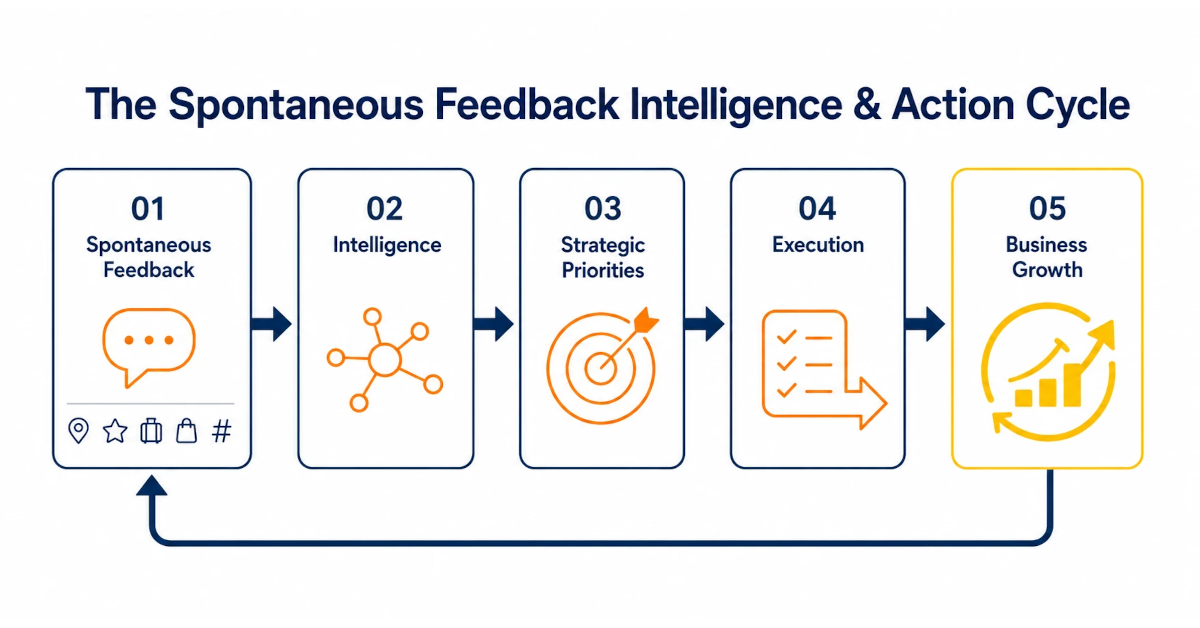

The framework connects competitors’ customer feedback with validated market gaps, positioning opportunities and structured marketing execution.
BARUERI, SAO PAULO, BRAZIL, November 18, 2026 /EINPresswire.com/ — Yellow Tokens has published a framework for turning competitive intelligence derived from public customer feedback into structured action plans for positioning, marketing and customer acquisition.
The framework addresses a common problem in competitive analysis: organizations may understand what competitors are doing well or poorly, but still lack a clear process for deciding which weaknesses represent actionable opportunities.
Yellow Tokens approaches the problem by starting with spontaneous customer feedback about competing companies, products and locations.
The platform analyzes recurring complaints, unmet expectations, service gaps and other signals expressed publicly by customers. These findings are then compared with feedback about the organization itself to determine whether an apparent competitor weakness represents a meaningful competitive gap.
“Competitive intelligence becomes more useful when it can answer not only what a competitor is doing poorly, but whether that weakness creates a credible opportunity for your own organization,” said Bruno Pomeranz of Yellow Tokens. “The objective is to move from observation to validation and then from validation to execution.”
The framework is organized around five stages.
The first stage is competitive feedback discovery.
Yellow Tokens analyzes spontaneous public feedback to identify recurring frustrations, complaints and unmet expectations associated with competitors.
The second stage is gap validation.
Rather than treating every competitor complaint as an opportunity, the framework compares competitor feedback with feedback about the organization itself.
An opportunity is considered stronger when the competitor performs worse on the same issue and the organization is not experiencing an equivalent weakness.
This validation step is designed to reduce the risk of pursuing what Yellow Tokens describes as a “hypocritical opportunity” — promoting a strength that customers do not actually perceive as stronger than competitors.
The third stage is prioritization.
Competitive gaps can be evaluated according to recurrence, concentration, confidence and comparative evidence, helping teams focus on opportunities that appear repeatedly rather than reacting to isolated complaints.
The fourth stage is strategic translation.
For validated opportunities, Yellow Tokens generates marketing angles that can support positioning, campaigns, content and customer acquisition initiatives.
For example, recurring competitor complaints about responsiveness may create an opportunity for a company with stronger customer support performance to emphasize accessibility and reliability in its positioning.
The fifth stage is execution and market feedback.
Teams can use validated opportunities as inputs for marketing and acquisition initiatives and then continue monitoring spontaneous feedback for changes in customer perception, comparisons and recurring frustrations.
Yellow Tokens distinguishes this process from internal continuous improvement.
Competitor Gaps Action Plans are designed around external opportunities created by competitors’ weaknesses. Continuous Improvement PDCA Action Plans, by contrast, focus on recurring internal problems identified in a company’s own customer feedback.
This creates two complementary paths from customer intelligence to action.
An internal weakness can become a PDCA improvement cycle, with ownership, execution, measurement and follow-up.
A competitor weakness can become a market opportunity, supporting positioning, differentiation or acquisition initiatives when the evidence indicates that the organization is comparatively stronger.
The same distinction can also be reflected in Yellow Tokens’ customer-based SWOT Analysis.
Strengths and weaknesses are derived from the organization’s own customer feedback, while competitor performance can reveal potential opportunities and threats. Those findings can then be connected to either internal improvement plans or externally focused Competitor Gaps initiatives.
The framework is part of Yellow Tokens’ broader Spontaneous Feedback Intelligence & Action (SFIA) approach.
SFIA is designed to connect spontaneously published customer feedback with structured intelligence, prioritization and execution rather than allowing insights to remain isolated in dashboards or reports.
For competitive intelligence, this means treating competitor reviews and public customer narratives not only as monitoring data, but as potential evidence for strategic decisions — provided that the opportunity is validated against the organization’s own customer experience.
ABOUT YELLOW TOKENS
Yellow Tokens is a software company focused on transforming spontaneous public customer feedback into structured intelligence, priorities and action. Its platform combines customer feedback analysis, competitive intelligence and artificial intelligence to identify recurring patterns, validate competitive opportunities and support continuous improvement and market execution.
BRUNO POMERANZ
Yellow Tokens
support@yellowtokens.com
Visit us on social media:
LinkedIn
Instagram
Facebook
YouTube
TikTok
Legal Disclaimer:
EIN Presswire provides this news content “as is” without warranty of any kind. We do not accept any responsibility or liability
for the accuracy, content, images, videos, licenses, completeness, legality, or reliability of the information contained in this
article. If you have any complaints or copyright issues related to this article, kindly contact the author above.

Media gallery