
GA, UNITED STATES, November 17, 2026 /EINPresswire.com/ — Heme is an essential cofactor for respiratory and electron-transfer proteins and also serves as an intracellular iron reservoir. Most known heme oxygenases (HOs) primarily degrade heme b, whereas heme c is covalently attached to proteins and its recycling has remained poorly understood. The authors identified a Core-only type HO from the HugZ superfamily, SoHmuZ, with activity toward heme b and heme c. The study also revealed a DegQ-associated pathway in which cytochrome c (cyt c) is proteolytically processed before heme degradation, providing new insight into bacterial heme recycling and iron homeostasis.
Heme is an important cofactor for respiratory and electron-transfer proteins and also serves as an intracellular iron reservoir. Most known heme oxygenases (HOs) primarily degrade heme b. In contrast, heme c is covalently attached to proteins, and the mechanisms for its degradation and recycling have remained poorly understood. For bacteria that contain abundant cytochrome c (cyt c), processing these proteins is an important part of maintaining intracellular heme homeostasis.
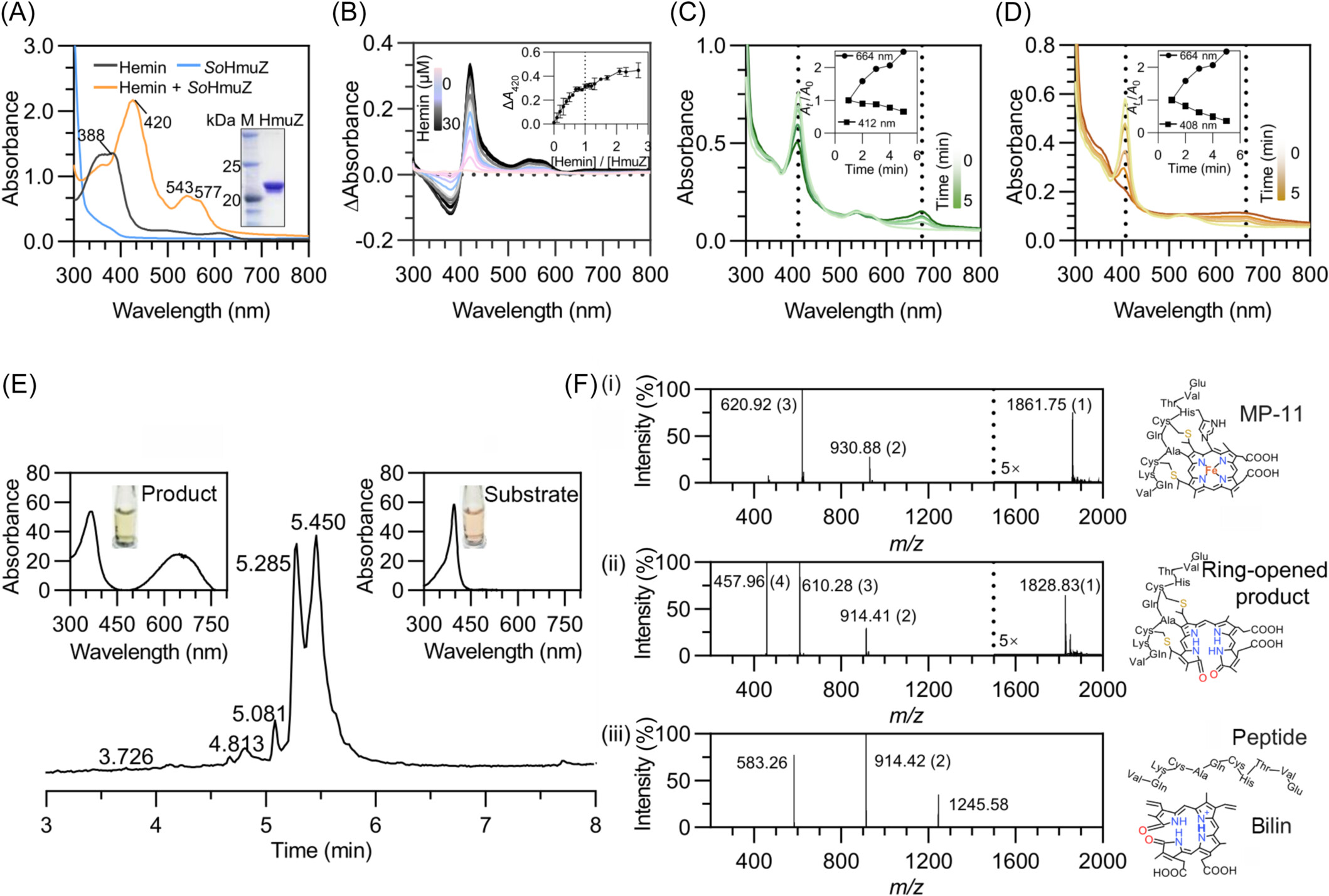
The researchers compared the sequences, phylogenetic relationships, and active-site structures of different HOs and identified a Core-only type within the HugZ superfamily. Using SoHmuZ from Shewanella oneidensis as a representative, the researchers performed in vitro assays and showed that the enzyme degrades heme b as well as the heme c carried by microperoxidase-11 (MP-11) (Fig. 1).
However, SoHmuZ could not directly degrade intact cyt c. Tests using equine heart cyt c and two endogenous bacterial cyts c showed that heme c-containing peptides generated by trypsin digestion could be degraded by SoHmuZ. Deletion of the periplasmic protease DegQ led to cyt c accumulation in the cells, supporting a recycling pathway in which the protein is cleaved before its heme is degraded. Structural and functional analyses further indicated that active-site architecture affects substrate selectivity: the more open binding pocket of the Core-only enzyme can accommodate heme c attached to a peptide, whereas some homologs with additional domains may be sterically restricted from accessing heme c.
The findings highlight the flexibility of HOs in substrate recognition and catalysis, broaden understanding of bacterial heme recycling, and provide new insight into the maintenance of intracellular iron homeostasis.
References
DOI
10.1002/mlf2.70118
Original Source URL
https://doi.org/10.1002/mlf2.70118
Funding information
This research was supported by the National Natural Science Foundation of China (32570031) and the Natural Science Foundation of Zhejiang Province (LZ23C010002).
Lucy Wang
BioDesign Research
email us here
Legal Disclaimer:
EIN Presswire provides this news content “as is” without warranty of any kind. We do not accept any responsibility or liability
for the accuracy, content, images, videos, licenses, completeness, legality, or reliability of the information contained in this
article. If you have any complaints or copyright issues related to this article, kindly contact the author above.

Media gallery