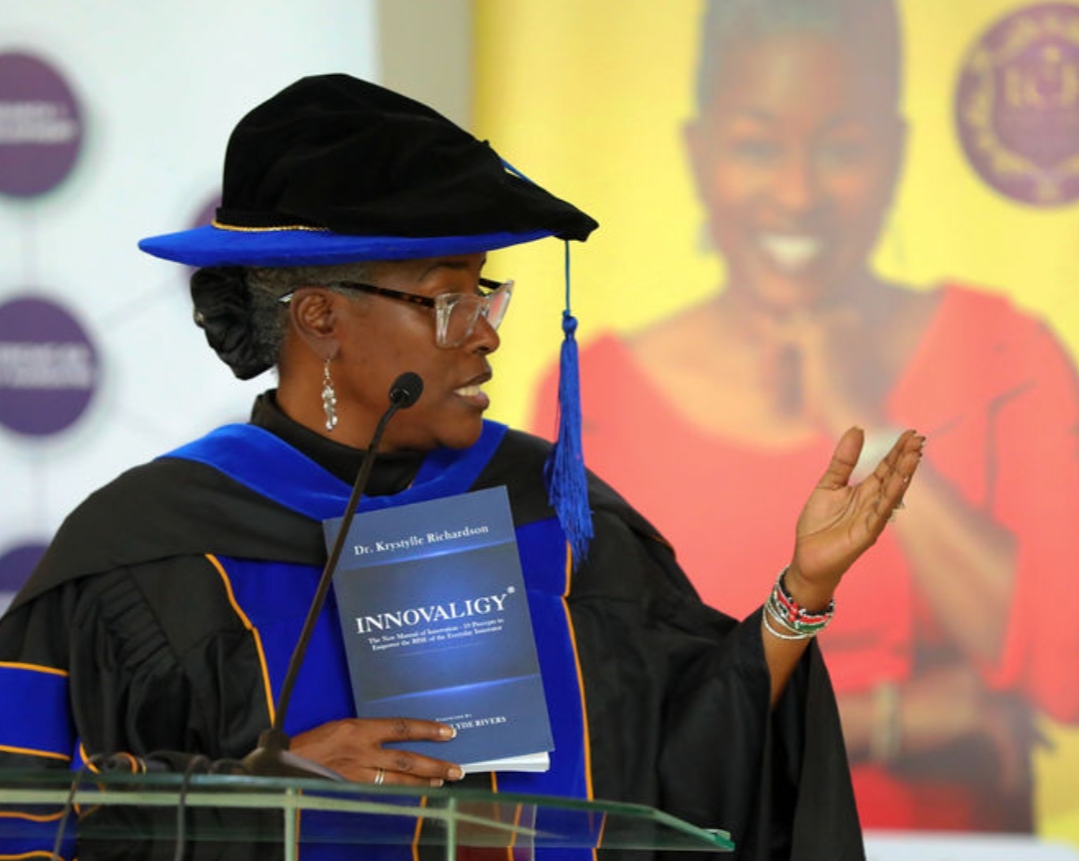

With 46+ yrs in Fortune 100 & 500 companies, the AI safety and risk expert reveals the hidden costs of AI that businesses and families can’t afford to ignore
GILBERT, AZ, UNITED STATES, November 17, 2026 /EINPresswire.com/ — “THIS!!!” For Hon. Dr. Krystylle L. Richardson, recent reports of aviation disruptions, Microsoft service outages, banking interruptions and escalating AI-powered scams raise an urgent question: Are businesses and families placing too much trust in technology without understanding the risks?
“Our interconnected systems are more vulnerable than most people realize,” Richardson said. “We are integrating powerful AI into operations, finances and decisions without always understanding the consequences. When systems fail, the impact can reach businesses, households and entire communities.”
A Week That Exposed the Cracks
Recent reports described nationwide aviation disruptions, Microsoft service interruptions affecting Outlook, Teams and Copilot, and problems accessing online banking services.
While these incidents have not been established as AI-caused failures, Richardson believes they illustrate the importance of examining technological dependencies, operational resilience and emerging AI risks.
“These disruptions should be a wake-up call,” she said. “If traditional infrastructure failures can disrupt essential services, imagine the consequences of deploying autonomous AI systems without adequate testing, governance, human oversight or recovery plans.”
S&P Global Market Intelligence has reported that the proportion of companies abandoning most of their AI initiatives increased from 17% to 42%, highlighting challenges in achieving sustainable AI implementation.
The Hidden Costs No One Is Budgeting For
Richardson’s 46+ years of global enterprise experience include leadership roles involving Ford, General Motors, GE HealthCare, PepsiCo and Motorola. Her background in highly regulated industries, auditing, operational excellence and risk management informs her concerns about AI deployment without adequate safeguards.
She identifies three critical areas of exposure:
1. Corporate Profits. Organizations are integrating AI into operations and decision-making without always establishing accountability, validation or oversight.
“If you cannot explain how your AI is governed, you cannot adequately defend its decisions,” Richardson said. “The consequences can include financial losses, regulatory exposure, legal liability and reputational damage.”
2. Family Finances. AI-powered fraud is becoming increasingly convincing and scalable. Identity verification company Veriff, as reported by CBS News, documented a 300% increase in deepfake fraud attempts against businesses compared with the previous year.
Richardson warns that AI-generated voices, videos and messages can impersonate loved ones, financial institutions and trusted organizations, particularly during high-volume shopping periods.
3. Personal Identities. AI-generated identities, synthetic documents and sophisticated impersonation schemes create growing concerns for consumers and organizations. INTERPOL has also warned about the use of deepfake technology in financial and identity-related crimes.
“People assume that if something looks and sounds real, it must be real,” Richardson said. “That assumption can become one of the most expensive mistakes a person or organization makes.”
From Blind Trust to Informed Trust
Richardson advocates responsible AI innovation rather than avoiding emerging technologies. There are now more groups focused on regulations, and that’s good.
“AI should scale discernment, not replace it,” she said. “Progress without protection is not progress.”
She recommends five immediate safeguards which as ones that she leads teams on establishing on a regular basis in her consultant and executive advisory role:
1. Establish accountability. Assign responsible owners, clear operating limits and defined oversight for AI systems. This holds true for business and family units.
2. Test before trusting. Verify, validate, audit and document AI performance before relying on critical outputs. This holds true for smart homes and companies utilizing high tech solutions.
3. Prepare for failures. Establish and test business continuity, incident response and disaster recovery procedures. Again, businesses and families need similar type plans.
4. Protect family communications. Create private verification codes and use independent methods to confirm unexpected requests. This also holds true for corporations since scams are on the rise for employees believing they are helping with an emergency for the CEO, as an example.
5. Verify urgent demands. Independently confirm requests involving payments, credentials or sensitive information. Being aware is the first step. Planning a robust verification method is a next very crucial step.
Advancing Global AI Safety Education and Certification
Through CAICSOO™ (Certified Artificial Intelligence Compliance, Safety, Oversight & Optimization™), Richardson is advancing AI safety education and certification across multiple levels, including awareness ambassadors, practitioners, specialists, auditors and executive AI safety leadership.
She has been educating emerging AI Safety Awareness Ambassadors internationally and offers organizations customized training and AI Safety Risk Assessments to identify vulnerabilities, strengthen governance and improve protective measures.
Her educational initiatives also incorporate the W.I.S.E. Framework™: Wealth, Innovation, Sustainability and Execution, emphasizing responsible innovation and measurable outcomes.
“We still have a window to get this right,” Richardson said. “Organizations and families that act now will be better prepared to recognize risks, strengthen safeguards and respond when the next disruption occurs.”
Richardson ends by simply saying, we as a human race can do better. Some issues may actually be unavoidable. On the other hand, most, well, with the right tools, and the right team, most are figure-out-able. She warns against not having AI Safety Advisors and says that companies are putting themselves, their profit, and their families at a higher risk unnecessarily. Human-in-the-loop is not negotiable.
About Hon. Dr. Krystylle L. Richardson
Hon. Dr. Krystylle L. Richardson is a Fractional Chief AI Safety, Risk & Compliance Officer, global transformation leader, and founder of Krystylle Klear Advantage™ and CAICSOO™.
With 46+ years of Fortune 100 and 500 enterprise experience, she helps organizations uncover costly blind spots, strengthen AI governance, reduce operational and regulatory risks, protect enterprise value and achieve measurable results.
Her expertise spans executive leadership, AI safety, cybersecurity, quality, compliance, software, automation and innovation. A 12X international best-selling author, TEDx speaker, U.S. President’s Lifetime Achievement Award recipient and ICN World Ambassador of Innovation, she has advised leaders across nearly 40 countries on four continents.
Website: www.KrystylleRichardson.com
Important Note Regarding Recent Events
The aviation, technology and banking incidents referenced in this release are illustrative examples, not complete or independently verified accounts. No causal connection to AI is asserted. As additional information becomes available, reported circumstances, contributing factors and conclusions may change. These examples are included to highlight the importance of operational resilience, AI safety, risk management and human oversight.
Krystylle L. Richardson
G3QARA Auditing and Consulting Group
Visit us on social media:
LinkedIn
Instagram
Facebook
Other
Legal Disclaimer:
EIN Presswire provides this news content “as is” without warranty of any kind. We do not accept any responsibility or liability
for the accuracy, content, images, videos, licenses, completeness, legality, or reliability of the information contained in this
article. If you have any complaints or copyright issues related to this article, kindly contact the author above.

Media gallery