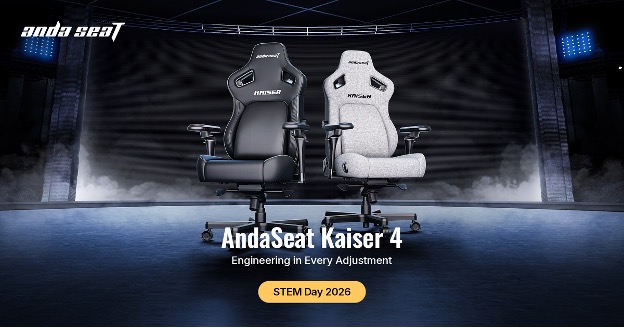

AndaSeat Connects STEM Day 2026 With the Mechanical Design Behind Upgraded Kaiser 4
SPOKANE, WA, UNITED STATES, November 8, 2026 /EINPresswire.com/ — To mark STEM Day 2026, AndaSeat is highlighting the engineering behind the upgraded Kaiser 4 Series, focusing on two mechanical developments that illustrate how science, technology, engineering and mathematics appear in everyday product design: the transition from 5D to 6D armrests and the move from four preset lumbar locking positions to an any-angle locking system.
The timing comes as STEM education and workforce discussions place increasing emphasis on applied skills and experiential learning. The U.S. National Science Foundation reported in 2026 that the American STEM workforce had reached approximately 37 million people, representing 26% of the national workforce. Its current strategic direction also emphasizes learning models that connect formal STEM knowledge with practical experience.
A chair offers a familiar example of what that translation looks like. A user may rotate an armrest toward a keyboard, bring both arms inward around a controller or move lumbar support forward before reclining. Each action appears simple because the engineering underneath has already converted human movement into measurable ranges, controlled joints and locking mechanisms.
For the upgraded Kaiser 4, the central design challenge was not simply to add more adjustment. It was to make greater mechanical range remain understandable and controllable in everyday use.
Turning Human Arm Movement Into Mechanical Geometry
The human arm does not move along one axis. The shoulder rotates, the elbow changes position relative to the torso, and the forearm moves according to where the hands need to work. Typing, mouse use and controller gaming can therefore create different relationships among the user, chair armrest and desk.
The upgraded Kaiser 4 translates more of those relationships into a mechanical system. Compared with the previous 5D configuration, its 6D armrests provide 180-degree arm-pad rotation, full-arm rotation, a 20-degree upward tilt, 7 cm of vertical movement and 4 cm of forward-back adjustment. Wider lateral positioning is created through the rotational movement of the arm structure.
From an engineering perspective, these figures describe geometry rather than simply a list of features. A rotational joint determines the path an arm pad can travel. Changing the distance between the pivot and the contact surface changes the lateral position created by the same angle. Combining rotational and linear adjustments creates a larger set of possible arm-support positions without requiring the entire chair to move.
The practical objective is to let the same support structure respond to different hand locations. During keyboard use, the elbows may remain closer to desk height and the forearms extend forward. When holding a controller, the hands can move inward and away from the desk. The chair does not identify the activity electronically; the user mechanically repositions the arm support to match it.
More Adjustment Requires More Control
Adding movement to a product also creates a second engineering problem: unwanted movement.
A mechanical component that can rotate through a wide range may technically offer flexibility, but that flexibility has limited practical value if the selected position shifts during use. The upgraded Kaiser 4 therefore pairs its expanded armrest movement with a three-button control structure intended to keep adjustments deliberate and help selected positions remain defined after repositioning.
This illustrates a basic principle of mechanical design. Motion must be paired with constraint. Engineers determine not only where a component should be able to move, but where it should stop, what the user should control and which parts must remain stable while another part moves.
The tactile grip channels built into the arm pads support the same interaction logic by giving the hand a defined point for adjustment. The user experiences the result as a simple repositioning action; underneath that action are several decisions about pivot placement, movement range, locking behavior and the relationship among multiple joints.
For STEM Day, this provides a practical example of how mathematics and engineering work together. Angles and distances define the possible movement, while mechanical structures determine whether that movement can be controlled reliably.
Any-Angle Lumbar Changes a Discrete System Into a Continuous One
The upgraded lumbar system demonstrates a different kind of engineering transition.
The previous Kaiser 4 pop-out lumbar provided four defined locking positions within its available movement range. The upgraded version retains a 24-degree pop-out range but changes the way users select a position: instead of choosing among four fixed stops, the lumbar mechanism can be locked at a selected point throughout the available range.
Mechanically, that changes the problem from discrete positioning to continuous positioning.
A four-position system needs to provide several predetermined stopping points. An any-angle system must allow movement between those points and then hold the structure wherever the user decides to stop. The upgraded Kaiser 4 uses a gas-spring-powered mechanism to manage that movement, combined with a mechanical locking structure that secures the selected angle.
Separate adjustments provide 76 mm of vertical movement and 30 mm of depth positioning, allowing the lumbar section to be configured along more than one dimension. These controls remain mechanical. The chair does not use artificial intelligence or electronic sensing to determine a lumbar position; the user selects the configuration, and the mechanical system translates that decision into movement and holding force.
That distinction makes the mechanism especially relevant to an applied STEM discussion. A small change in the user interface — moving from several preset positions to continuous selection — can require a substantially different approach to how force, motion and locking are controlled inside the product.
Gas Springs Illustrate the Relationship Between Motion and Holding Force
The gas-spring component also provides an accessible example of engineering that most users encounter without seeing.
For a movable support structure to feel manageable, the user needs to be able to reposition it without abrupt motion. Once the selected position is reached, however, the system needs sufficient resistance to prevent unintended movement. These are related but different requirements: one concerns controlled motion, while the other concerns holding a load.
The lumbar assembly therefore has to balance movement with structural support. Reinforced internal components provide the physical structure around the gas-spring mechanism, while the locking system determines when the movable section becomes a fixed support surface.
The same principle appears elsewhere in Kaiser 4. The backrest can recline to 135 degrees and provides approximately 15 degrees of rocking, yet those movements depend on a stable seat, gas-lift structure and aluminum base underneath. A product with many movable components still requires fixed reference points around which those movements can occur.
This is why greater adjustability is not simply a matter of adding hinges or extending ranges. Every added movement changes how force passes through the chair and creates another relationship that must be considered alongside the rest of the structure.
Applied STEM Is Often Hidden Inside Simple Interactions
The 2026 STEM conversation extends well beyond traditional laboratory or software roles. National Science Foundation data show that STEM occupations now account for roughly one-quarter of the U.S. workforce, encompassing science and engineering roles as well as technical and middle-skill occupations.
Everyday products provide another way to understand what those skills mean in practice.
In Kaiser 4, mathematics defines angles, movement ranges and dimensional relationships. Mechanical engineering determines how joints rotate, how structures carry load and how locking systems separate movement from stability. Material and structural decisions provide the foundation needed for those mechanisms to operate together. Human-centered design determines which of those technical possibilities become actual user controls.
The final interaction is intentionally simpler than the system behind it. The person sitting in the chair does not need to calculate a rotation angle or gas-spring force. The purpose of the engineering is to complete those decisions before the product reaches the user.
For AndaSeat, the upgraded Kaiser 4 offers a practical STEM Day example of that principle. The transition from 5D to 6D armrests expands the geometry of arm positioning, while the move from four lumbar presets to any-angle locking changes how users control support within a continuous mechanical range.
Together, the developments illustrate a larger idea behind applied engineering: complexity does not need to be transferred to the user simply because it exists inside the product.
About AndaSeat
Founded in 2007, AndaSeat develops ergonomic furniture and workspace products for gaming, professional and home environments. Its portfolio includes ergonomic chairs, standing desks, monitor arms and related workspace accessories. AndaSeat’s product-development approach combines structural engineering, adjustable ergonomics, material development and integrated workspace design, with a focus on how technology and furniture increasingly coexist within contemporary homes.
AndaSeat Marketing
AndaSeat
Visit us on social media:
LinkedIn
Instagram
Facebook
YouTube
TikTok
X
Legal Disclaimer:
EIN Presswire provides this news content “as is” without warranty of any kind. We do not accept any responsibility or liability
for the accuracy, content, images, videos, licenses, completeness, legality, or reliability of the information contained in this
article. If you have any complaints or copyright issues related to this article, kindly contact the author above.

Media gallery