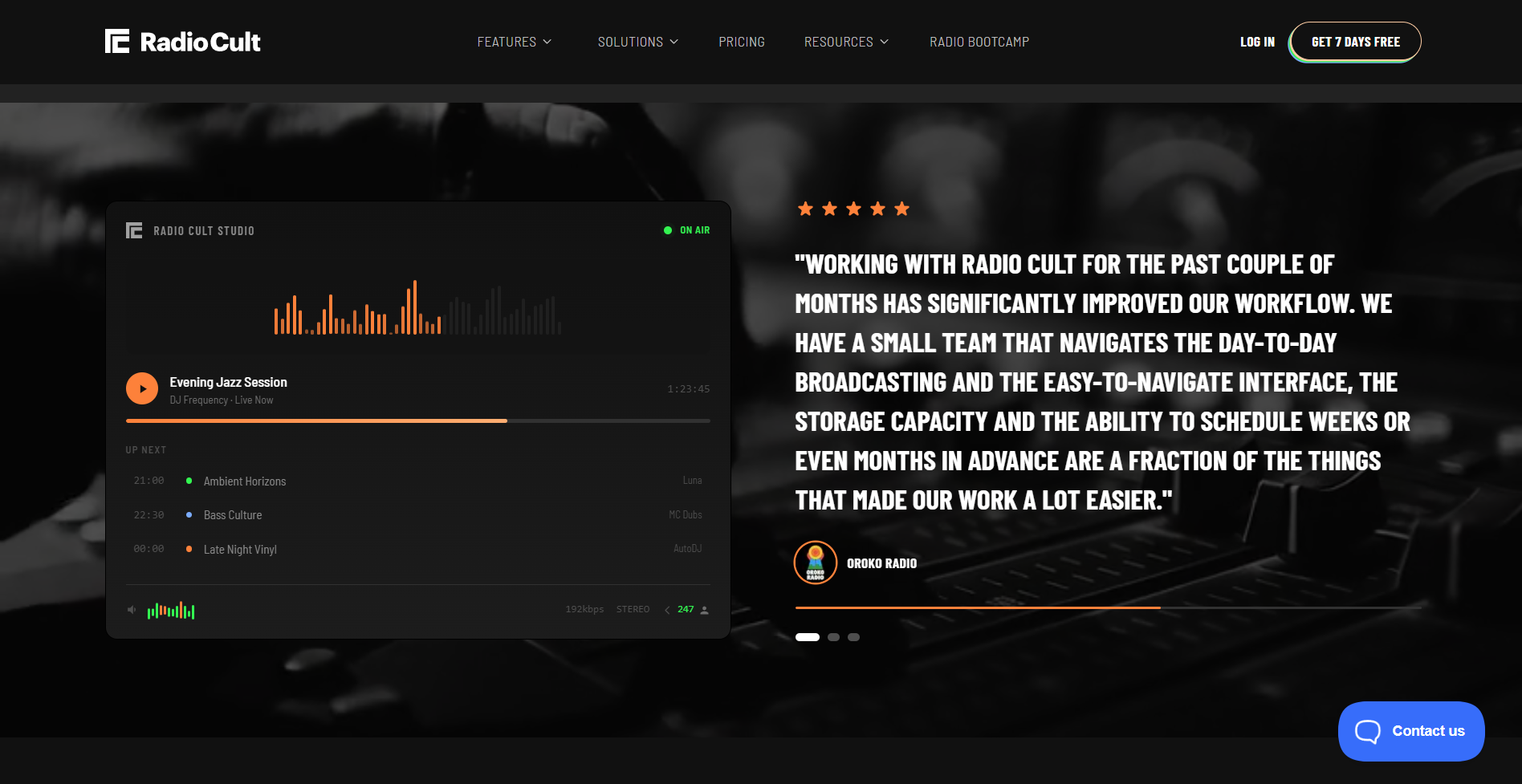

Rotating lineups, long mixes with no track data, and artists with their own followings: what a DJ collective needs that a single-host station does not.
NEW YORK, NY, UNITED STATES, October 1, 2026 /EINPresswire.com/ — A DJ collective is not a small radio station. It is a group of artists with their own followings, taking turns on a shared outlet, playing long continuous mixes rather than discrete tracks. RadioCult, which builds online radio software for DJs and collectives, has broken down where that model diverges from conventional radio and what a crew should look for in a platform as a result.
The first divergence is the lineup. A conventional station schedules staff against fixed slots. A collective runs rotating guests, residents, and one off takeovers, which means access has to be granted and withdrawn constantly. Platforms built for this tie live access to the assigned slot itself, so a guest can go live for their set and is disconnected automatically when it ends, without anyone handing out and retrieving credentials. RadioCult provides five built in user roles for DJs, contributors, managers, and station teams, which is usually enough granularity for a crew without becoming an administrative project of its own.
The second is the content itself. A DJ set is one long file, and embedded metadata is usually missing or incomplete, so the tracks inside it are invisible to the platform. That creates two problems at once: listeners see blank or wrong Now Playing information, and the collective has no record of what was actually played. Continuous track detection solves both by identifying tracks inside a mix and producing timestamped logs, which is also what royalty reporting requires. On RadioCult this is available as an optional add on rather than part of the base plans, which is worth confirming on any platform a crew is comparing.
“A station has a playlist. A collective has a room full of people with their own records and their own audiences,” said a RadioCult spokesperson. “The platform has to understand that the show, the mix, and the artist are three different things.”
The third is identity. In a collective the individual artists carry the audience, so a platform that treats presenters as interchangeable logins works against the crew. Artist profiles that hold a name, description, social links, genres, and tags, which are searchable across the roster and editable by the artists themselves, let each DJ keep their own presence while the collective keeps one shared outlet. It also removes a real bottleneck, since presenters can update their own details and manage their assigned shows without routing every change through whoever administers the platform.
The fourth is what happens after the set ends. On conventional radio a broadcast is largely disposable. For a DJ crew the mix is the artifact, and it usually has a longer life on Mixcloud or SoundCloud than it did on air. Post broadcast archiving to those destinations, and the ability for presenters to upload their own pre recorded content, is what keeps a set from being lost when the stream moves on.
Measurement differs too. A collective that wants to book and promote well needs to know which sets and which artists drew listeners, not only how the station performed overall. Per track listener data, including unique listeners and partial plays, answers a question a station level dashboard cannot.
Two practical notes round this out. Collectives tend to grow in spikes, when a set circulates or a guest brings their own audience, so unlimited concurrent listeners matters at exactly those moments rather than as a day to day concern. And because a crew rarely has a dedicated engineer, hosted broadcasting that runs continuously without the collective maintaining a server removes the failure mode where the stream goes quiet because the person who set it up is unavailable.
RadioCult’s station and artist management and music recognition features are available on its website, along with its guide to uploading mixes to SoundCloud.
About RadioCult
RadioCult is an online radio hosting platform built for independent and community stations that broadcast 24/7 with multiple presenters. It combines live and automated broadcasting, radio-native scheduling, station and artist management, and unlimited concurrent listeners in one platform, with human support and pricing that starts at $33 per month. Learn more at https://www.radiocult.fm.
Corey Haines
Conversion Factory
email us here
Visit us on social media:
Instagram
Facebook
X
Legal Disclaimer:
EIN Presswire provides this news content “as is” without warranty of any kind. We do not accept any responsibility or liability
for the accuracy, content, images, videos, licenses, completeness, legality, or reliability of the information contained in this
article. If you have any complaints or copyright issues related to this article, kindly contact the author above.

Media gallery