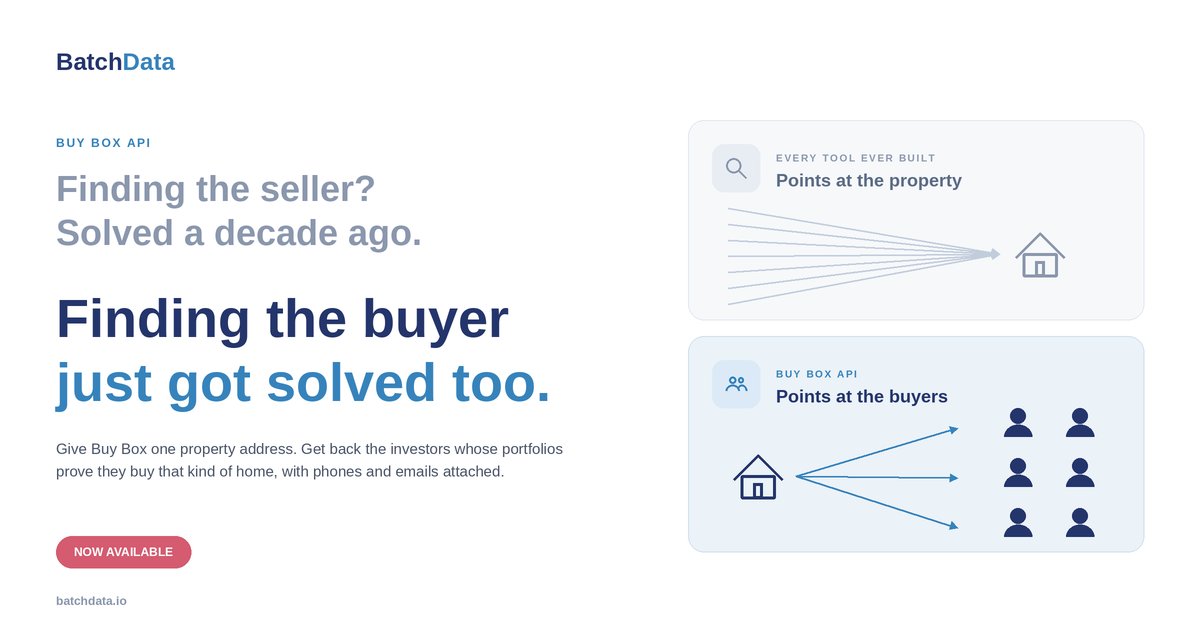

Buy Box returns the investors whose past purchases match a property being sold, with phone numbers, emails and portfolio history attached.
SCOTTSDALE, AZ, UNITED STATES, September 15, 2026 /EINPresswire.com/ — For most of the last decade, real estate technology has pointed its best data at one side of the deal. Find the motivated seller. Find the absentee owner. Find the property before anyone else does. Entire companies were built on the buying side, and the tools got very good.
The selling side never got the same treatment. Once a property is under contract, finding the buyer is still done by hand: a spreadsheet of people who bought something similar once, a group text, and a list of relationships that belongs to one person rather than the company, and walks out the door when they quit.
BatchData today launched the Buy Box API, which flips that equation. Give it the address of a property that needs to sell and it returns the investors most likely to buy it, based on what those investors have actually purchased, with phone numbers and email addresses so the conversation can start the same day.
It is available now, both to companies that sell property and to the software platforms that serve them.
One in three homebuyers is an investor
BatchData’s own research shows why the sell side has become the harder half of the deal. According to the company’s Investor Pulse Q1 2026 report, prepared by CJ Patrick Company using BatchData’s data, investors made roughly 32 percent of all U.S. home purchases in the first quarter, the fourth straight quarter above 30 percent.
Those buyers are almost entirely small operators. The report counts roughly 16 million investor-owned single-family homes in the United States, and more than 96 percent are held by investors who own ten properties or fewer. They do not publish acquisition criteria. Their buy box exists only in their transaction history.
The report also found that about 40 percent of investor sales go to another investor. That investor-to-investor trade is already a large share of the market, and it runs almost entirely on personal contacts.
“The industry has an acquisition bias baked into it,” said Ivo Draginov, President of BatchData. “We have spent years helping customers answer the question of who might sell. Almost nobody has been helping them answer the question of who will buy, and that question is worth just as much money. A wholesaler with a signed contract and no buyer has a liability, not an asset. Buy Box turns the sell side into a data problem instead of a relationship problem.”
How it works, in three steps
Every active investor has a buy box: the kind of property they keep buying. Three-bedroom, two-bath homes built before 1990 in the eastern suburbs, paid in cash. Small multifamily under a certain price. Investors describe their buy box to wholesalers all the time, but until now there was no way to look one up without being told, or to search a market for everyone whose buy box fits a specific house.
Buy Box does it in three steps. Start with the property that needs to sell. BatchData finds the nearby homes that look like it, using the same property-matching technology behind its Property Comparables product. Then, instead of handing back the homes, Buy Box hands back the investors who own them or have bought and sold them: a ranked list, largest portfolios first, or sorted by whatever matters most.
Every buyer arrives with the context a sales team needs before dialing. How many properties they own. How many they bought in cash. How many they have purchased in the last twelve months. How long they typically hold. Whether the phone number on file has actually been reached recently. Do Not Call and litigator flags travel with every contact, so teams can apply their own outreach rules before the first call.
For anyone who needs to find a buyer
Wholesalers turn every signed contract into a ranked buyer list in seconds instead of maintaining one by hand, so deals get assigned before the contract runs out of time.
Fix-and-flip investors line up a buyer before the renovation wraps, by seeing who already owns homes like theirs nearby and how many of them paid cash.
Agents and brokers walk into a listing appointment with named buyers for hard-to-place or off-market properties, not a promise to market the home.
Builders with finished inventory find the investors already buying new construction in the same submarket, rather than waiting on retail traffic to clear standing homes.
iBuyers and institutional sellers point Buy Box at an entire resale pipeline and filter by portfolio size, recent purchase volume and property type to find the right exit for each home.
Landlords and portfolio owners selling a single rental or an entire portfolio find the landlords whose holdings look like theirs, sorted by how many properties they own and how long they typically hold.
The common thread is that the buyer is no longer a guess. Every name on the list is there because that investor already owns or has traded homes like the one being sold.
What changes on a real deal
Consider a wholesaler who puts a house under contract in a suburb they do not usually work. Today, they open a spreadsheet, text three people, post in two groups, and wait. Nobody on that list was chosen because their portfolio matched this house.
With Buy Box, the same wholesaler enters the address and gets back the investors who own homes like it within a few miles, each one showing how many properties they hold, how many they bought in cash, what they have purchased in the last year, and a phone number flagged as recently reachable. The first call goes to the buyer holding the largest matching portfolio, not to whoever is most likely to pick up.
For the platforms that serve them
The second audience for Buy Box is the software companies whose customers face this problem every day.
Investor CRMs, deal and disposition platforms, marketplaces and listing portals, portfolio management tools, and lead generation products all tend to have the same gap. They handle everything up to the point of sale and then hand the user back to a spreadsheet. Buy Box lets them close that gap without building a buyer graph of their own.
Building one internally is a multi-year project. It means acquiring nationwide transaction and ownership records, connecting properties to the people and entities behind them, keeping phone numbers and email addresses current, and maintaining all of it as the market moves. BatchData already runs that infrastructure.
For platforms, the practical points are these. Results come back as the same standard BatchData investor profiles many products already use, so it fits an existing data model rather than introducing a new one. White-label delivery means the capability ships under the platform’s own brand. One integration serves every customer on the platform, and buyer matching becomes a feature worth charging for rather than a support ticket.
“Most platforms that serve sellers have the seller side handled and nothing to offer on the buyer side,” Draginov said. “Building that from scratch is years of work before you ship anything. We already run it. They can turn it on as a feature and give their users a reason to stay.”
No black box
BatchData is deliberate about one point, because it differs from how buyer matching is usually sold. Buy Box does not assign each investor a secret compatibility score and ask customers to trust it. A buyer makes the list because they own or have traded homes like the one being sold. Buyers are ranked by a measure the user chooses, such as portfolio size, cash purchases, recent activity or hold time, and every one of those numbers is shown.
That matters for a sales team that has to justify its call list, and for a platform that has to explain the results to its own customers.
“Customers have been burned by black box matching before, and they are right to be skeptical,” said Jesse Burrell, CEO at BatchData. “We could have wrapped this in a proprietary score and asked people to take it on faith. We would rather show you why every buyer is on the list, and let you decide what a good buyer looks like for your deal.”
Availability
The Buy Box API is available now. Companies with their own software can connect to it directly. Teams without developers can receive results as data files or work through BatchData’s managed data services. Platforms can embed it and deliver it under their own brand. To scope any of these, talk to a BatchData data expert at https://batchdata.io/contact-sales.
BatchData is also expanding how it classifies investors, tagging them by type, recent activity, investment focus and geography, so buyers can be targeted directly and not only through a specific property.
“The goal is that selling stops being the part of the deal nobody has data for,” Draginov said. “You should be able to know who buys what, everywhere, and reach them the same day. That is what Buy Box delivers starting today, both for the companies selling the houses and for the platforms that build software for them.”
About BatchData
Founded in 2018, BatchData is a leading provider of property data and predictive intelligence for the real estate ecosystem. Built by industry experts, BatchData has established one of the deepest and most accurate data lakes in the property technology sector, delivering instant access to over 155 million U.S. property records. The platform empowers businesses, ranging from proptech startups to enterprise institutions, with robust APIs, bulk data solutions, and AI-powered insights. By transforming complex public records into actionable intelligence, BatchData fuels decision-making for investors, lenders, and home service providers nationwide. For more information, visit www.BatchData.io
Ivo Draginov
BatchData
email us here
Visit us on social media:
LinkedIn
Legal Disclaimer:
EIN Presswire provides this news content “as is” without warranty of any kind. We do not accept any responsibility or liability
for the accuracy, content, images, videos, licenses, completeness, legality, or reliability of the information contained in this
article. If you have any complaints or copyright issues related to this article, kindly contact the author above.

Media gallery