
The Business Research Company’s Fifth Generation (5G) Network Slicing Global Market Report 2026 – Market Size, Trends, And Forecast 2026-2035
LONDON, GREATER LONDON, UNITED KINGDOM, October 26, 2026 /EINPresswire.com/ — The evolution of telecommunications is rapidly advancing with the integration of sophisticated technologies like fifth generation (5G) network slicing. This innovation is reshaping how networks operate by enabling customized, efficient, and flexible connectivity solutions. Let’s explore the market dynamics, leading players, regional insights, and future growth drivers shaping the Fifth Generation (5G) Network Slicing market.
Overview of Market Size and Its Relationship to the Next-Generation Network Market
The Fifth Generation (5G) Network Slicing market is projected to exceed $15 billion by 2030. In a broader context, it forms a part of the Next-Generation Network market, which is expected to reach approximately $52 billion by the same year. Notably, 5G Network Slicing will represent nearly 29% of this parent market. Within the expansive Information Technology industry, anticipated to be valued at $13,788 billion in 2030, the 5G Network Slicing sector is estimated to make up about 0.1% of the total market value.
Request A Free Sample Of The Fifth Generation (5G) Network Slicing Market Report
https://thebusinessresearchcompany.com/sample_request?id=20710567&type=smp&name=Fifth%20Generation%20%285G%29%20Network%20Slicing%20Market%20Report%202026&utm_source=EINPresswire&utm_medium=Paid&utm_campaign=Oct_PR
Asia-Pacific Positioned as the Leading Region in 2030 for 5G Network Slicing
By 2030, Asia-Pacific is set to emerge as the largest regional market for Fifth Generation (5G) Network Slicing, valued at $5.1 billion. The market is forecasted to grow from $1.1 billion in 2025, registering a compound annual growth rate (CAGR) of 37%. This remarkable expansion is driven by fast-paced commercialization of standalone 5G networks, heavy investments in smart city initiatives and digital infrastructure, the rise of industrial automation, and growing private 5G deployments. Additionally, the increased use of latency-sensitive applications in sectors such as manufacturing and healthcare, alongside supportive government policies encouraging advanced wireless technologies and digital transformation, are key contributors to this surge.
The United States Set to Dominate the Country-Level 5G Network Slicing Market by 2030
The USA is expected to lead the global Fifth Generation (5G) Network Slicing market at the country level in 2030, with an estimated market value of $4.0 billion. Starting from $0.9 billion in 2025, the market there is anticipated to grow at a CAGR of 36%. Factors fueling this growth include widespread deployment of standalone 5G infrastructure by telecom providers, increasing enterprise demand for tailored network performance and service-level agreements, and greater adoption of edge computing and cloud-native networks. Investments in mission-critical connectivity for defense and public safety, along with collaborations between communication service providers and cloud technology firms, further support the expansion of commercial network slicing offerings.
Access The Detailed Fifth Generation (5G) Network Slicing Market Report Here
https://thebusinessresearchcompany.com/report/fifth-generation-5g-network-slicing-market-report?utm_source=EINPresswire&utm_medium=Paid&utm_campaign=Oct_PR
Dominance of Solutions Segment in the Fifth Generation (5G) Network Slicing Market
Segmented by component, the Fifth Generation (5G) Network Slicing market is divided into solutions and services. Among these, the solutions segment is projected to be the largest, accounting for 65% or $10 billion of the total market by 2030. Growth in this segment is backed by increasing deployment of network orchestration and slice management platforms, rising automation demands for end-to-end lifecycle management, and the adoption of software-defined networking and network function virtualization technologies. Enterprises are increasingly relying on dedicated virtual networks to support critical workloads, while ongoing innovations in AI-driven network optimization enhance service quality and operational efficiency.
Segment Overview: Deployment, Organization Size, Industry Verticals, and Applications
The market also breaks down by deployment into public cloud, private cloud, and hybrid cloud options. In terms of organization size, it includes large enterprises as well as small and medium enterprises. Industry verticals covered range from manufacturing, automotive, energy and utilities, healthcare, media and entertainment, banking, financial services and insurance (BFSI), public safety, agriculture, and other sectors. The application areas include remote monitoring, real-time surveillance, supply chain and asset management, real-time streaming, network monitoring, network function virtualization (NFV), and multimedia services.
Projected Growth Rate Leading Up to 2030
The Fifth Generation (5G) Network Slicing market is expected to expand at a compound annual growth rate (CAGR) of 36% through 2030, reflecting strong and sustained market momentum.
Primary Growth Drivers Accelerating Market Expansion
One major force propelling the market is the increasing demand for industry-specific network services. Companies in manufacturing, healthcare, automotive, media, and public sectors need customized network environments that offer precise performance, security, and reliability. Network slicing empowers operators to create multiple virtual networks on shared physical infrastructure, enabling optimized connectivity for critical applications and boosting operational flexibility. This trend is projected to add roughly 1.5% annual growth to the market.
Another significant driver is the rising adoption of Internet of Things (IoT) devices. The surge in connected sensors, smart meters, industrial systems, and autonomous machinery introduces diverse networking needs across industries. Network slicing facilitates efficient distribution of network resources tailored to different IoT applications, ensuring consistent performance and scalability. As intelligent connected ecosystems become more common, the adoption of IoT is expected to contribute about 1.0% annual growth to the market.
The advancement of smart cities and connected infrastructure is also accelerating market growth. Governments and municipalities are boosting investments in digital public services, smart utilities, and intelligent transportation systems to enhance operational efficiency. Network slicing supports these developments by providing secure, low-latency, and application-specific connectivity for multiple simultaneous services. This capability is particularly valuable for managing the complex communication demands of urban infrastructure, contributing approximately 0.8% annual market growth.
Opportunities Within Solutions and Services Segments for 2030
The most promising growth prospects lie in the combined solutions and services segments, expected to surpass $11 billion by 2030. This is fueled by the growing implementation of cloud-native 5G architectures, demand for automated network orchestration and lifecycle management, increased deployment of private 5G networks in industrial settings, and expanding investments in AI-powered network optimization and assurance platforms. These trends reflect the telecom sector’s drive toward flexible, scalable, and application-tailored connectivity, which is accelerating growth in the global 5G network slicing ecosystem.
Between 2025 and 2030, the solutions segment alone is projected to grow by $7 billion, while services will increase by $4 billion. The market is shaped by a diverse group of global telecom equipment manufacturers, network infrastructure providers, and cloud-native technology firms. These players focus on virtualization technologies, software-defined networking, and orchestration platforms that enable dynamic, isolated network slices suited to specific applications and industries. The push for ultra-low latency, better bandwidth allocation, edge computing integration, and automated end-to-end network management is driving continuous innovation. Compliance with evolving telecom standards, customization for enterprise connectivity, and support for critical applications remain central to competitive strategy. A thorough understanding of this landscape is crucial for stakeholders seeking new growth, technological progress, and strategic alliances in the fast-evolving 5G sector.
Telefonaktiebolaget LM Ericsson Leading the Market in 2025
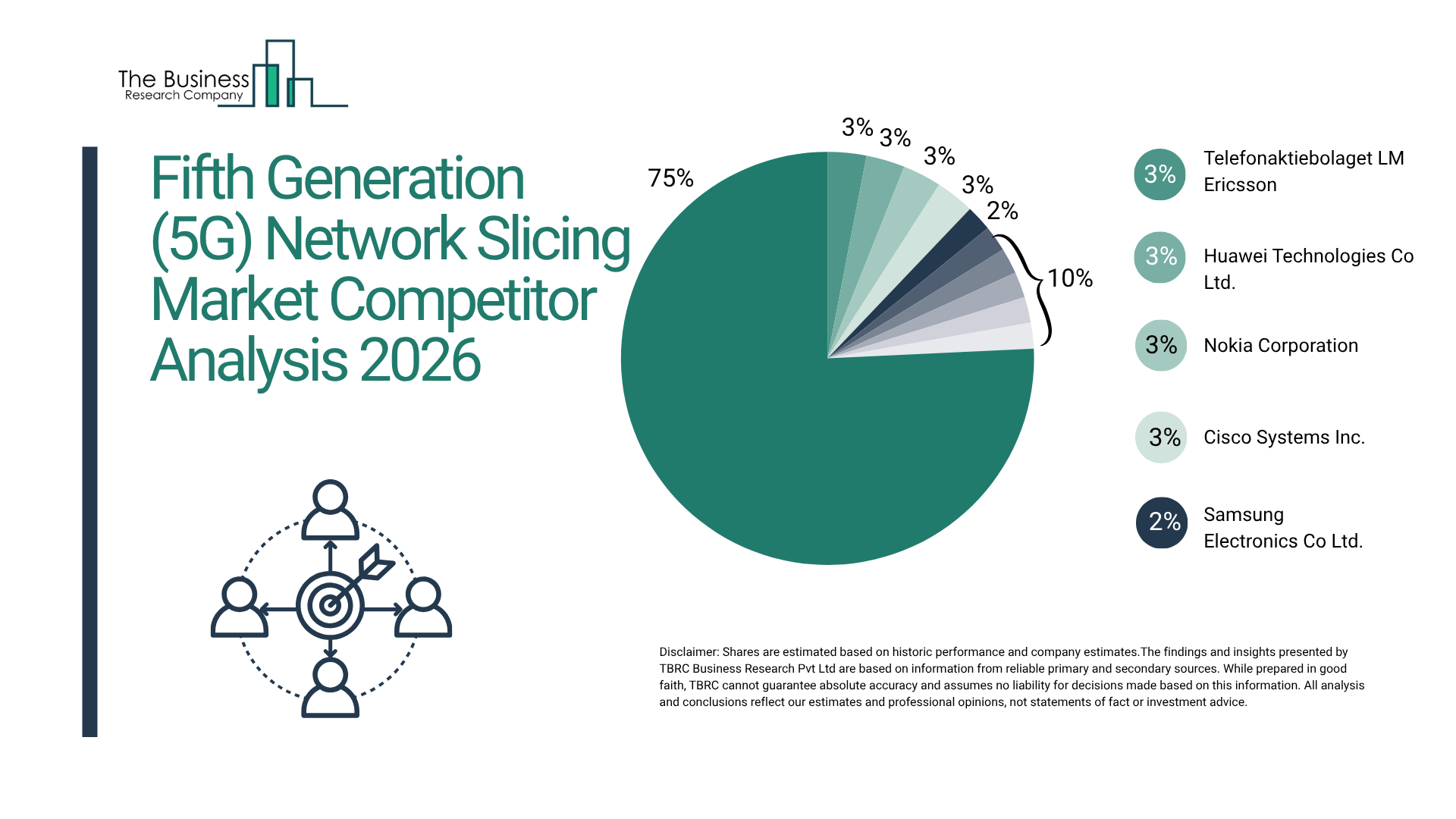
Our research indicates that Telefonaktiebolaget LM Ericsson led global sales in 2025 with a 3% share of the market. Through its network infrastructure and digital services division, the company offers a broad portfolio of 5G core network solutions, cloud-native platforms, network orchestration systems, and virtualization technologies. These capabilities enable dynamic network slicing, ultra-low latency connectivity, and differentiated service delivery tailored for enterprises and telecom operators.
Key Market Participants Driving the Fifth Generation (5G) Network Slicing Industry
The market features several prominent players including Telefonaktiebolaget LM Ericsson, Huawei Technologies Co Ltd., Nokia Corporation, Cisco Systems Inc., Samsung Electronics Co Ltd., ZTE Corporation, Qualcomm Technologies Inc., Microsoft Corporation, Intel Corporation, Hewlett Packard Enterprise (HPE) Co., NEC Corporation, Mavenir Systems Inc., Ciena Corporation, Fujitsu Limited, Broadcom Inc., Amdocs Limited, BT Group plc, Deutsche Telekom AG, NTT DOCOMO Inc., AT&T Inc., Telefónica S.A., and Jio Platforms Ltd.
Market Concentration and Competitive Landscape
The Fifth Generation (5G) Network Slicing market is moderately fragmented, with the top 10 companies accounting for 25% of total market revenue in 2025. This reflects significant entry barriers due to the complexity of 5G infrastructure, advanced virtualization technology requirements, strict telecom regulations, spectrum allocation, and the need for reliable, low-latency, scalable performance in mission-critical and enterprise applications. Leading firms such as Telefonaktiebolaget LM Ericsson, Huawei Technologies Co Ltd., Nokia Corporation, Cisco Systems Inc., Samsung Electronics Co Ltd., ZTE Corporation, Qualcomm Technologies Inc., Microsoft Corporation, Intel Corporation, and Hewlett Packard Enterprise (HPE) Co. maintain strong positions through extensive 5G network portfolios, global deployment capabilities, partnerships with telecom operators, and ongoing innovation in network slicing and cloud-native infrastructure. As demand increases for ultra-low latency services, enterprise-grade connectivity, private 5G networks, and dynamic network slice management, these players are expected to strengthen their market foothold through collaborations, product innovation, and regional expansion.
Raw Material Providers Supporting the Fifth Generation (5G) Network Slicing Market
Key suppliers of raw materials and foundational technologies include Nokia Corporation, Ericsson AB, Huawei Technologies Co. Ltd., Samsung Electronics Co. Ltd., Cisco Systems Inc., ZTE Corporation, NEC Corporation, Fujitsu Limited, Qualcomm Incorporated, Intel Corporation, Nokia Solutions and Networks Oy, Telefonaktiebolaget LM Ericsson, Cisco Systems International B.V., VMware Inc., Hewlett Packard Enterprise Company, Dell Technologies Inc., IBM Corporation, Oracle Corporation, Broadcom Inc., Marvell Technology Inc., Analog Devices Inc., Texas Instruments Incorporated, NXP Semiconductors N.V., Keysight Technologies Inc., and Ciena Corporation.
Principal Wholesalers and Distributors in the Market
Notable distributors and wholesalers serving the Fifth Generation (5G) Network Slicing market include Ingram Micro Inc., Tech Data Corporation, Arrow Electronics Inc., Avnet Inc., Synnex Corporation, ScanSource Inc., Westcon Group, Exclusive Networks SA, ALSO Holding AG, Esprinet S.p.A., Bechtle AG, Redington Limited, Mindware FZ LLC, ASBIS Enterprises PLC, Logicom Public Limited, EET Group A/S, Future Electronics Inc., Macnica Inc., WESCO International Inc., CDW Corporation, Insight Enterprises Inc., Softchoice Corporation, and D&H Distributing Company.
End Users Driving Demand in the Fifth Generation (5G) Network Slicing Market
Major end users encompass telecom operators and cloud service providers such as Verizon Communications Inc., AT&T Inc., T-Mobile US Inc., Vodafone Group Plc, Telefonica S.A., Orange S.A., BT Group plc, Deutsche Telekom AG, China Mobile Limited, China Telecom Corporation Limited, China Unicom Hong Kong Limited, Reliance Jio Infocomm Limited, Bharti Airtel Limited, SK Telecom Co. Ltd., KT Corporation, NTT Docomo Inc., SoftBank Group Corp., AWS Telco Network Services, Microsoft Azure Network Services, Google Cloud Platform, Amazon Web Services Inc., Rakuten Mobile Inc., Singtel Group, Telstra Corporation Limited, and KDDI Corporation.
Current Competitive Trends Transforming the Market
Artificial intelligence (AI)-driven autonomous network slicing solutions are revolutionizing the 5G network slicing landscape by enabling real-time orchestration, dynamic resource allocation, and intent-based network performance optimization. For example, in December 2025, Nokia introduced an autonomous 5G advanced network slicing solution in partnership with du. This offering features machine learning-based self-optimizing slice performance, intent-based policy control, integration with AirScale base stations, and the MantaRay SMO platform to enhance automation, maintain service quality, and improve overall network efficiency.
Strategic Approaches for Market Leadership
Companies are adopting several strategies to maintain competitiveness, including developing AI-driven network slicing solutions that optimize resource allocation, leveraging network function virtualization (NFV), software-defined networking (SDN), and edge computing technologies to enable scalable 5G services, expanding both 5G core and radio access network (RAN) infrastructure to improve coverage and capacity, and integrating machine learning techniques to boost orchestration and network performance management.
Key enhancements in our 2026 market reports include:
• Market attractiveness scoring and analysis
• Total addressable market (TAM) analysis
• Company scoring matrix graphics and tables
• Excel-based forecasting dashboards
• Market hotspots infographics
• Key technologies and future trend analysis
• Updated graphics and tables
Learn More About The Business Research Company
The Business Research Company (www.thebusinessresearchcompany.com) is a leading market intelligence firm renowned for its expertise in company, market, and consumer research. We have published over 30,000+ reports across 27 industries and 60+ geographies. Our research is powered by 1,500,000 datasets, extensive secondary research, and exclusive insights from interviews with industry leaders.
We provide continuous and custom research services, offering a range of specialized packages tailored to your needs, including Market Entry Research Package, Competitor Tracking Package, Supplier & Distributor Package and much more.
Disclaimer: Please note that the findings, conclusions and recommendations that TBRC Business Research Pvt Ltd delivers are based on information gathered in good faith from both primary and secondary sources, whose accuracy we are not always in a position to guarantee. As such TBRC Business Research Pvt Ltd can accept no liability whatever for actions taken based on any information that may subsequently prove to be incorrect. Analysis and findings included in TBRC reports and presentations are our estimates, opinions and are not intended as statements of fact or investment guidance.
Contact Us:
The Business Research Company
Americas +1 310-496-7795
Europe +44 7882 955267
Asia & Others +44 7882 955267 & +91 8897263534
Email: marketing@tbrc.info
Follow Us On:
LinkedIn: https://in.linkedin.com/company/the-business-research-company
Oliver Guirdham
The Business Research Company
7882 955267
Visit us on social media:
LinkedIn
Facebook
X
Legal Disclaimer:
EIN Presswire provides this news content “as is” without warranty of any kind. We do not accept any responsibility or liability
for the accuracy, content, images, videos, licenses, completeness, legality, or reliability of the information contained in this
article. If you have any complaints or copyright issues related to this article, kindly contact the author above.

Media gallery