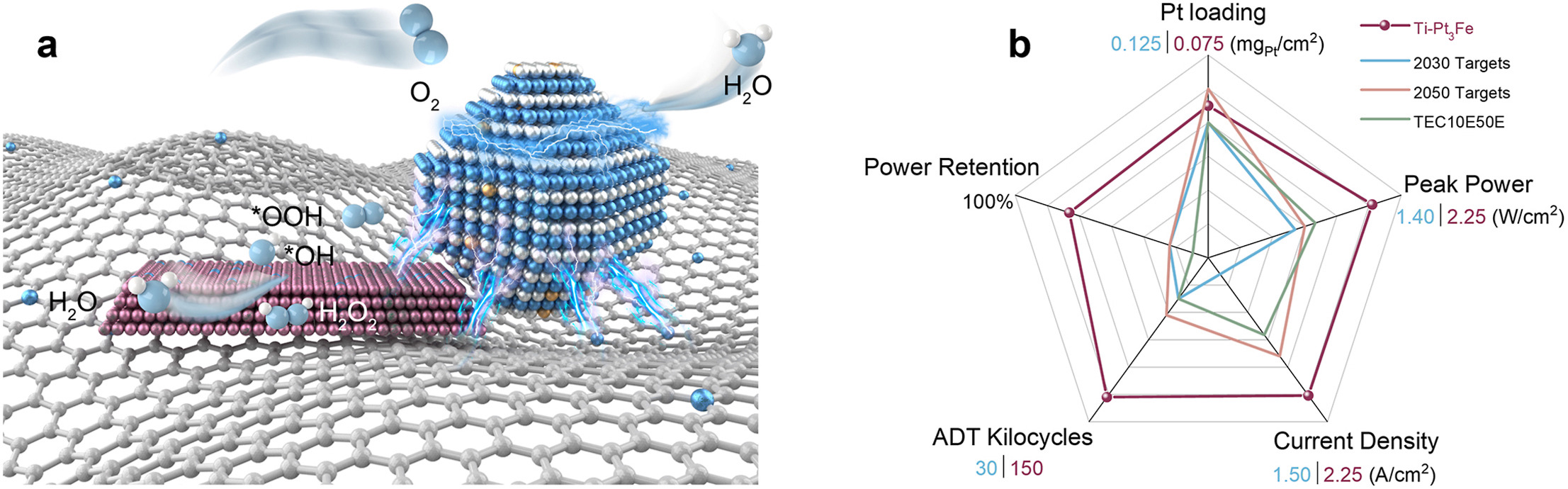

GA, UNITED STATES, November 24, 2026 /EINPresswire.com/ — A titanium-doped platinum–iron intermetallic nanoalloy supported on a titanium nitride (TiN)–iron–nitrogen–carbon (FeNC) aerogel has been designed as an oxygen reduction reaction (ORR) catalyst for proton exchange membrane fuel cells. The design combines ordered Pt nanoalloys with dual anchoring and radical-scavenging functions to address sintering, metal dissolution and support corrosion at once. It enables high power at ultralow cathode platinum loading and maintains performance through extended durability testing. The catalyst retains structural integrity and activity after aggressive cycling, including tests beyond typical laboratory protocols. The work offers a practical materials strategy for durable, low-platinum cathodes in heavy-duty fuel-cell applications.
Proton exchange membrane fuel cells (PEMFCs) are attractive for heavy-duty vehicles (HDVs) because of high energy density and fast refueling, but HDV operation demands long life and ultralow platinum (Pt) loading. The oxygen reduction reaction (ORR) cathode faces a trilemma among cost, activity and durability. Ordered Pt–M intermetallic nanoparticles can improve activity and dissolution resistance, yet high-temperature ordering promotes sintering, and transition-metal leaching can trigger Fenton chemistry that corrodes carbon supports and ionomers. Protective coatings or heteroatom-doped supports help only partially, often at the expense of mass transport or Pt loading. Given these challenges, in-depth research is needed on multifunctional supports and stabilization strategies that address activity, durability and ultralow Pt loading together.
Researchers at Wuhan University, the Air Force Logistics Academy and Luoqing New Materials Company report the design in eScience, published online Nov. 2026. They synthesized a titanium-doped ordered intermetallic platinum–iron (Pt₃Fe) nanoparticle catalyst supported on a titanium nitride–iron–nitrogen–carbon (TiN–FeNC) aerogel, hereafter Ti-doped Pt₃Fe/TiN–FeNC, through sol–gel assembly, supercritical drying, ammonia pyrolysis and high-temperature annealing. The study combines microscopy, X-ray spectroscopy, electrochemical testing and density functional theory (DFT) to link structure, stability and ORR performance. Shengli Chen is the corresponding author.
The catalyst’s ordered Pt₃Fe nanoparticles are confined to a few nanometres and anchored by TiN and Fe–Nₓ sites, which suppress migration and coalescence. Titanium incorporated into the Pt₃Fe lattice strengthens the alloy, while TiN scavenges peroxide intermediates and limits Fenton-type carbon corrosion. The aerogel provides hierarchical pores for oxygen transport and a high surface area for active-site dispersion. In membrane electrode assemblies (MEAs), the catalyst reaches high peak power at an ultralow cathode Pt loading and shows no performance loss after 30,000 cycles; after 150,000 cycles, most peak power remains, with the small voltage loss attributed mainly to ionomer degradation. Hydrogen peroxide yield stays negligible after extended cycling, and Fe dissolution is strongly suppressed. Post-test analysis shows Pt₃Fe cores with a Pt-rich shell, while reference samples lacking TiN or lattice Ti degrade faster. DFT indicates that Ti doping raises Fe vacancy and segregation barriers and weakens oxygen binding. The support’s interconnected aerogel framework also avoids the need for a thick protective coating that could block active sites or impede mass transport.
The authors said the advance comes from addressing several degradation pathways at once rather than adding a single protective layer. They said TiN and Fe–Nₓ sites anchor the nanoparticles, lattice titanium makes the alloy harder to dissolve, and TiN also neutralizes peroxide radicals. In their view, this combined stabilization is what allows ordered Pt₃Fe to keep its activity at very low Pt loading while surviving extreme cycling. They said the remaining MEA loss after 150,000 cycles points to ionomer degradation, not catalyst collapse, which sharpens the next engineering target.
For HDVs, the results suggest that ultralow-platinum PEMFC cathodes can combine high power and long life, reducing precious-metal cost while meeting demanding duty cycles. The aerogel-supported intermetallic design may also inform catalysts for other electrochemical devices where metal dissolution and carbon corrosion limit durability. Remaining challenges include scaling the aerogel synthesis, validating performance under real HDV operating profiles, stabilizing the ionomer and catalyst layer over full vehicle lifetimes, and confirming supply-chain readiness. The reported MEA durability is a strong laboratory milestone, but independent testing, system-level validation, contaminant tolerance and durability under start–stop, freeze–thaw and low-humidity conditions are still needed before commercial deployment at competitive cost for heavy-duty transportation.
References
DOI
10.1016/j.esci.2026.100557
Original Source URL
https://doi.org/10.1016/j.esci.2026.100557
Funding information
National Natural Science Foundation of China (Grant No. 22332004); Jiangsu Provincial Natural Science Foundation–Youth Fund (Grant No. BK20250323). Online: 13 February 2026.
Lucy Wang
BioDesign Research
Legal Disclaimer:
EIN Presswire provides this news content “as is” without warranty of any kind. We do not accept any responsibility or liability
for the accuracy, content, images, videos, licenses, completeness, legality, or reliability of the information contained in this
article. If you have any complaints or copyright issues related to this article, kindly contact the author above.

Media gallery