

Two technologies that share a name
A red light sauna and a red light therapy panel can both expose the body to red and near infrared wavelengths, but they are not the same technology and they are not designed to create the same experience.
The biggest difference is simple: an incandescent red light sauna is primarily a radiant-heat system that also produces a broad spectrum of light, while an LED therapy panel is primarily a light-delivery system designed to provide selected wavelengths with very little heat. Understanding that distinction makes the two much easier to compare.
Incandescent red light saunas produce light and radiant heat together
A red light sauna typically uses incandescent heat lamps positioned relatively close to the body. A heated tungsten filament produces a broad, continuous spectrum rather than one or two selected wavelengths. That spectrum begins around 550 nm in visible amber light, runs through visible red (about 620 to 700 nm) and near infrared (700 to 1,400 nm), and continues into mid and longer infrared, where most of the energy is felt as radiant warmth.
That means an incandescent sauna session combines several things at once:
- visible red light
- near infrared and longer infrared wavelengths
- radiant heat delivered directly toward the body
- rising warmth inside the enclosure
- sweating as the session progresses
This combination is what makes a red light sauna fundamentally different from standing in front of a red LED panel.
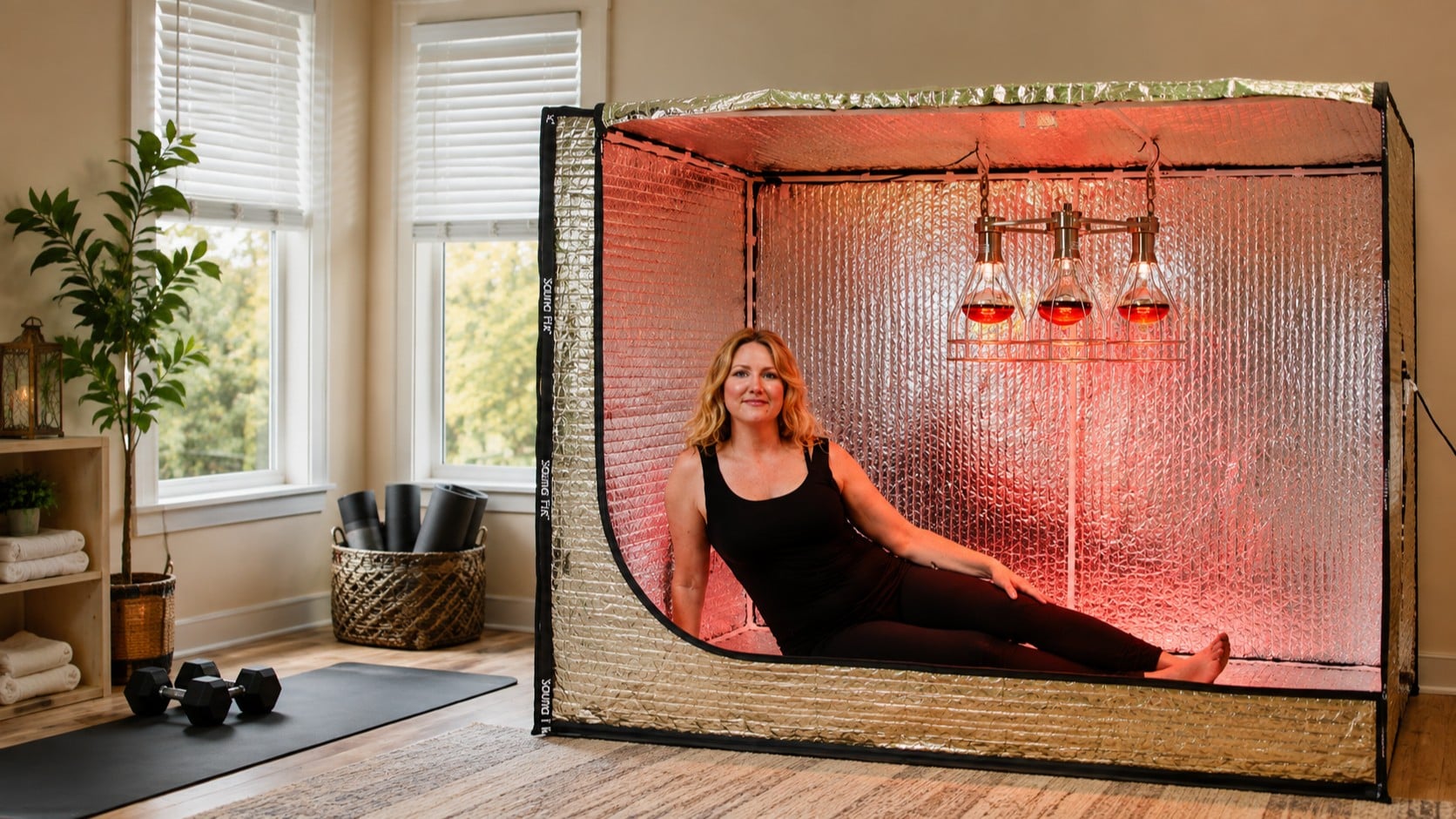
The enclosure matters as well. It holds heat around the body while the lamps keep delivering radiant energy, so lamp intensity, distance from the body, exposure time and enclosure temperature all shape the thermal experience. The Sauna Fix® system, for example, uses a four-bulb incandescent lamp with the user seated about 18 to 30 inches from the bulbs inside an insulated tent with a reflective lining.
LED red light therapy panels take a more targeted approach
A red light therapy panel works differently. Instead of heating a filament to produce a continuous spectrum, LEDs are selected to emit relatively narrow wavelength bands. Many panels combine a specific red wavelength with a specific near infrared wavelength. The purpose is controlled light exposure rather than a hot environment.
Panels grew out of photobiomodulation research, where wavelength, irradiance and distance are tightly specified. Chung and colleagues (2012, Annals of Biomedical Engineering) describe roughly 600 to 1,070 nm as the window in which light passes through tissue most readily, which is why panel LEDs cluster in that range. Because LEDs convert much less of their output into radiant heat than incandescent heat lamps, a person can receive a relatively high measured irradiance without sitting in a sauna-temperature enclosure.
For an LED panel, the specifications that matter are:
- Wavelengths. Which red and near infrared wavelengths are actually produced?
- Irradiance. How much optical power reaches a given area?
- Distance. At what distance was that irradiance measured?
- Exposure time. How long is the treatment area exposed?
Those variables determine the light dose delivered during a session.
Thermal dose and light dose are not the same thing
This is where many comparisons become confusing. A red light therapy panel delivers a measured light dose, described by irradiance and exposure time. An incandescent sauna creates both a light exposure and a thermal dose: its radiant heat warms the body while the enclosure gradually warms as well. How spectrum, intensity, distance, time and enclosure combine into that dose is explained in the light, heat and thermal dose guide.
Evaluating an incandescent sauna only by the wavelengths it produces misses a major part of what the equipment is designed to do. Likewise, evaluating an LED panel by how much it heats the room would miss the point of that technology. They are different tools.
What does a session feel like?
An LED red light therapy session is bright but comparatively cool. A person stands or sits a specified distance from the panel for a few minutes while exposing a particular area of the body.
An incandescent sauna session is designed around progressive warming. The user sits near the lamps inside an enclosure while radiant energy and retained heat build over 15 to 40 minutes, and sweating becomes part of the experience. That is why session length alone is not a meaningful comparison: ten minutes in front of an LED panel and ten minutes inside an incandescent sauna are very different exposures.
A note on electrical simplicity
An incandescent bulb is a filament sealed in glass, with no driver board or circuitry at the light itself. LED panels run on driver electronics. Neither fact settles the EMF question on its own; ask any maker for measurements taken at the distance you will actually use, as the low-EMF sauna guide explains.
Which technology better matches your goal?
If the goal is targeted red and near infrared light exposure without significant heat, an LED therapy panel is built for that purpose. If the goal is a sauna experience that combines radiant infrared energy, rising body warmth and sweating, an incandescent red light sauna is built around that combination.
Some people use both because they serve different purposes. An LED panel is convenient for shorter, localized or full-body light sessions without heating an enclosure. A sauna can be reserved for longer sessions when the desired experience includes substantial radiant warmth and sweating. One does not have to replace the other.
What should you look for before buying?
Marketing terms such as “red light,” “near infrared,” “full spectrum” and “high intensity” do not tell you enough on their own.
For an LED therapy panel, look for documented wavelengths and irradiance measurements that state the distance at which they were taken. For an incandescent sauna, look beyond cabin temperature: consider the lamp spectrum, radiant intensity, the distance between lamps and body, the positioning of the bulbs and the design of the enclosure. A spectral graph is particularly useful because it shows what a light source actually emits rather than a list of advertised wavelengths. Creatrix Solutions publishes the measured spectral curve for the Sauna Fix® bulb on its product testing page.
The most useful question is therefore not “Which one has more red light?” It is: “What kind of energy is this device designed to deliver, at what intensity, at what distance and for how long?”
Understanding the difference between a red light sauna and an LED therapy panel makes it easier to choose equipment based on how it actually operates rather than on similar-sounding marketing terms. An LED panel is designed around controlled light exposure. An incandescent red light sauna is designed around light, radiant infrared energy, retained heat and the sauna experience working together.
Creatrix Solutions designs and sells the Sauna Fix® near infrared sauna, an incandescent lamp-and-tent system. This article is educational and is not medical advice.
Creatrix Solutions
contact@creatrixsolutions.com
+1-866-686-5605
214 E Albany Avenue
Building E101
Kennewick
WA
99336
United States
