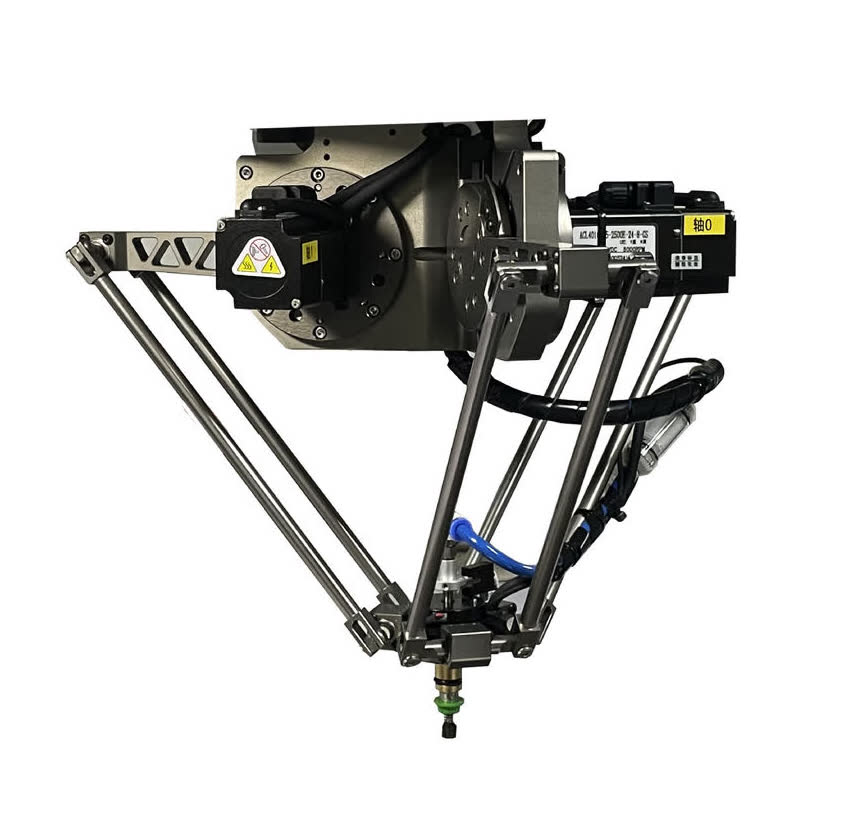

SHENZHEN, GUANGDONG, CHINA, October 30, 2026 /EINPresswire.com/ — High-speed discrete manufacturing requires seamless integration between raw material feeding, optical inspection, and robotic manipulation. Implementing a Production Line Integrated Intelligent Feeder resolves the synchronization bottlenecks that frequently occur when combining independent automation subsystems into continuous production lines. Operating feeding hardware, vision cameras, and robotic arms as disconnected units results in communication lag, camera motion blur, and starved assembly stations. Establishing deterministic communication handshakes and closed-loop control protocols enables automated manufacturing lines to maintain continuous line pacing and achieve maximum net throughput.
The Three-Pillar Architecture of an Intelligent Feeding Cell
An automated feeding workstation functions as a closed-loop mechatronic system composed of three tightly coupled functional pillars: the multi-axis vibration feeder, the machine vision guidance computer, and the high-speed robotic manipulator. Each subsystem performs a specialized operational role, but overall cell efficiency depends entirely on their real-time coordination.
The three core pillars interact through distinct functional responsibilities: – The multi-axis vibration feeder: Agitates, disperses, and flips bulk components on a flat pick surface using programmable voice-coil or electrodynamic actuators. – The machine vision system: Analyzes illuminated part contours, verifies component orientation, and calculates pick coordinates relative to the robot coordinate frame. – The robotic manipulator: Executes high-speed kinematic trajectories to retrieve oriented components and place them into downstream conveyor nests or assembly fixtures.
When these three systems operate without tight hardware synchronization, the cell experiences severe pacing inefficiencies. The robot sits idle waiting for vision coordinates, or cameras trigger while parts are still vibrating, capturing blurred images that cause false rejects. Unifying these subsystems through a central controller creates a responsive, self-regulating assembly cell.
Communication Protocols and Hardware Handshakes
Connecting three distinct automation components into an integrated workstation requires robust digital communication interfaces. Industrial control engineers deploy a combination of deterministic fieldbuses, serial links, and optical digital input-output lines to manage system handshakes.
A well-architected feeding cell employs structured communication layers: – High-speed Ethernet TCP/IP or industrial fieldbuses, such as EtherCAT or PROFINET, connect the vision computer to the robot motion controller, transmitting structured coordinate arrays in milliseconds. – Dedicated RS232 serial interfaces link the feeder controller to the master programmable logic controller, allowing the system to update vibration frequency, amplitude, and directional parameters dynamically. – Hardwired 24V DC optically isolated digital lines provide microsecond-level timing triggers for emergency stop loops, strobe illumination, and vibration pause signals. – Hardware encoder inputs monitor downstream conveyor belt speeds, synchronizing robotic placement trajectories with moving assembly lines.
Standardizing communication protocols prevents data packet collisions and ensures deterministic response times across all automation elements.
Eliminating Camera Blur Through Vibration Gating
Capturing sharp, high-contrast images of miniature parts requires eliminating relative motion between the component and the camera sensor during exposure. If the vision camera triggers while the multi-axis feeder platform is actively vibrating, the resulting optical blur distorts component edges, leading to failed contour matching and dropped pick cycles.
Advanced feeding cells implement a microsecond vibration gating sequence: – The feeder controller receives an image acquisition request from the vision computer and immediately cuts drive coil power. – Within ten to fifteen milliseconds, the mechanical vibration dampens completely, and the feeder outputs a settled hardware signal. – The vision system activates high-intensity LED backlight or coaxial strobes for two to five milliseconds to capture a freeze-frame image. – Immediately following exposure completion, the controller re-energizes the feeder coils to resume part agitation.
This rapid gating sequence eliminates optical motion blur without causing noticeable pauses in overall part feeding, maintaining continuous production cadence while ensuring micron-level optical inspection accuracy.
Dynamic Coordinate Buffering and Trajectory Queuing
Maximizing robotic pick throughput requires feeding coordinate data to the motion controller in continuous, buffered queues. In a high-speed picking cell, a single vision snapshot typically identifies five to fifteen correctly oriented components on the feeder surface simultaneously.
Pipelined coordinate buffering operates through a streamlined sequence: – The vision computer processes the captured frame and compiles an ordered FIFO coordinate queue containing X-Y positions, planar rotation angles, and pick priority rankings. – This data array transmits to the robot controller via high-speed Ethernet sockets in a single data burst. – The robot motion planner calculates optimal point-to-point trajectories, picking components sequentially from the coordinate queue without pausing between strokes. – While the robot executes picks from the active queue, the vision processor analyzes subsequent camera frames in the background.
Deploying a Production Line Integrated Intelligent Feeder with coordinate queuing eliminates communication latency pauses, enabling parallel Delta robots to sustain throughput between 3,000 and 4,500 parts per hour.
Closed-Loop Hopper Replenishment and Density Control
Maintaining optimal component density on the feeder platform is essential for steady pick rates. If too few components occupy the tray, the robot experiences part starvation. Conversely, overloading the plate with excess bulk parts creates overlapping clusters that obscure vision recognition and reduce pickable yields.
Automated closed-loop replenishment maintains balanced part distribution: – The vision computer continuously tracks the total number of recognized components within the field of view after each robotic pick. – When the active part count drops below a pre-programmed lower threshold, the controller sends an activation signal to an upstream bulk storage hopper. – The bulk hopper vibrates for a calibrated duration, metering a controlled batch of fresh components onto the feeder tray. – Digital load cells mounted beneath the feeder platform provide secondary weight feedback, verifying that bulk replenishment remains within safe mechanical limits.
Automation equipment manufacturers like FIDER integrate closed-loop hopper controls directly into their intelligent feeding systems, ensuring stable part presentation without manual operator intervention.
Fault Recovery and Line Conveyor Pacing
Industrial manufacturing lines frequently experience upstream starvation or downstream backlogs that require automated speed pacing and fault recovery. An intelligent feeding cell must adapt dynamically to surrounding line conditions without generating system errors.
Automated fault recovery protocols safeguard continuous operation: – Downstream pacing: If downstream assembly stations back up, the feeding cell pauses robotic placement and slows feeder agitation to prevent component wear. – Vacuum pick failure recovery: If an end-effector vacuum sensor detects a dropped component, the controller flags the coordinate, retries the pick, or discards the flawed part into a reject chute. – Unpickable part clearance: If unpickable components accumulate on the feeder surface, the system executes an automated forward sweep pulse, clearing the tray into a return chute. – Telemetry logging: Real-time operational data logs pick success rates, cycle times, and error frequencies, providing line engineers with actionable predictive maintenance data.
Integrating a Production Line Integrated Intelligent Feeder provides modern factories with the responsive, closed-loop automation needed to maintain peak line efficiency. To review intelligent feeder integration protocols or discuss multi-axis feeding architecture for your production line, explore comprehensive technical specifications at https://www.fdrautomation.com/ to schedule an engineering consultation.
FIDER
FIDER
Legal Disclaimer:
EIN Presswire provides this news content “as is” without warranty of any kind. We do not accept any responsibility or liability
for the accuracy, content, images, videos, licenses, completeness, legality, or reliability of the information contained in this
article. If you have any complaints or copyright issues related to this article, kindly contact the author above.

Media gallery