
SHENZHEN, GUANGDONG, CHINA, October 28, 2026 /EINPresswire.com/ — Power Supply Configuration Shapes Industrial System Performance
Selecting an appropriate AC power supply configuration is an important step in designing reliable electrical and industrial systems. Different applications require different input conditions, output voltages, power ratings, mounting arrangements, and protection functions. A configuration that works for a compact control cabinet may not be suitable for high-power equipment or a specialized testing environment.
Huyssen Power examines these requirements through its broad power supply portfolio, which includes AC-DC power supplies, DIN rail power supplies, programmable power supplies, battery chargers, and DC-DC converters. Established in 2011, the company has developed more than 1,300 product models for applications across industrial equipment, communications, healthcare, automotive electronics, consumer electronics, and other sectors. Its product diversity provides buyers with multiple options when evaluating power requirements for different systems.
Understanding AC Input and DC Output Configurations
In industrial equipment, the term AC power supply can refer to different arrangements. Some equipment requires alternating current directly, while electronic control systems frequently need direct current converted from an AC mains input. An AC-DC power supply performs this conversion, providing a DC output suitable for connected components.
The distinction is important when selecting a product. Engineers must identify whether the equipment requires AC output or regulated DC output, then confirm the voltage, current, and power ratings specified by the equipment manufacturer. Input voltage range and frequency compatibility must also be checked against the available electrical supply.
Huyssen Power offers AC-DC power supply products alongside its DIN rail power supply range. This broader portfolio allows buyers to evaluate different product formats according to their system architecture instead of treating every power requirement as identical. The final configuration should be selected according to the electrical specifications and installation conditions of the intended application.
DIN Rail Power Supplies Support Industrial Control Systems
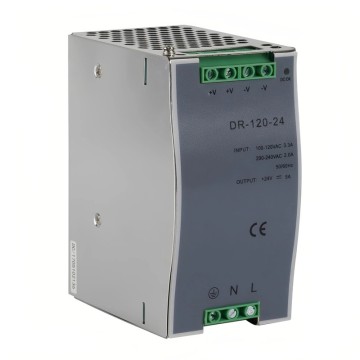
DIN rail power supplies are commonly installed inside electrical cabinets and control panels. Their mounting format allows them to be fitted alongside circuit protection devices, terminal blocks, relays, programmable logic controllers (PLCs), and other control components. This arrangement supports organized wiring and makes the power supply easier to access during installation or maintenance.
Huyssen Power’s DIN rail product range includes MDR, NDR, and DR series models. The available configurations cover different voltage and power requirements, giving buyers options for industrial control, building control, and automation applications. The company’s product listings include the MDR-60-12, rated at 12 V and 60 W, and the NDR-120-24, rated at 24 V and 120 W.
These examples illustrate why output ratings should be matched to the intended load. A system powering several sensors and control modules may have different requirements from equipment containing multiple actuators or other higher-demand components. Engineers should calculate the combined load, consider startup current where relevant, and provide appropriate capacity without exceeding the selected model’s rated limits.
Huyssen Power identifies easy installation, stable output, and durability as key characteristics of its DIN rail power supplies. These design priorities are particularly relevant where control equipment operates continuously or where maintenance access and cabinet organization influence overall system design.
Input Range and Output Ratings Guide Configuration Selection
Input voltage compatibility is a fundamental consideration when evaluating power supply configurations. Industrial facilities may have different mains conditions, and equipment intended for international deployment may need to accommodate a wider range of input voltages. Huyssen Power lists DIN rail models with an input range of 85–264 VAC. This range can support applications operating within the specified limits, although the input requirements of each individual model should always be verified.
Output voltage is equally important. Industrial control equipment commonly uses 12 V or 24 V DC, while some systems require 48 V DC. The appropriate selection depends on the connected devices and their electrical specifications.
Power rating must also be considered alongside voltage. A power supply with the correct voltage but insufficient current capacity may not support the full connected load. Conversely, selecting a model without evaluating actual demand can affect equipment cost and cabinet utilization. A systematic assessment of voltage, current, total wattage, and operating conditions helps narrow the available options.
Huyssen Power’s range of 12 V, 24 V, and 48 V DIN rail products offers several configurations for comparison. This range is useful for projects in which different control devices or equipment sections require different DC supply levels.
Protection Functions and Thermal Conditions Affect Reliability
Electrical protection is another factor that influences power supply selection. Industrial systems can experience overloads, short circuits, and abnormal voltage conditions, making appropriate protection functions important for equipment operation and system design.
Huyssen Power’s DIN rail power supply information identifies overload, short-circuit, and overvoltage protection. Certain listed models also specify overcurrent and overtemperature protection. These features help address common electrical risks, but their exact operation and availability vary by model. Buyers should review the corresponding datasheets to confirm the functions required for a particular installation.
Thermal management also deserves attention. Power supplies generate heat during energy conversion, and the surrounding temperature, cabinet ventilation, installation spacing, and electrical load can influence operating conditions. Selecting a suitable unit requires checking the manufacturer’s temperature limits and derating guidance rather than relying on nominal power ratings alone.
Huyssen Power lists efficiency of up to 90% for certain DIN rail models. Actual efficiency depends on the specific product and operating conditions. For systems running over extended periods, reviewing efficiency alongside thermal requirements can help engineers assess operating costs and installation suitability.
Huyssen Power Combines Product Diversity with R&D Capabilities
Product range is one factor that industrial buyers consider when comparing power supply suppliers. A supplier with multiple configurations can help customers evaluate different output requirements, mounting formats, and application needs through a broader product portfolio.
Huyssen Power reports more than 1,300 product models across its power supply categories. The company also states that it introduces two to three new power supply models each month, reflecting an ongoing product development program intended to address changing market requirements. Its research and development activities cover product performance, functionality, and application-specific needs.
Quality assurance is another stated area of focus. According to the company’s website, its production process incorporates statistical sampling and analysis, while products undergo burn-in procedures and automated final testing before shipment. Huyssen Power also identifies production bases in Shenzhen and Dongguan, supporting its manufacturing and delivery operations.
These capabilities provide relevant considerations for buyers evaluating long-term supply relationships. Product selection is only one part of procurement; consistency in manufacturing, quality control, technical communication, and delivery planning can also influence project implementation.
Customization Supports Specialized Power Requirements
Standard products may not satisfy every application. Some projects involve unusual output requirements, restricted installation space, specific electrical interfaces, or operating conditions that call for further technical evaluation. In these situations, a supplier’s design capabilities can become an important selection factor.
Huyssen Power provides design services for customers whose requirements cannot be met by an existing catalog model. The company describes a customization process that includes requirements communication, design confirmation, product sampling, validation, mass production, quality inspection, and delivery.
This structured approach gives customers a defined framework for discussing technical requirements before production. It can be particularly relevant to equipment manufacturers and system integrators that need a power supply aligned with a specific product design.
However, customized solutions should be evaluated against clearly documented requirements, including electrical specifications, environmental conditions, safety standards, and testing expectations. Confirming these details early can help reduce compatibility issues during integration and production.
Application Requirements Remain Central to Power Supply Selection
Different AC power supply configurations serve different purposes, and effective selection begins with understanding the electrical and mechanical requirements of the target system. Input compatibility, output ratings, mounting arrangements, protection functions, efficiency, and thermal conditions all contribute to determining whether a product is suitable.
Huyssen Power combines a broad product portfolio with ongoing R&D, documented quality control procedures, and customization services. Its DIN rail power supply series provides options for industrial automation, control cabinets, and related applications, while its wider range of AC-DC and other power conversion products addresses additional system requirements.
For industrial buyers, comparing these factors systematically can support more informed procurement decisions and improve compatibility between power supplies and connected equipment. To learn more about Huyssen Power’s products, manufacturing capabilities, and customized power solutions, visit the official website: https://www.huyssenpsu.com/
Huyssen power
Huyssen power
86-13570841067
mandy@huyssenpower.com
Legal Disclaimer:
EIN Presswire provides this news content “as is” without warranty of any kind. We do not accept any responsibility or liability
for the accuracy, content, images, videos, licenses, completeness, legality, or reliability of the information contained in this
article. If you have any complaints or copyright issues related to this article, kindly contact the author above.

Media gallery