
The Business Research Company’s Software Defined Radio Global Market Report 2026 – Market Size, Trends, And Forecast 2026-2035
LONDON, GREATER LONDON, UNITED KINGDOM, October 26, 2026 /EINPresswire.com/ — The Software Defined Radio (SDR) market is poised for substantial growth as technology continues to evolve, offering enhanced flexibility and interoperability across multiple communication platforms. This sector is steadily carving out its space within the larger communications and IT industries, driven by growing demand from defense, public safety, and commercial sectors. Let’s explore the market’s size, key growth drivers, leading players, and future prospects in detail.
Software Defined Radio Market Size and Its Role Within the Broader Communications Sector
The Software Defined Radio market is expected to exceed $40 billion by 2030. In comparison, its parent market, Communications Hardware, is projected to reach around $1,026 billion by the same year, with SDR representing roughly 4% of that total. Within the much larger Information Technology industry, estimated to be valued at $13,788 billion by 2030, the SDR market will account for about 0.3% of the overall value.
Request A Free Sample Of The Software Defined Radio Market Report
https://thebusinessresearchcompany.com/sample_request?id=21140275&type=smp&name=Software%20Defined%20Radio%20Market%20Report%202026&utm_source=EINPresswire&utm_medium=Paid&utm_campaign=Oct_PR
North America’s Dominance in the Software Defined Radio Market by 2030
North America is set to lead the global Software Defined Radio market in 2030 with a valuation of $14 billion. This marks an increase from $10 billion in 2025, growing at a compound annual growth rate of 7%. The region’s growth is fueled by extensive defense modernization programs, upgrades to military communication systems, and increased adoption of secure and interoperable communication networks for public safety. Furthermore, investments in 5G, 6G, and advanced wireless infrastructure, combined with the expanding use of SDR in aerospace, satellite communications, electronic warfare, and intelligence, underscore North America’s pivotal role. The strong presence of semiconductor, defense, and communication technology companies in the USA and Canada also supports this trend.
The United States as the Largest Country Market in Software Defined Radio
The US is projected to be the largest single country market for Software Defined Radio in 2030, with a value of $12 billion. From $9 billion in 2025, it is expected to grow at a CAGR of 8%. This growth is propelled by ongoing defense communication modernization, increasing demand for mission-critical interoperability across military and homeland security sectors, and the deployment of advanced spectrum management and cognitive radio technologies. The rising use of SDR platforms in space and satellite communications, continual upgrades in naval and airborne communication systems, and investments in next-generation secure wireless infrastructure contribute significantly to this expansion.
Access The Detailed Software Defined Radio Market Report Here
https://thebusinessresearchcompany.com/report/software-defined-radio-global-market-report?utm_source=EINPresswire&utm_medium=Paid&utm_campaign=Oct_PR
Dominant Segments in the Software Defined Radio Market by 2030
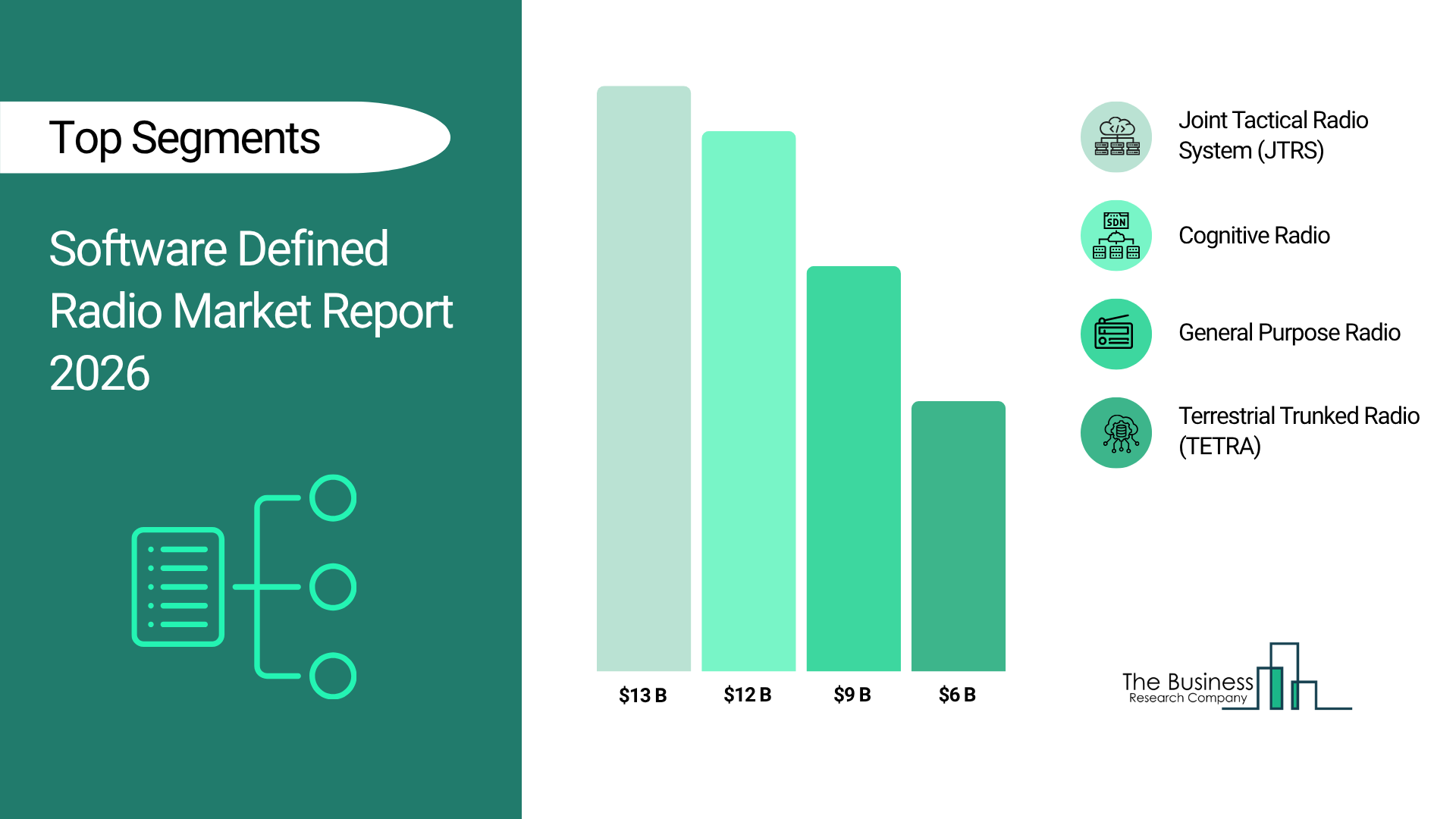
Among the various types of SDR, the joint tactical radio system (JTRS) segment will be the largest, comprising 33% of the market or $13 billion by 2030. This segment is driven by the demand for network-centric warfare capabilities, unified battlefield communication systems, and multi-band, multi-mission radio platforms across defense forces. Integration of SDR with advanced electronic countermeasures and threat detection, the need for secure voice and data communication in joint military operations, and upgrades in command and situational awareness systems also support this growth. Other important market segments include cognitive radios, general purpose radios, and terrestrial trunked radio (TETRA).
Hardware, Software, and Services as Core SDR Components
The SDR market is divided into hardware, software, and services segments. Each component plays a vital role in the development, deployment, and maintenance of SDR systems across various platforms such as airborne, naval, land, and space. The market also segments by frequency bands including high frequency (HF), very high frequency (VHF), ultra-high frequency (UHF), and others, catering to diverse communication needs.
End-User Segments Driving SDR Adoption
Key end users of SDR technology span aerospace and defense, telecommunications, public safety, commercial sectors, and others. These groups benefit from the versatility and adaptability of SDR, which supports critical communication systems and enhances operational efficiency in mission-critical environments.
Anticipated Growth Rate for the Software Defined Radio Market Until 2030
The SDR market is forecasted to grow at a healthy compound annual growth rate of 8% leading up to 2030, reflecting increasing investments and technological advancements across multiple sectors.
Factors Accelerating Software Defined Radio Market Expansion
Rising Demand for Multi-Standard Wireless Communication Systems
A significant factor propelling the SDR market is the increasing need for multi-standard wireless communication systems that can support numerous wireless protocols within a single device. This demand comes from sectors such as defense, telecommunications, transportation, and public safety, all seeking interoperable networks to maintain seamless communication across different platforms and frequencies. SDR technology offers the flexibility to configure communication systems via software instead of relying on multiple hardware components, reducing complexity and enhancing spectrum efficiency. The growing adoption of integrated wireless systems in both government and commercial spheres further drives market growth, contributing to an estimated annual increase of 2.7%.
Growing Defense and Public Safety Communication Needs
Defense and public safety agencies are rapidly adopting SDR to meet their escalating communication demands. These organizations require highly reliable, secure, and adaptable systems that offer frequency agility and interoperability during critical missions. SDRs enable secure tactical communications, surveillance, and disaster response operations by supporting multiple standards in dynamically changing environments. Public safety bodies also depend on SDR for maintaining communication during emergencies and natural disasters. This increasing reliance on SDR technology is expected to add around 2.5% to the market’s yearly growth.
Infrastructure Expansion as a Key Enabler for SDR Market Growth
The expansion of wireless network infrastructure globally is another major catalyst for SDR market development. Telecommunications providers and enterprise users demand flexible communication solutions that can adapt quickly to evolving network requirements and spectrum conditions. SDR enables better integration with various network architectures and improves coverage in both urban and remote locations. Growing investments in wireless infrastructure by governments and private entities support this trend, driving approximately 2.2% annual growth in the SDR market.
Promising Growth Areas Within the Software Defined Radio Market by 2030
Key growth opportunities lie in segments such as joint tactical radio systems (JTRS), cognitive radios, general purpose radios, and terrestrial trunked radio (TETRA). These sectors together are projected to contribute over $13 billion by 2030. Drivers include the adoption of AI-enabled adaptive spectrum use, autonomous signal optimization, SDR platforms in unmanned and autonomous defense systems, multi-domain communications spanning land, air, sea, and space, and resilient communication solutions in contested environments. Additionally, advancements in satellite-linked and mesh network architectures and investments in programmable radio ecosystems are fueling demand for faster mission-specific communication deployments. These trends point to a transformative phase in secure and flexible defense communications.
Market Value Increases Expected Across SDR Segments
From 2025 to 2030, the JTRS market is anticipated to grow by $4 billion, cognitive radios by $4 billion, general purpose radios by $3 billion, and TETRA systems by $2 billion. The competitive landscape features a blend of global defense electronics giants and specialized wireless communication providers, all investing in programmable radio architectures, multi-band and multi-protocol systems, and enhanced signal processing. Focus areas such as interoperability, cybersecurity, spectrum efficiency, and AI integration remain central for market players seeking to expand their presence.
Leading Software Defined Radio Companies Shaping the Market
Elbit Systems Ltd. led global sales in 2025 with a 2% market share. Its communication systems division offers a broad portfolio of programmable radios, multi-band platforms, tactical radios, and advanced signal processing solutions supporting defense, aerospace, and military communications. Other major players include L3Harris Technologies Inc., Raytheon Technologies Corporation, Leonardo S.p.A., BAE Systems plc, Thales Group, Israel Aerospace Industries Ltd., Rohde & Schwarz GmbH & Co. KG, General Dynamics Corporation, and ViaSat Inc.
Market Concentration and Competitive Dynamics
The SDR market is moderately fragmented, with the top 10 companies capturing about 22% of total revenue in 2025. This reflects high entry barriers due to complex defense regulations, advanced technology requirements, and the need for secure, interoperable communication systems. Leading firms maintain their positions through diversified defense portfolios, robust government contracts, expansive supply chains, and ongoing innovation in SDR and secure communications. As demand rises for cognitive radio capabilities and AI-powered signal processing, strategic collaborations and geographic growth are expected to enhance their competitive edge.
Key Suppliers of Raw Materials for Software Defined Radio
Major suppliers of raw materials essential to SDR production include technology companies such as Analog Devices Inc., Texas Instruments Incorporated, NXP Semiconductors N.V., Intel Corporation, and Qualcomm Incorporated. Others are Broadcom Inc., Microchip Technology Incorporated, Infineon Technologies AG, Renesas Electronics Corporation, NVIDIA Corporation, Samsung Electronics Co. Ltd., Sony Semiconductor Solutions Corporation, and Rohde & Schwarz GmbH & Co. KG. Component suppliers also feature Keysight Technologies Inc., National Instruments Corporation, Qorvo Inc., Skyworks Solutions Inc., Mercury Systems Inc., Leonardo S.p.A., Thales Group, BAE Systems plc, and L3Harris Technologies Inc., among others.
Major Wholesalers and Distributors in the Software Defined Radio Market
The distribution network for SDR products is supported by key players such as Arrow Electronics Inc., Avnet Inc., Ingram Micro Inc., Tech Data Corporation, and Synnex Corporation. Additionally, DigiKey Electronics, Mouser Electronics Inc., Future Electronics Inc., RS Components Limited, Farnell Global Trading Limited, and TTI Inc. serve as important channels. Other notable distributors include Allied Electronics and Automation, Macnica Inc., Westcon Group Inc., Exclusive Networks SA, ALSO Holding AG, Esprinet S.p.A., ScanSource Inc., D and H Distributing Company, Redington Limited, EET Group A S, Logicom Public Limited, ASBIS Enterprises PLC, Bechtle AG, and Cancom SE.
Primary End Users Driving Software Defined Radio Demand
Key end users include government and defense organizations such as the United States Department of Defense, NATO, Lockheed Martin Corporation, Northrop Grumman Corporation, Raytheon Technologies Corporation, Boeing Defense Space and Security, Airbus Defence and Space, and General Dynamics Corporation. Other significant users are Elbit Systems Ltd., Israel Aerospace Industries Ltd., Saab AB, Harris Corporation Legacy Systems, NATO Communications and Information Agency, Indian Space Research Organisation, Defence Research and Development Organisation India, Japan Ministry of Defense Communications Unit, European Space Agency, NASA, SpaceX Communications Systems, Nokia Networks Defense Division, and Ericsson Radio Systems.
Recent Competitive Innovations Shaping the SDR Market
Integrated software-defined radio platforms are revolutionizing the market by enhancing signal processing precision, boosting research productivity, and enabling versatile wireless system development across multiple standards. For example, in June 2026, Anritsu Corporation introduced an SDR solution combining the Universal RF Unit MD8190A with IQ Control Hub Software MX819040PC, designed for advanced wireless research. This platform integrates MATLAB-based workflows, wideband IQ data capture, and unified design-to-measurement capabilities, advancing R&D efforts and supporting next-generation technologies like 6G.
Strategies Companies Are Employing to Lead the Software Defined Radio Market
Market leaders are pushing the boundaries by advancing flexible SDR platforms that enhance communication and signal processing capabilities. They are embracing reconfigurable RF architectures to improve spectrum efficiency and adaptability, expanding wireless research infrastructure to foster innovation and prototyping, and incorporating AI-driven signal processing to boost network performance and accuracy. These efforts position companies to meet increasingly complex communication demands in defense, aerospace, and commercial sectors.
Our 2026 reports feature deeper market intelligence with market attractiveness scoring and analysis, total addressable market (TAM) analysis, company scoring matrix graphics and tables, Excel-based forecasting dashboards, market hotspots infographics, key technologies and future trend analysis, and updated graphics and tables.
Learn More About The Business Research Company
The Business Research Company (www.thebusinessresearchcompany.com) is a leading market intelligence firm renowned for its expertise in company, market, and consumer research. We have published over 30,000+ reports across 27 industries and 60+ geographies. Our research is powered by 1,500,000 datasets, extensive secondary research, and exclusive insights from interviews with industry leaders.
We provide continuous and custom research services, offering a range of specialized packages tailored to your needs, including Market Entry Research Package, Competitor Tracking Package, Supplier & Distributor Package and much more.
Disclaimer: Please note that the findings, conclusions and recommendations that TBRC Business Research Pvt Ltd delivers are based on information gathered in good faith from both primary and secondary sources, whose accuracy we are not always in a position to guarantee. As such TBRC Business Research Pvt Ltd can accept no liability whatever for actions taken based on any information that may subsequently prove to be incorrect. Analysis and findings included in TBRC reports and presentations are our estimates, opinions and are not intended as statements of fact or investment guidance.
Contact Us:
The Business Research Company
Americas +1 310-496-7795
Europe +44 7882 955267
Asia & Others +44 7882 955267 & +91 8897263534
Email: marketing@tbrc.info
Follow Us On:
LinkedIn: https://in.linkedin.com/company/the-business-research-company
Oliver Guirdham
The Business Research Company
+44 7882 955267
info@tbrc.info
Visit us on social media:
LinkedIn
Facebook
X
Legal Disclaimer:
EIN Presswire provides this news content “as is” without warranty of any kind. We do not accept any responsibility or liability
for the accuracy, content, images, videos, licenses, completeness, legality, or reliability of the information contained in this
article. If you have any complaints or copyright issues related to this article, kindly contact the author above.

Media gallery