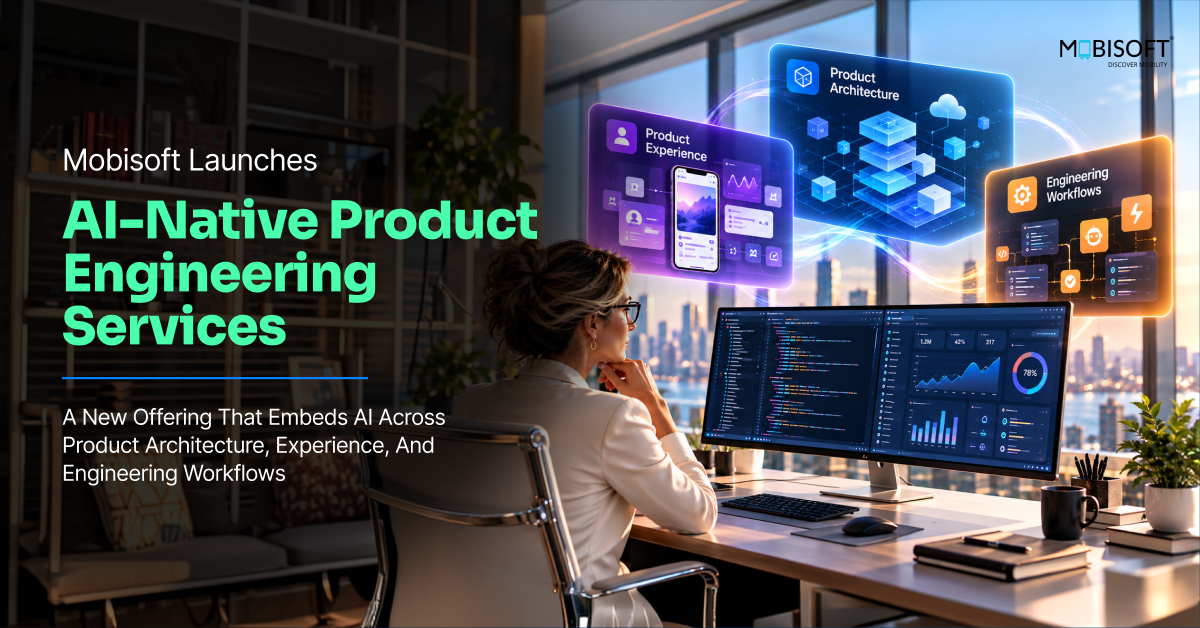

The new offering brings AI into the product engineering lifecycle to help organizations design, build, modernize, and scale software products.
HOUSTON, TX, UNITED STATES, October 12, 2026 /EINPresswire.com/ — Mobisoft Infotech today announced the launch of its AI-native product engineering services. The offering helps enterprises and startups build software products with AI embedded across product architecture, user experiences, engineering workflows, and operational systems.
These services target organizations looking to move beyond isolated AI features. The goal is to develop products where AI functions as a core design and engineering capability from the outset.
Generative AI, AI agents, intelligent automation, and multimodal technologies are becoming central to digital products. Companies are rethinking how software gets developed, tested, deployed, and improved. For many organizations, the challenge is shifting from experimenting with AI models to engineering dependable products. These products need to combine AI capabilities with scalable architecture, secure data foundations, reliable integrations, and measurable user value.
Mobisoft’s AI-native product engineering services address this transition across the full product lifecycle. The offering brings together capabilities across several domains.
These include:
– AI and generative AI engineering
– Software product development
– Cloud-native architecture
– Data engineering
– AI-assisted application modernization
– Platform integration
– DevSecOps
– Quality engineering
– Product lifecycle management
Engineering Products Around AI From the Start:
Traditional software products are typically built around deterministic application logic. They follow predefined user journeys and structured interfaces. AI-native products introduce an additional layer. Software can now interpret context, generate content, assist with decisions, and automate tasks. It can interact through natural language and increasingly coordinate actions across other systems.
These capabilities create new product opportunities. They also introduce engineering requirements that extend beyond conventional application development. Mobisoft’s approach focuses on integrating AI into the broader product architecture. At the same time, it maintains established software engineering disciplines around performance, reliability, security, scalability, maintainability, and governance.
The service portfolio includes the following:
– The AI-native product strategy identifies where AI can create real value and turns that value into a clear roadmap.
– The product architecture and modernization service builds cloud-native, modular systems that support AI models, APIs, and event-driven workloads.
– The generative AI and agent integration service brings conversational AI, copilots, and autonomous agents into everyday digital products.
– The data and knowledge engineering service prepares enterprise data, retrieval systems, and vector search for context-aware AI experiences.
– The experience design for AI products service shapes interfaces and interaction models around adaptive, conversational AI behavior.
– The full-stack product development service combines web, mobile, cloud, and backend components into a single production-ready system.
– The AI evaluation and quality engineering service measures AI outputs and system behavior against reliability and performance standards.
– The security and governance service applies access controls, data protection, and audit trails to keep AI use accountable.
– The DevSecOps and continuous delivery service carries both traditional software and fast-moving AI updates through one pipeline.
– The product optimization and lifecycle support service uses real usage data and feedback to improve performance over time.
Supporting Both Enterprise Modernization and Startup Product Development:
The offering addresses different product engineering priorities. These priorities vary across established enterprises and emerging technology companies. For enterprises, AI-native engineering can support the modernization of legacy applications. It can help develop intelligent employee and customer experiences. It can also integrate AI into existing platforms and create new digital products, all without requiring organizations to replace their broader technology estate.
For startups and product-led companies, the services support faster movement from concept and prototype to production. Teams can establish scalable architecture, product engineering practices, AI infrastructure, and operational foundations earlier in the development cycle.
Mobisoft does not treat these as separate disciplines. Instead, it positions AI engineering and conventional software engineering as interconnected parts of the same product development process.
“Building an AI demonstration is very different from building an AI-native product that customers can depend on every day,” said Ravindra Waghmare. “Production systems need strong software architecture, dependable data pipelines, evaluation frameworks, observability, security, and disciplined product engineering.”
Moving Beyond AI Features to AI-Native Products:
The launch reflects a broader shift in digital product development. Organizations are reassessing the role of AI within their technology strategies. In many early implementations, generative AI appeared as a standalone chatbot, search interface, or productivity feature. It was layered onto an existing product. The next stage of adoption focuses on integrating AI more deeply into core workflows, decision processes, product interfaces, and platform architectures.
This transition can include products that personalize experiences dynamically and automate multi-step workflows. It can also involve surfacing contextual recommendations, generating or interpreting complex information, and using AI agents to interact with enterprise systems on behalf of users.
At the same time, companies must manage emerging considerations. These include model reliability, changing model capabilities, inference costs, data privacy, AI security, vendor dependencies, governance, and appropriate human oversight. Mobisoft’s AI-native product engineering services address these requirements as part of the overall product engineering process. They are not treated as separate AI initiatives.
Building for an AI-First Software Environment:
The company expects AI-native development practices to become increasingly relevant. Product teams are moving toward architectures where AI models, agents, APIs, enterprise data, and conventional application components operate together within the same product ecosystem. For organizations, this shift places greater emphasis on flexible architecture and continuous evaluation. It also demands AI observability, secure data access, interoperability, and engineering teams capable of working across both traditional software and AI systems. Through the new service offering, Mobisoft aims to help enterprises and startups develop products that adapt as AI technologies evolve. At the same time, these products maintain the engineering discipline required for production-scale software.
About Mobisoft Infotech:
Mobisoft Infotech is an AI-native digital product engineering and technology solutions company. It helps enterprises, startups, and technology-led businesses design, build, modernize, and scale digital products and platforms. Its capabilities span artificial intelligence, generative AI, AI agents, software product engineering, cloud technologies, data engineering, application modernization, automation, and enterprise software development. Mobisoft works with organizations across the full product lifecycle. This spans strategy and architecture through engineering, integration, deployment, and ongoing optimization. The focus remains on building scalable, secure, and maintainable technology systems.
Ravindra Waghmare
Mobisoft Infotech
+ +1 855-572-2777
Visit us on social media:
LinkedIn
Instagram
Facebook
YouTube
X
Legal Disclaimer:
EIN Presswire provides this news content “as is” without warranty of any kind. We do not accept any responsibility or liability
for the accuracy, content, images, videos, licenses, completeness, legality, or reliability of the information contained in this
article. If you have any complaints or copyright issues related to this article, kindly contact the author above.

Media gallery