
Technical comparison and practical selection strategies for targeted protein quantification in life-science research
HUSTON, TX, UNITED STATES, September 28, 2026 /EINPresswire.com/ — For life-science researchers, accurate protein quantification underpins a wide array of experimental work — from evaluating cytokine responses under drug treatment to identifying disease-related biomarkers. Selecting a suitable detection platform directly shapes experimental success, data quality and overall lab workflow efficiency. Faced with mainstream assay options including classic ELISA, flow-cytometry-based CBA, high-throughput Luminex and ultra-sensitive MSD, many research teams struggle to identify the most appropriate solution for their study. This release unpacks core technical principles, head-to-head performance metrics and real-world application scenarios to deliver a practical decision-making framework for assay platform selection.
ELISA: Proven classic platform for single-analyte measurement
Enzyme-Linked Immunosorbent Assay (ELISA) is a well-established workhorse for protein measurement. Its workflow builds on a sandwich immunoassay format: capture antibodies are immobilised on microplate wells to bind target proteins, followed by enzyme-conjugated detection antibodies. A colour-generating substrate is catalysed by the conjugated enzyme to produce quantifiable readouts.
ELISA delivers solid stability and cost-effectiveness. For single-target protein testing, it remains a highly cost-competitive solution operable with standard microplate readers and minimal hands-on training. Modern one-step ELISA formats further streamline incubation steps, completing plate-based testing within one hour and achieving a sensitivity down to 0.13 pg/mL.
Its key limitation lies in single-plex detection per run. Measuring 30 different cytokines demands 30 separate wells, repeated handling and 30 sets of calibration standards. It consumes larger sample volumes of 50-100 μL per analyte, involves labour-intensive workflows and carries risks of elevated batch-to-batch variation.
CBA: Flexible multi-analyte tool built for flow cytometry workflows
Cytometric Bead Array (CBA) shares conceptual similarities with Luminex but runs on standard laboratory flow cytometers. Distinct bead populations labelled with unique fluorescence intensities are pre-coupled with capture antibodies for individual analytes. After target protein binding, PE-tagged detection antibodies are added to form sandwich immune-complexes. The flow cytometer differentiates bead populations via classification fluorescence to identify analytes, while PE signal intensity determines protein abundance.
A major strength of CBA is accessible instrumentation. Laboratories with existing flow cytometry hardware can run multi-parameter assays without capital investment in dedicated equipment. Assays finish within 3-4 hours, much faster than the 12-24-hour timeline of conventional ELISA. It requires only 25-50 μL sample input and enables simultaneous measurement of 5-30 analytes in one sample tube. Sensitivity lands at the pg/mL range, with high-sensitivity kits reaching 0.274 pg/mL.
Still, CBA calls for skilled operators. Polystyrene beads may precipitate and aggregate if samples are not thoroughly vortexed after serum addition, which can distort bead population separation and invalidate datasets. Calibration and standardisation workflows are relatively complex, and performance differences can appear across reagent batches.
Luminex (xMAP): High-throughput mainstream for multi-analyte profiling
Luminex leverages fluorescent-coded bead technology. Varying mixing ratios of two fluorophores create up to 100 bead sets with distinct fluorescent signatures. Each bead set is conjugated to capture antibodies for one specific analyte. During detection, a red laser identifies bead identity, while a green laser measures reporter fluorescence intensity for quantification.
Luminex delivers exceptional multiplexing capacity: 2-100 analytes can be profiled from a single 50 μL sample. It reaches sensitivity as low as 0.01 pg/mL and offers a broad dynamic range spanning 3.5-6 orders of magnitude. Researchers can build custom panels by mixing different bead sets to match project requirements.
This platform requires dedicated hardware and specialised analytical software, calling for instrument access and staff training. Cross-reactivity between different analytes represents a potential risk in high-plex assays, which demands rigorous validation from reagent developers.
MSD: Ultra-high-sensitivity solution for low-abundance target proteins
Meso Scale Discovery (MSD) works on electrochemiluminescence principles. Carbon electrodes sit at the bottom of assay plates; electrical voltage triggers luminescence from detection labels. Low background signal enables fg/mL-level sensitivity alongside a broad dynamic range covering 5-6 orders of magnitude.
For low-abundance proteins such as serum-derived IL-4, IL-13 or cerebrospinal fluid neural biomarkers, MSD frequently delivers reliable quantitative results that other immunoassays cannot achieve. Published comparative studies rank MSD among the most sensitive immunoassay platforms. It also shows strong resistance to matrix interference, removing the need for extensive pre-treatment across diverse sample types.
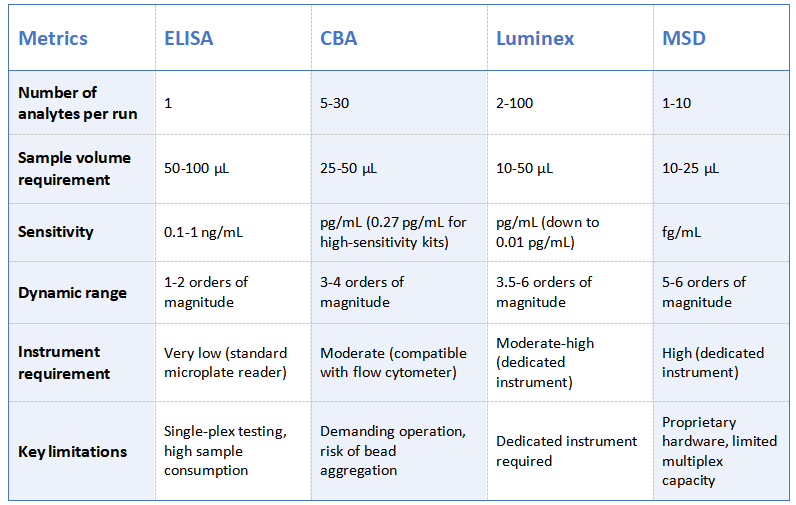
Table 1. Side-by-side performance comparison of ELISA, CBA, Luminex and MSD
Table note: Performance data compiled from peer-reviewed publications and vendor documentation
Practical guidance: match platforms to research scenarios
Scenario 1: Routine single-analyte validation with limited budget When only one or two protein targets need measurement, or large sample batches require routine screening, ELISA remains a robust choice. Kits are well-validated, handling is straightforward, costs are manageable and minimal special equipment is needed.
Scenario 2: Multi-analyte screening with in-house flow cytometry instruments For projects profiling 5-30 cytokines simultaneously where flow cytometers are already available on-site, CBA provides strong cost efficiency. No extra capital equipment purchase is necessary, assay turnaround is fast and sample consumption is low. Operators must implement thorough bead vortexing and consistent standard operating practices to prevent bead aggregation.
Scenario 3: High-plex multi-analyte screening with precious sample material For studies measuring dozens of analytes in limited samples such as mouse cerebrospinal fluid or bronchoalveolar lavage fluid, Luminex serves as the preferred option. One assay generates comprehensive immune profiling outputs while preserving scarce sample material, with superior sensitivity compared with conventional ELISA.
Scenario 4: Research targeting low-abundance analytes with high-sensitivity priorities When studying proteins present at extremely low concentrations, for instance certain inflammatory mediators in healthy serum or early-stage biomarkers for neurodegenerative disorders, MSD delivers unmatched fg-grade sensitivity. Its wide linear dynamic range also reduces measurement errors caused by repeated sample dilution.
Scenario 5: Discovery-driven research for global proteome profiling For exploratory work aiming to measure hundreds to thousands of proteins, affinity-based proteomic platforms such as Olink PEA or SomaScan are better suited. These platforms work with sample volumes as low as 1 μL. It should be noted that they generate relative quantitative outputs at higher cost; they fit large cohort screening instead of targeted analytical validation.
Cloud-Clone: Reagent solutions for multi-analyte protein detection
For researchers seeking reliable commercial kits for multi-protein measurement, Cloud-Clone delivers a compelling option. Its core strengths lie in dual-platform compatibility, extensive analyte coverage and dependable assay performance.
Cloud-Clone develops reagent kits supporting both Luminex xMAP and flow-based CBA systems. Teams with existing flow cytometers can adopt CBA kits without further hardware investment; only APC and PE detection channels are required to measure up to 27 analytes in one assay. When higher multiplexing capacity or expanded dynamic range is required, Luminex-compatible kits are available. The two solution sets offer comparable performance metrics, enabling researchers to select based on local instrument access and achieve consistent results from identical sample sources across platforms.
The reagent portfolio covers more than 7000 analytes across over ten species. Beyond common research models including human, mouse and rat, it also supports species such as guinea pig, chicken, dog, pig and cow, alongside custom development for rare species. Over 350 pre-validated disease-focused assay panels cover research fields including autoimmunity, neuroscience, cardiovascular research, bone biology and oncology. For Alzheimer’s disease studies, pre-built panels range from 4-plex to 10-plex configurations optimised for precious cerebrospinal fluid samples. Bone-research-oriented panels include more than 50 validated combinations addressing bone formation, bone resorption and bone remodelling pathways.
Assay validation data from Cloud-Clone demonstrates recovery rates between 80%-120%, R² values ≥0.97 for serially diluted samples, while intra-assay and inter-assay coefficients of variation stay below 10% for both Luminex and CBA products, supporting stable and comparable experimental outputs.
Custom panel development is also available. If pre-configured panels cannot fully satisfy project goals, researchers can select analytes from the large library of over 7000 targets for custom panel assembly. Custom orders covering up to 4 analytes can be ready within 1-3 weeks. For research groups balancing tight budget constraints and high-quality data expectations, Cloud-Clone’s dual-platform offering, broad analyte library and flexible customisation provide a practical solution.
There exists no universally superior protein-detection platform; the optimal selection depends on specific research goals. ELISA excels in stability and affordability; CBA offers flow-cytometer-enabled flexibility; Luminex shines in multiplex throughput; MSD provides industry-leading sensitivity and wide dynamic measurement range.
A proven experimental workflow strategy involves initial multi-analyte screening using CBA or Luminex to identify candidate biomarkers, followed by targeted confirmation with MSD or ELISA. This approach balances research expenditure and robust data quality. Ongoing advances in multi-analyte protein-detection reagents give global researchers expanded practical options to support their life-science investigations.
About Cloud-Clone Corp.
Cloud-Clone Corp. is dedicated to the development and production of high-quality immunoassay reagents and detection solutions. With a focus on antibody engineering, multiplex assay development, and cross-platform compatibility, the company provides research tools designed to support precision medicine and advanced biomedical investigation globally. Our core products and services include the research and development of proteins, antibodies, ELISA kits, primary cells, and multiplex cytokine assay kits, as well as professional CRO services to fully meet the diverse needs of biomedical research and related fields.
For more information about Cloud-Clone Corp, visit www.cloud-clone.com.
CLOUD-CLONE CORP.(CCC)
Tel: 001-832-538-0970, 0086-27-8425-9552
Email: mail@cloud-clone.com, sales@cloud-clone.us
Visit us on social media:
LinkedIn: https://www.linkedin.com/company/cloud-clone-corp/
Instagram: https://www.instagram.com/cloudclonecorp2023/
TickTok: https://www.tiktok.com/@cloudclonecorp2026
SuKi Duan
CLOUD-CLONE CORP.WUHAN
email us here
Visit us on social media:
LinkedIn
Instagram
TikTok
X
Legal Disclaimer:
EIN Presswire provides this news content “as is” without warranty of any kind. We do not accept any responsibility or liability
for the accuracy, content, images, videos, licenses, completeness, legality, or reliability of the information contained in this
article. If you have any complaints or copyright issues related to this article, kindly contact the author above.

Media gallery