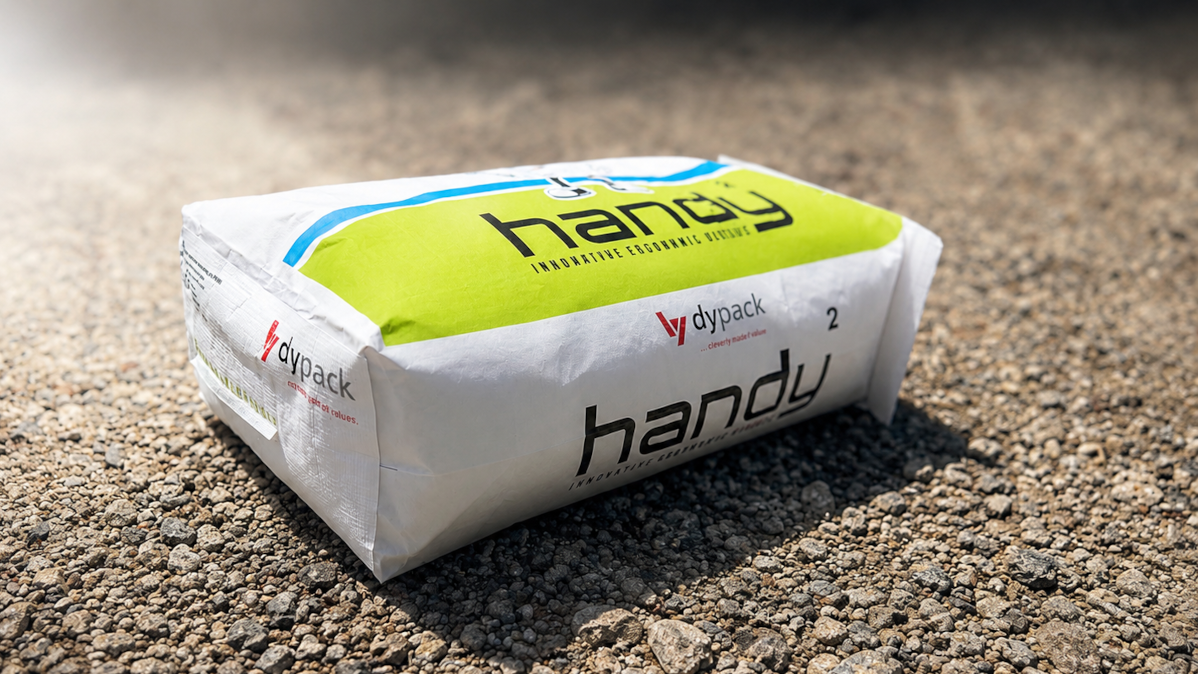

Vacuum technology is indispensable in paper sack manufacturing. It plays a vital role at several critical stages of the production process.
MAULBURG, GERMANY, September 23, 2026 /EINPresswire.com/ — At dy-pack, suction cups mounted on small robotic arms grip the sides of each sack blank, lift it from the stack and position it for the next process step. Vacuum ensures that the sacks are aligned one after the other so that the bottom can be opened in a controlled manner. It also helps spread the sack bottom, ensuring precise and consistent folds. Without vacuum technology, these process steps could not be performed reliably.
dy-pack is a family-run company based in Wenden and has been specialized in manufacturing paper sacks for more than 75 years. The company supplies customers worldwide and has a strong export business. The products are used across a range of industries such as chemicals, foodstuffs and additives as well as construction materials. Depending on the application, filling material and filling process, the sacks must meet various requirements regarding dimensions, materials, bonding or surface texture.
Next-generation vacuum supply
The new solution aimed to simplify the system by reducing the number of pump types from five to two. This significantly lowered technical complexity, enabled more efficient maintenance planning and streamlined spare parts management.
The modernization was not a change in the vacuum principle, but a targeted upgrade of the existing system. Older first-generation vacuum pumps were replaced by more efficient models equipped with IE4 motors. This allowed dy-pack to benefit from government funding from the German Federal Office for Economic Affairs and Export Control (BAFA), which covered around 40% of the investment costs.
Measurable results during operation
For dy-pack, it was crucial that the high quality of the paper sacks was ensured in the long term and manufacturing could be operated reliably even under demanding conditions. At the same time, dy-pack sought to further improve the production environment and future-proof its vacuum supply. An additional benefit of the modernization was the reduction in energy consumption.
Measurements show that energy consumption has been reduced from around 155,000 kWh per year to around 148,800 kWh per year. This corresponds to a saving of around 6,200 kWh per year.
The use of the new-generation MINK pumps with optimized silencer technology significantly reduced noise levels, resulting in improved working conditions.
“Overall, the new Busch solution has given us a more efficient, streamlined and reliable vacuum supply that provides stable support for our production, even under demanding conditions,” says Christian Wagner, Head of Maintenance.
For dy-pack, the goal of the new solution was not only to improve maintenance processes, but above all to ensure that service work does not interfere with ongoing operation. Since vacuum is fundamental to production, minimizing downtime was a top priority.
By reducing the system to just two pump types, the vacuum pumps can be replaced within minutes during operation, allowing maintenance work to be carried out without interrupting production. Instead of repairing them on site, the vacuum pumps are exchanged and maintained separately. For dy-pack, this translates into high system availability and the assurance that the vacuum supply will remain reliable even during maintenance activities.
A service concept has been established to avoid unplanned standstills and make maintenance more predictable. As a result, maintenance activities are now clearly structured and can be planned in advance without requiring unplanned interventions or production downtime.
The conclusion of a service contract changes maintenance from a reactive measure to a planned process. Service visits are scheduled ahead of time and carried out in a controlled manner, significantly improving operational predictability.
Integration of digital monitoring as the next step
As part of the continuous optimization process, dy-pack is currently testing OTTO – Digital Services from Busch. The digital solution collects and monitors relevant operating data from the vacuum pumps, such as running times and energy consumption, and presents this information clearly in a dashboard.
With the help of a traffic light system, users gain a quick overview of the system status and can detect deviations at an early stage. The system is currently being used on a production line to assess its potential under real-life conditions. The aim is to gain a better understanding of the behavior of the pumps and processes.
Even if the system is not yet fully implemented, it represents the next step in the advancement of vacuum supply. In the future, continuous data evaluation can help enable more condition-based maintenance planning, further increase equipment availability and create the basis for predictive maintenance.
A compelling example of continuous improvement
Modernization of the vacuum supply is another step for dy-pack on the way to even more efficient and future-proof production. By investing in modern vacuum technology, reducing the number of pump types in use, implementing structured service concepts and leveraging digital solutions, the company has created the conditions for high process stability, consistently high product quality and long-term equipment availability.
Dr Sandra Thirtle-Höck
Busch Group
+49 64 418021460
email us here
Legal Disclaimer:
EIN Presswire provides this news content “as is” without warranty of any kind. We do not accept any responsibility or liability
for the accuracy, content, images, videos, licenses, completeness, legality, or reliability of the information contained in this
article. If you have any complaints or copyright issues related to this article, kindly contact the author above.

Media gallery