


PanuShot // Shutterstock
How long you finance a car makes a big difference in not just how much you pay every month, but also how much it costs you over the life of the loan. Longer loan terms have become increasingly common as drivers try to keep monthly payments manageable.
Caribou explains how to weigh the trade-offs when comparing loan terms, whether you’re buying a car or refinancing your current auto loan.
Why drivers are taking out longer loans
Drivers have steadily stretched their auto loans over the past several years. Nearly 1 in 4 new auto loans in Q2 2026 were for 84 months or longer, a record high, according to Edmunds. Two trends are driving that shift.
The first is price. New vehicle prices currently hover around $50,000, based on estimates from Kelley Blue Book. As a result, buyers are faced with larger loan balances and are extending terms to keep payments manageable.
Vehicles have also gotten more reliable, so drivers are keeping their cars longer. The average car on the road today is 12.8 years old, according to S&P Global. Bigger loan balances plus longer ownership timelines add up to longer loan terms.
Shorter vs. longer auto loan terms
There is no perfect loan term. The right choice depends on your budget, interest rate, car value and how long you plan to keep the vehicle.
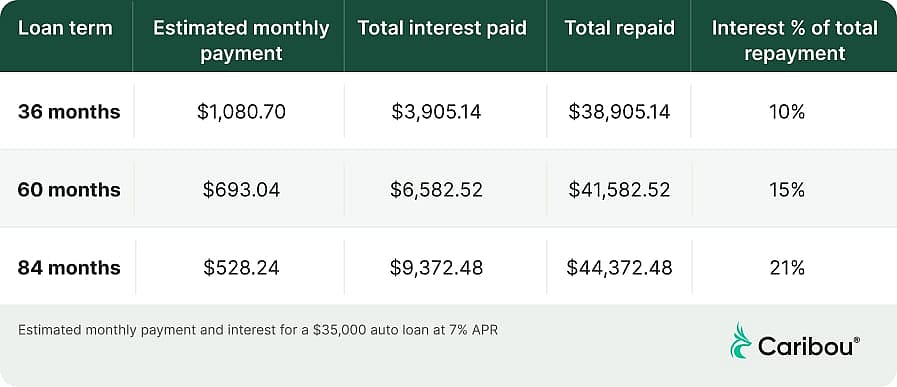
Let’s assume you have a $35,000 auto loan at 7% APR. Choosing an 84-month term over a 36-month loan lowers the monthly payment by about $552. But it also increases the total interest paid by more than $5,400.
Caribou
A longer loan term gives you more room in your monthly budget now, but a higher total cost over time. The right choice is the one that works best based on your current financial situation.
Shorter loan terms
A shorter term may make sense if you can comfortably afford the payment and want to reduce your total cost. You would be able to pay off the loan faster and pay less interest overall. A shorter loan term can also help you build equity in your car sooner and therefore reduce the risk of being upside down on your loan.
The downside is that your monthly payment will usually be higher, so a shorter term may not be the right choice if it would constrain your monthly budget.
Longer loan terms
A longer loan term spreads your balance across more months and may make sense if your primary goal is to lower your monthly payment to avoid falling behind—or if you need to free up monthly cash flow for other necessary expenses.
If your car payment is putting pressure on your budget, refinancing into a longer term with a lower APR may help. The key is to check whether the lower APR helps offset the added time.
For example, New York driver Matthew Carl extended his loan to 72 months when he refinanced his Toyota RAV4 to create breathing room in his budget as his family prepared for a new baby. “The savings are going toward diapers and baby food,” he says.
A longer term may also make sense if you plan to make extra payments when you can. This approach provides more flexibility—you can lower your required monthly payment but make extra payments to pay down the loan faster when you are able. Just make sure your lender does not charge a prepayment penalty before making extra payments.
What to consider with a longer loan
A longer term is not automatically bad. Sometimes, lowering your monthly payment is the move that helps you better manage your budget. But it can create risk if the lower payment is the only thing you look at. With a longer loan term, you may:
- Pay more interest over the life of the loan.
- Owe money on the car for longer.
- Build equity more slowly.
- Still have payments when the car is older or needs repairs.
- Have a harder time selling or trading in the car if you owe more than it is worth.
This matters because negative equity can make your next car loan more expensive. Edmunds reported that, in Q2 2026, buyers who rolled negative equity into a new loan had an average monthly payment of $944, compared with the overall industry average of $777.
How to choose the right auto loan term
Auto loans typically come in terms of 36, 48, 60, 72, or 84 months, and sometimes longer. The right loan term should balance affordability today with total cost over time. Before choosing a term, ask yourself these questions.
Can I afford the monthly payment?
A shorter term can save money, but it only works if the payment fits in your budget. If the payment is too high, you may be more likely to miss payments or take on more debt to cover other expenses.
How much interest will I pay?
Look at the total interest, not just the monthly payment. A longer term may look better month to month but cost more by the end of the loan.
How long do I plan to keep the car?
If you plan to trade in or sell the car soon, a longer term could make it harder to build equity before your next purchase.
Is the car likely to need repairs before the loan is paid off?
The longer you keep a loan, the more likely you are to still have payments when the car is older. That can be tough if repair costs start rising at the same time.
Am I already upside down on my auto loan?
If you owe more than your car is worth, extending your term may lower your payment but keep you in negative equity longer.
How to change your loan term by refinancing
Refinancing can help your car payment fit your budget better. Think of it like switching phone plans, but for your car. You replace your current loan with a new one, ideally with a lower interest rate, a lower monthly payment, a different term, or a combination of the three.
Refinancing into a longer term can raise your total cost, even if the payment is lower. Before refinancing, look past the monthly payment and consider these factors:
- Your current loan balance.
- Your current APR.
- Your new APR.
- Your current payoff timeline.
- Your new loan term.
- Your estimated total interest.
An auto refinance calculator can help you compare how much you’ll pay based on the loan term.
If your credit score has improved or rates have shifted since you bought the car, refinancing can lower your payment and let you reset your term to something that fits your finances now.
For example, Cameron Worthington, a driver from Georgia, shortened his term from 48 months to 36 months when he refinanced his Dodge Dart. His payment rose by about $14 a month, but he saved more than $1,000 in interest over the life of the loan. “My refinancing goal was to figure out how I can pay my car off faster,” he says.
The best loan term is the one that works with your budget
Loan terms affect the cost of credit by changing both your monthly payment and the amount of interest you pay over time. A longer auto loan term can make your payment more affordable, but it usually increases the total cost of borrowing. A shorter term can save money overall, but the payment may be harder to manage.
Before choosing a loan term, compare the monthly payment, APR, total interest and total amount repaid. The best loan is not always the one with the lowest payment. It’s the one that fits your budget without costing more than necessary.
This story was produced by Caribou and reviewed and distributed by Stacker.

