
Recognition highlights his creation of a physics-based, unifying foundation for power-electronics-enabled autonomous power systems.
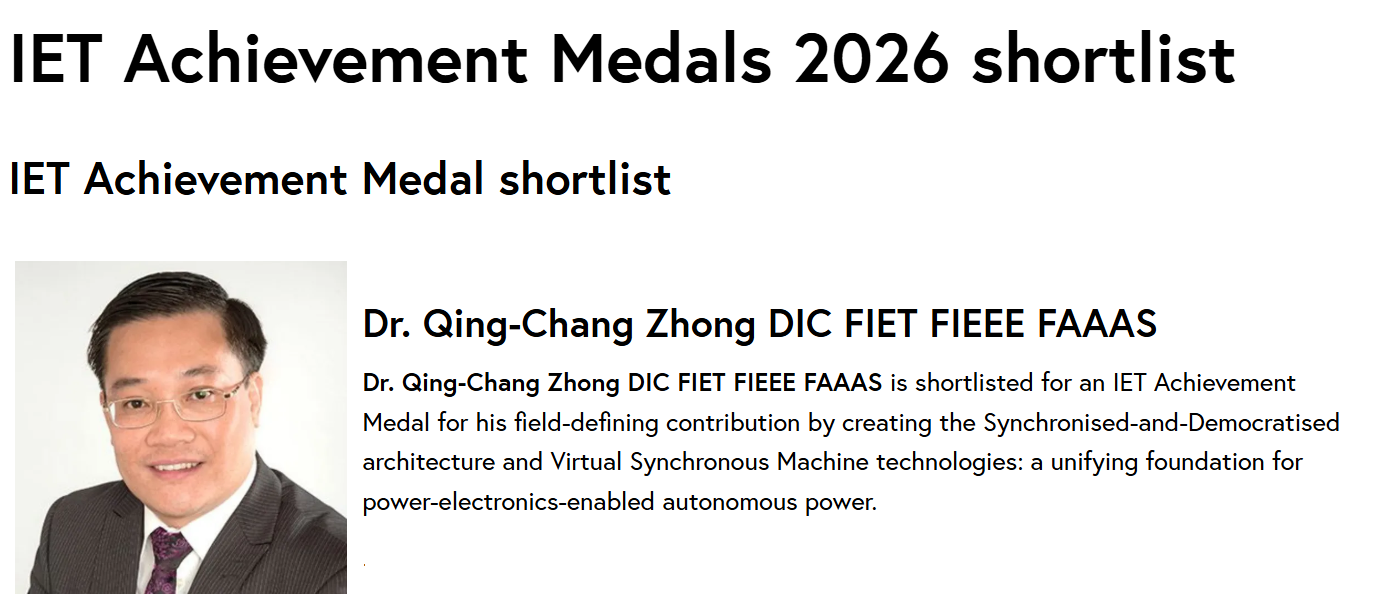
LONDON, UK & CHICAGO, IL, UNITED STATES, September 14, 2026 /EINPresswire.com/ — Syndem LLC today announced that Dr. Qing-Chang Zhong, its founder and CEO, has been shortlisted for a 2026 Achievement Medal by the Institution of Engineering and Technology (IET).
In its 2026 shortlist, the IET cites Zhong for his “field-defining contribution by creating the Synchronised-and-Democratised architecture and Virtual Synchronous Machine technologies: a unifying foundation for power-electronics-enabled autonomous power.” The IET Achievement Medals recognize individuals who have made exceptional contributions to the advancement of science, engineering, or technology; up to five established-career Achievement Medals are awarded across all areas of engineering and technology.
Zhong created the Synchronized-and-Democratized (SYNDEM) architecture and pioneered its enabling Virtual Synchronous Machine (VSM) technologies to address a fundamental challenge facing modern power systems: how growing numbers of power-electronic generators, energy-storage systems, network converters, electric vehicles, and flexible loads can remain compatible with the existing grid and operate together as a stable system. Under SYNDEM, these heterogeneous resources can share a common physical synchronization mechanism while participating in voltage and frequency regulation according to their capabilities.
A foundational VSM realization was the synchronverter, invented by Zhong in 2008 and introduced to the wider engineering community through the 2011 paper “Synchronverters: Inverters That Mimic Synchronous Generators.” His subsequent work advanced VSM technology through self-synchronization, robust and universal droop control, reconfigurable inertia and damping, bounded operation, and system-level stability methods. His invited, sole-authored 2016 IEEE Power Electronics Magazine cover article, “Virtual Synchronous Machines: A Unified Interface for Grid Integration,” presented VSM as a common dynamic interface for both supply- and load-side power-electronic resources. The 2011 synchronverter paper ranks among the top three most-cited non-survey papers in the 44-year history of IEEE Transactions on Industrial Electronics, while the 2016 VSM article ranks among the top two most-cited and most-popular articles in the history of IEEE Power Electronics Magazine.
The work has since progressed from research to large-scale engineering practice, policy recognition, and international standardization. During Zhong’s UK-based career at the University of Sheffield, his technical leadership helped establish the foundation for State Grid Corporation of China to designate VSM technology as one of its Ten Key Science and Technology Innovation Projects. State Grid subsequently independently implemented and commissioned the 140-MW Zhangbei VSM demonstration. The broader SYNDEM/VSM direction also entered the U.S. policy record when synchronized-and-democratized architectures and virtual synchronous machines were cited in the 2018 U.S. House hearing, “The Electric Grid of the Future.”
Zhong later initiated IEEE Std 2988-2024 and chaired the Working Group that developed it. Published in January 2025, IEEE Std 2988-2024 is the first global standard dedicated specifically to the use and functions of Virtual Synchronous Machines, providing an international consensus framework for the technology while remaining implementation-neutral.
Zhong says, “I am deeply honored to be shortlisted for an IET Achievement Medal. This recognition is especially meaningful because it reflects a long-term effort to develop SYNDEM and VSM technologies from fundamental engineering ideas into practical approaches for autonomous, stable, reliable, and resilient power-electronic grids. I am grateful to the many colleagues, collaborators, students, industry partners, and standards participants who have contributed along the way.”
Zhong is an IET Fellow, IEEE Fellow, and Fellow of the American Association for the Advancement of Science (AAAS). He founded Syndem LLC in Greater Chicago in 2017 to translate advances in VSM technology and the SYNDEM architecture into engineering products, field validation, education, and broader deployment.
For technical details about SYNDEM and VSM, read Zhong’s book Power Electronics-Enabled Autonomous Power Systems: Next Generation Smart Grids (Wiley-IEEE, 2020), https://ieeexplore.ieee.org/book/9063368.
For workforce development with hands-on skills, see SYNDEM Smart Grid Research and Educational Kits at http://syndem.com/Products.html.
About Syndem LLC
Syndem LLC is a technology company developing and commercializing technologies for autonomous, stable, reliable, secure, and resilient power-electronic energy systems. Its work centers on the Synchronized-and-Democratized (SYNDEM) architecture and Virtual Synchronous Machine technologies, with products and platforms for grid-forming power conversion, research, education, and system validation. Syndem’s Founder and CEO, Dr. Qing-Chang Zhong, initiated and chaired the development of IEEE Std 2988-2024, the first global standard dedicated specifically to the use and functions of Virtual Synchronous Machines. More information is available at www.syndem.com.
About the Institution of Engineering and Technology (IET)
The Institution of Engineering and Technology (IET) is a global professional engineering and technology organization with more than 157,000 engineering and technology professionals in 148 countries. Its mission is to inspire, inform, and influence the global engineering community to engineer a better world. The IET is a registered charity in England and Wales and in Scotland. More information is available at www.theiet.org.
Sue Yu
Syndem LLC
email us here
Visit us on social media:
LinkedIn
YouTube
Legal Disclaimer:
EIN Presswire provides this news content “as is” without warranty of any kind. We do not accept any responsibility or liability
for the accuracy, content, images, videos, licenses, completeness, legality, or reliability of the information contained in this
article. If you have any complaints or copyright issues related to this article, kindly contact the author above.

Media gallery