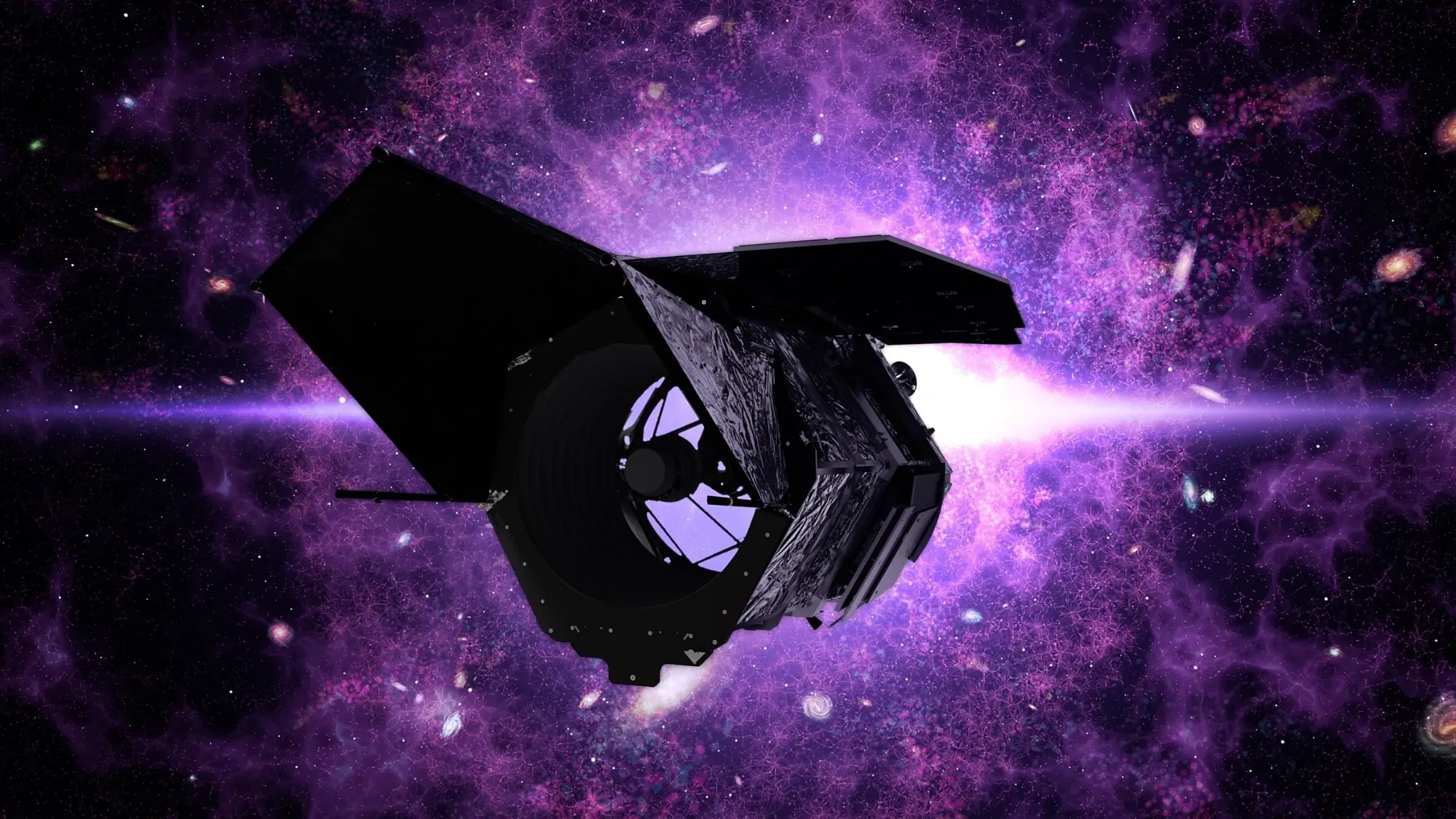

California-built release technology helped enable the precise deployment of NASA’s newest space observatory
LOS ANGELES, CA, UNITED STATES, September 8, 2026 /EINPresswire.com/ — NASA’s Nancy Grace Roman Space Telescope has successfully completed its critical deployment sequence, transforming from a compact spacecraft secured for launch into a fully deployed observatory ready to begin its mission.
Release mechanisms manufactured by Ensign-Bickford Aerospace & Defense (EBAD) at its Moorpark, California facility supported several of the spacecraft’s critical deployment activities.
Roman launched aboard a SpaceX Falcon Heavy rocket from Launch Complex 39A at NASA’s Kennedy Space Center in Florida and traveled approximately one million miles from Earth to a region called the second Sun-Earth Lagrange point, or L2.
Once at L2, Roman began carefully deploying its antennas, covers, solar-array hardware and protective shields. Each system had to move in the correct order and perform as intended before the telescope could begin collecting scientific data.
Roman’s field of view will be at least 100 times larger than Hubble’s, allowing it to survey the sky much faster while maintaining sharp infrared vision. Scientists will use the observatory to investigate dark energy and dark matter, study billions of galaxies, discover and characterize exoplanets, and explore the formation and history of the universe.
EBAD Mechanisms Support Critical Deployment Events
EBAD provided a number of release mechanisms for the spacecraft, including mechanisms supporting the release of critical booms, covers and solar-array hardware.
Among them are EBAD TiNi™ P50 Pin Pullers, which supported the release of Roman’s cover. A pin puller works like a precisely controlled latch. It holds hardware securely during launch, then retracts its pin when commanded so the restrained equipment can move into position. For Roman, the mechanism was optimized to operate in the extremely cold environment encountered in space.
Roman’s successful deployment also required several other spacecraft systems to work together.
The spacecraft’s High-Gain Antenna (Aug. 31) will serve as Roman’s primary connection to ground stations. Its lightweight carbon-composite dish will send large amounts of scientific data across nearly one million miles of space. The antenna’s Ka-band communications system can transmit data at rates of up to 500 megabits per second, allowing Roman to send high-resolution images and other information back to Earth.
Roman also deployed several protective shields designed to maintain the stable environment its sensitive instruments need.
The Lower Instrument Sun Shade (Aug 30), or LISS, acts like a large sunblock for the telescope’s infrared instruments. It is made from two lightweight, garage-door-sized panels covered with specialized protective films. Built-in dampers helped the panels open gradually and smoothly, limiting vibrations that could disturb the telescope’s instruments.
The Deployable Aperture Cover (Sept. 1), sometimes referred to as Roman’s visor, protected the telescope’s opening during launch. It helped keep dust, moisture and other particles away from the primary mirror before deployment. Once Roman reached its operating location, the cover moved out of the way. Thermal blankets also help prevent uneven heating that could affect the telescope’s precise alignment.
The Solar Array Sun Shield (Aug 30) serves two purposes. Its solar panels collect sunlight to generate power for the spacecraft, while the shield helps block heat from reaching the cold side of the observatory. This helps keep the Wide Field Instrument and other sensitive equipment within the stable temperature range needed to observe the universe in infrared light.
These systems may be very different from one another, but they all depend on the same basic requirement: hardware must remain secure during launch and then move exactly when commanded in space.
Heritage from James Webb
EBAD’s NEA® release mechanism technology also brings heritage from another landmark NASA mission, the James Webb Space Telescope. Webb used EBAD release mechanisms to support critical release events during its deployment.
For Roman, that heritage is being carried forward into another observatory designed to change our view of the universe.
“Space missions like Roman remind us that the most extraordinary discoveries often depend on very precise engineering behind the scenes,” said Ruben Betancourt, Principal Engineer, EBAD. “Our mechanisms may be small compared with the telescope itself, but they perform critical functions that have to work exactly when commanded. It is incredibly rewarding to know that technology developed and manufactured by our team in Moorpark helped enable this successful deployment.”
The mechanisms faced a very different environment than the one in which they were manufactured. They had to remain secure through the intense vibration and acceleration of launch, then perform reliably after reaching space, where there was no opportunity for a technician to make an adjustment.
That combination of precision, reliability and extreme operating conditions is at the heart of what EBAD engineers and manufactures every day.
And that is what makes Roman more than a story about a telescope.
It is a story about the people who design, build, test and manufacture the technologies that allow spacecraft to do things that cannot be repaired, reset or replaced once they leave Earth.
From EBAD’s Moorpark facility, engineers and manufacturing teams helped turn highly engineered mechanisms into flight hardware that has now supported one of NASA’s most ambitious science missions.
“You don’t get a second chance in space.”
For the people who built Roman’s hardware, that challenge was the job.
For anyone looking for a career where precision engineering, advanced manufacturing and space exploration intersect, it is also an opportunity to help build what comes next.
About EBAD
Ensign-Bickford Aerospace & Defense (EBAD) is a leading provider of advanced aerospace and defense technologies, specializing in energetic systems, release and separation mechanisms, and precision engineering solutions for demanding applications. EBAD products support critical missions across space, defense and other high-performance markets. The company designs and manufactures mission-critical technologies at facilities in Moorpark, California, Simsbury, Connecticut and Graham, Kentucky. Visit us at www.ebad.com.
Kathy Beazley
KRB Communications
+1 214-728-5573
email us here
Visit us on social media:
LinkedIn
Instagram
Facebook
YouTube
Legal Disclaimer:
EIN Presswire provides this news content “as is” without warranty of any kind. We do not accept any responsibility or liability
for the accuracy, content, images, videos, licenses, completeness, legality, or reliability of the information contained in this
article. If you have any complaints or copyright issues related to this article, kindly contact the author above.

Media gallery