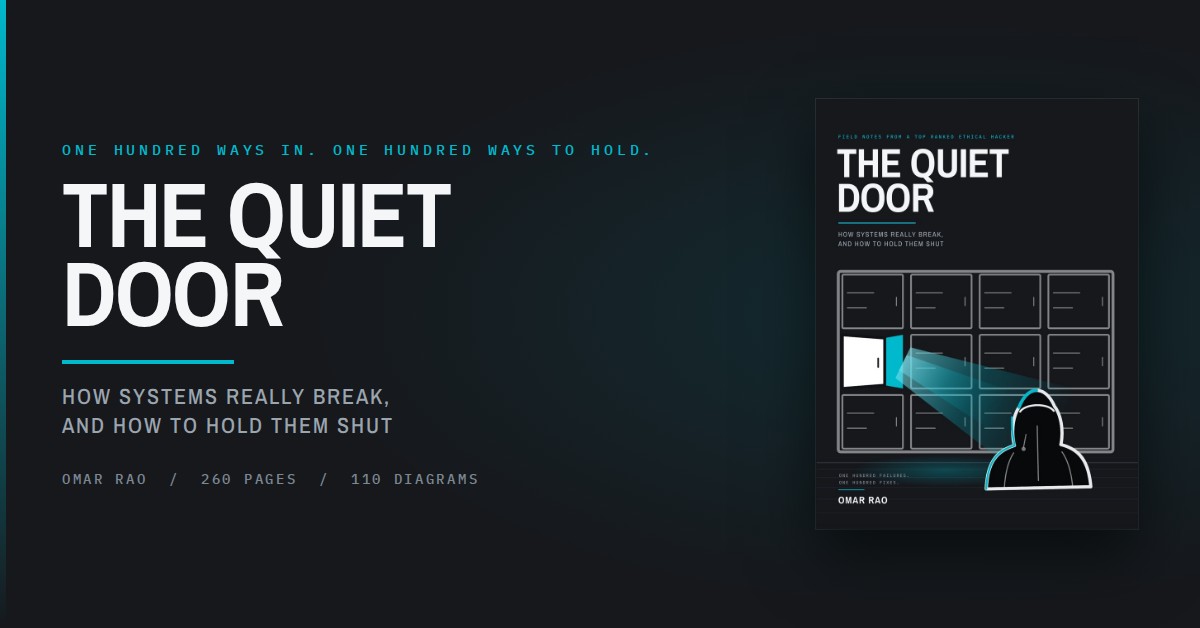

One hundred illustrated case studies from authorized security assessments, with no organization named and no method published.
WILLOW GROVE, PA, UNITED STATES, September 3, 2026 /EINPresswire.com/ — A new book by security practitioner Omar Rao argues that most organizational breaches begin not with sophisticated attacks but with ordinary, documented decisions that were entirely reasonable on the day they were made.
“The Quiet Door: How Systems Really Break, and How to Hold Them Shut,” published August 31, 2026, is a 260 page illustrated field record of one hundred such failures, each paired with the specific control that would have prevented it.
The book draws on Rao’s career conducting authorized security assessments, work in which an organization grants written permission to have its defenses tested. In his account, intrusions rarely begin with an exploit. They begin with a shared password documented in an operations runbook, a supplier connection opened for a project that ended years earlier, a forgotten server nobody claims ownership of, or an alert that fired correctly into a queue nobody had capacity to read.
“In a career spent breaking into places I was invited to break into, I have almost never needed an exploit,” Rao said. “I needed a password somebody reused. A door somebody propped. A server nobody claimed. The organizations that held me out were not the ones with the most tooling. They were the ones that had gone back and closed the door somebody left open years earlier.”
Each of the hundred cases occupies a single two page spread. The left page describes how the failure occurred in plain language, along with the observable indicator a defending team would have seen in its own logs. The right page sets out the controls that close it, the effort and time required, and which function in the organization has to own the work.
That last element is deliberate. “Most security advice fails at the point where somebody has to pay for it,” Rao said. “Every fix in this book carries what it costs, how long it takes, and who has to own it. A control nobody can afford to run is not a control. It is a plan.”
TWO EDITORIAL CONSTRAINTS
The book observes two rules that distinguish it from much of the incident literature.
No organization is named anywhere in the text. Cases are not disguised or anonymized versions of identifiable events; identifying detail is absent. “The people who let me in were competent and busy, working inside processes somebody else designed,” Rao said. “None of them deserve to be somebody’s case study.”
The book also contains no commands, no product or tool names, and no reproducible procedures. “The mechanism is the useful part, and you can describe a mechanism without handing anybody a method,” Rao said.
STRUCTURE
The hundred cases are organized into ten parts that move outward from the individual to the enterprise, and finally to the aftermath of failure: Who You Say You Are; The People In The Path; The Building And The Body; What You Chose To Trust; The Things You Forgot; The Settings Nobody Set; Where The Data Lives; Everybody Else In Your Estate; Watching, And Being Watched; and The Day It All Stops.
The volume contains 110 original technical diagrams, drawn in a single visual language developed for this book. The print editions use a large format so that full page schematics remain legible when the book is laid flat on a conference table. In the digital edition, every figure carries descriptive alternative text, making the diagrams accessible to readers using screen readers.
INTENDED READERSHIP
The book is written for security leaders who need to convert known risks into funded work, for defensive teams who need to recognize these patterns in their own telemetry, for IT and platform owners who own a substantial share of the failures described, and for audit and risk functions concerned with expired exceptions and unattributable access. It assumes no tooling and requires no laboratory environment.
AVAILABILITY
“The Quiet Door: How Systems Really Break, and How to Hold Them Shut” is available now through Amazon. The paperback edition is 8.5 by 11 inches, 260 pages, priced at 14.99 US dollars, ASIN B0HHLCX78B, ISBN 979-8170281978. The Kindle edition is reflowable with 110 figures, priced at 9.99 US dollars, ASIN B0HHKSJW56. A hardcover edition at 8.25 by 11 inches is forthcoming, priced at 19.99 US dollars.
The book is independently published. More information, sample diagrams and a full case study are available at thequietdoor.info.
ABOUT THE AUTHOR
Omar Rao is a security practitioner based in Willow Grove, Pennsylvania. His work centers on authorized offensive security assessment: entering client environments with permission in order to identify how those environments can be compromised, and then explaining the result without assigning blame. “The Quiet Door” is his first book.
Review copies, high resolution cover art, author photography and interior sample spreads are available on request. Interview requests are welcome.
S. Rao
The Quiet Door
info@recruiteye.com
Legal Disclaimer:
EIN Presswire provides this news content “as is” without warranty of any kind. We do not accept any responsibility or liability
for the accuracy, content, images, videos, licenses, completeness, legality, or reliability of the information contained in this
article. If you have any complaints or copyright issues related to this article, kindly contact the author above.

Media gallery