


sebra // Shutterstock
Home care and family caregiving: What makes home care work
Families often begin searching for home care because a loved one needs help with daily activities. Yet the decision to hire home care is rarely driven by practical needs alone, according to a 2026 survey commissioned by A Place for Mom. Using proprietary survey data from 708 family caregivers who were searching for, using, or had discontinued nonmedical home care, the report examines how families experience home care over time and what distinguishes sustained home care arrangements from those that aren’t. Below, A Place for Mom shares what the survey results reveal about what makes home care work.
Families view home care as a long-term aging-in-place strategy, not a temporary service
Families don’t appear to view home care primarily as a short-term response to an immediate care need. Instead, they increasingly see it as the foundation of a long-term strategy to help loved ones remain at home as needs evolve. Among caregivers actively searching for home care, 62% expected it to become a long-term or permanent solution, while only 19% expected it to be temporary. When considering future changes in a loved one’s needs, families were generally more likely to modify home care than replace it with another care setting, suggesting they view home care as an adaptable way to support aging in place.
Home care reshapes family caregiving more than reducing it
Professional caregivers take on many day-to-day care responsibilities, but family caregivers rarely step away from caregiving altogether. Among long-term home care users, 54% said their involvement had stayed about the same after home care began, while only 24% said it had decreased. Rather than reducing family involvement, home care often reshapes it. As professional caregivers assume more hands-on responsibilities, family caregivers increasingly focus on coordinating care, monitoring changing needs, and helping ensure their loved one’s care continues to reflect their preferences and goals.
Trusted relationships with professional caregivers help families adapt to change
Changing care needs were common across nearly every stage of the home care journey, but most families reported being able to adjust successfully. What distinguished long-term home care users from families who discontinued services wasn’t simply the amount of care they received: It was the quality and consistency of the caregiving experience. Families who continued using home care reported higher satisfaction with caregiver reliability, communication, and continuity, while those who discontinued care experienced more scheduling disruptions and lower satisfaction with the consistency of care. The findings suggest that trusted relationships with professional caregivers help families navigate change with greater confidence over time.
Families who choose home care are trying to preserve a way of life
Family caregivers often begin searching for home care because a loved one needs help with specific tasks. A parent may need help with bathing. It may no longer be safe for a spouse to drive. Managing medicines, preparing meals, and helping with mobility may have become increasingly difficult.
These are practical problems, and the home care search naturally encourages practical questions:
- What services are needed?
- How many hours of support will help?
- What will it cost?
- How quickly can care begin?
The speed with which families must make decisions often reinforces this practical focus. In the survey, 62% of families who recently hired home care began receiving services within two weeks of starting their search, and 83% began care within a month.
Yet the practical challenges that trigger a search don’t fully explain why families choose home care. More often, they’re trying to solve those problems in a way that allows a loved one to continue living the life they value.
According to the survey, 63% of family caregivers said their loved one’s preference to receive care at home was one of the most important reasons they chose or considered home care. That motivation far exceeded other factors, including:
- Affordability (36%)
- Need for part-time assistance (28%)
- Temporary post-hospital support or rehabilitation (19%)
- Difficulty finding a suitable senior living community (15%)
For many families, remaining at home reflects something larger than a preference for a particular living arrangement. Home is where older adults have established routines, built relationships, and maintained a sense of independence over many years. Home care helps preserve those elements of daily life while providing the support seniors need as care needs increase.
Among caregivers actively searching for care, 62% expected home care to become a long-term or permanent solution, while only 19% expected it to be temporary. Many also anticipated that care needs — and consequently care hours — would increase. Forty-four percent expected the number of care hours their loved one would need to grow over the following year, compared with only 2% who expected care hours to decrease.
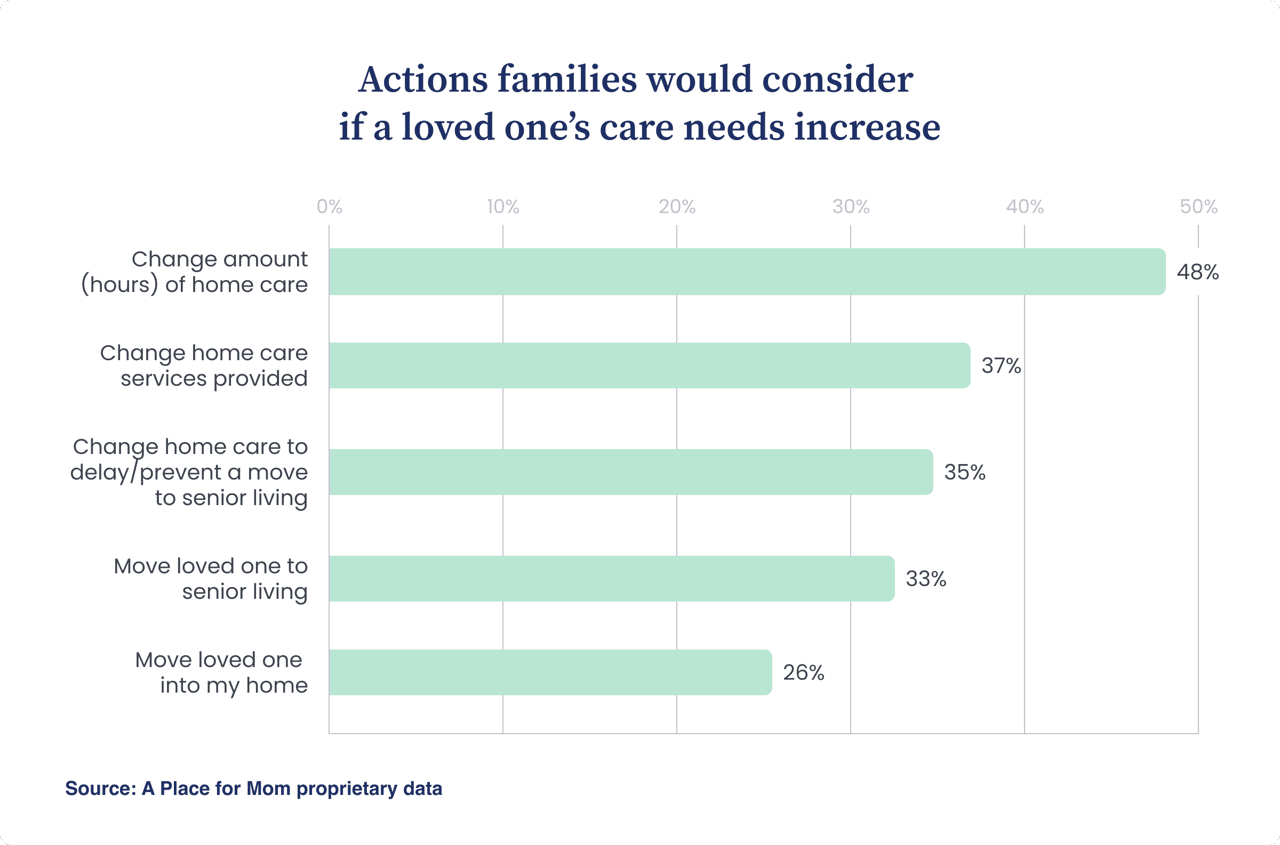
Perhaps most importantly, families appear more likely to adapt home care than replace it when circumstances change. When asked how they would respond if a loved one’s needs increased in the future, nearly half said they would adjust the number of care hours being provided, while 37% said they would modify the types of services received. More than one-third said they would specifically increase or modify home care to delay or prevent a move to senior living. By comparison, only 33% said they would consider moving their loved one into a senior living community.
A Place for Mom
These findings suggest that families aren’t merely choosing home care instead of another care option. They’re using home care as part of an aging-in-place strategy. Rather than serving primarily as a temporary solution, home care becomes the infrastructure that allows older adults to remain at home. As care needs evolve, families appear more inclined to expand, modify, and adapt home care than replace it altogether.
That perspective helps explain many of the findings throughout this report. Families may begin the home care search with urgent questions about safety, schedules, services, and cost, but the decision itself is often driven by a broader objective. They’re trying to help a loved one remain at home while preserving as much independence, dignity, continuity, and quality of life as possible. Home care becomes the mechanism that makes that goal achievable.
Professional caregivers become part of an existing caregiving system
Understandably, many family caregivers begin searching for home care in the hopes that professional support will reduce the amount of care they personally provide. By then, caregiving responsibilities have often expanded beyond what one person can reasonably manage alone.
But caregiving is more than a collection of tasks. It’s an ongoing arrangement of responsibilities, relationships, routines, and decisions that help a loved one remain safe and supported. Family members may be coordinating appointments, managing medications, providing emotional support, and handling countless day-to-day needs. A system for providing care is already in place.
When home care begins, a professional caregiver joins that existing system. The survey findings suggest that this changes the family caregiver’s role, but it rarely eliminates it.
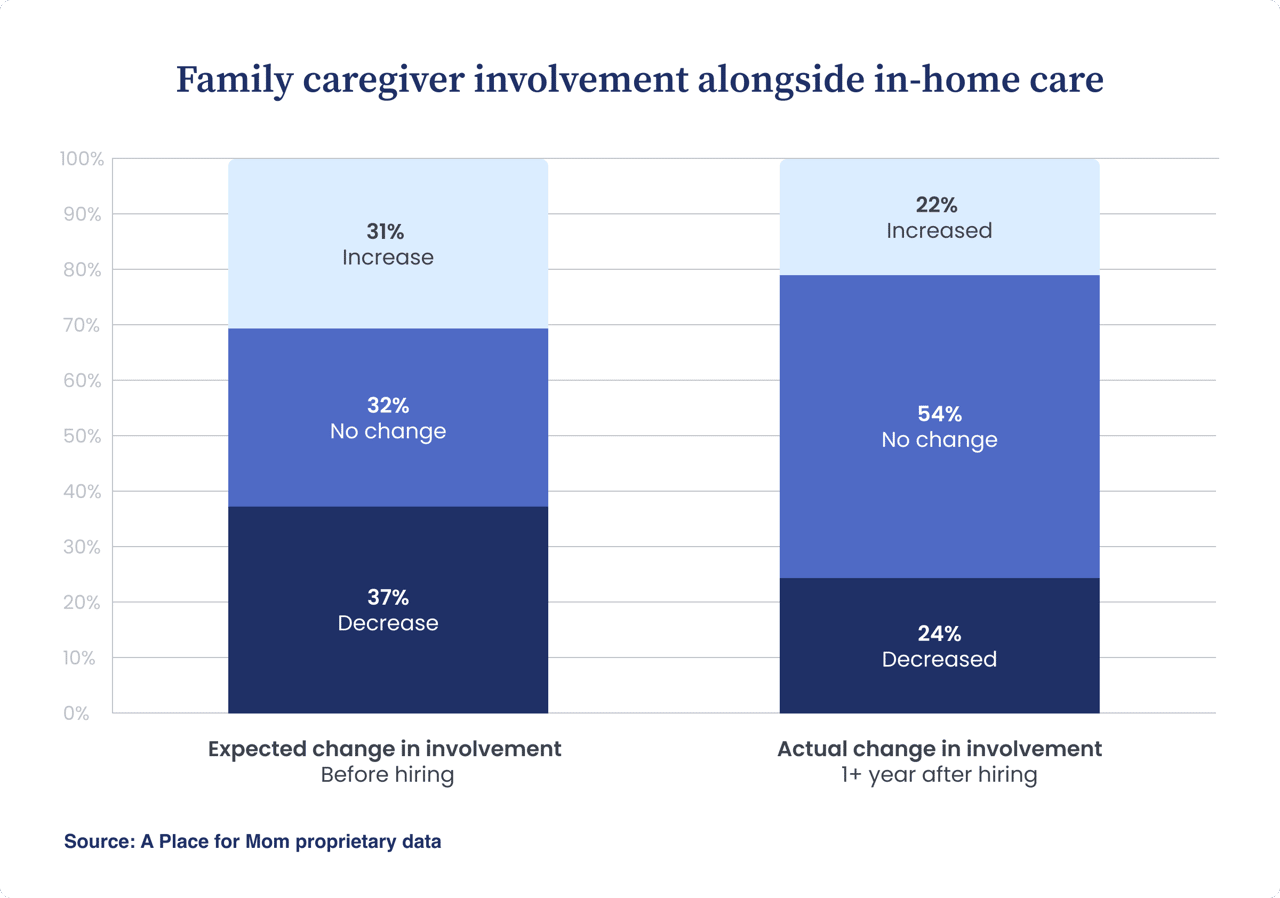
Before hiring home care, many family caregivers expected professional support to reduce their involvement. Thirty-seven percent of active searchers expected the amount of care they personally provided to decrease. In practice, however, most long-term home care users remained just as involved as before. More than half (54%) said their involvement had stayed about the same, while only 24% reported that it had decreased.
A Place for Mom
The reason becomes clearer considering the responsibilities that family caregivers continue to manage after professional care begins. Across every stage of the home care journey, family caregivers reported that they oversee about five to six caregiving responsibilities on average. Emotional support and companionship, scheduling and attending medical appointments, household management, transportation, and meal preparation remained common responsibilities, even when professional caregivers were involved.
Professional caregivers often assume many day-to-day care tasks, but family members continue serving as advocates, coordinators, and decision-makers. Rather than stepping away from caregiving, they frequently become responsible for overseeing the broader care arrangement, monitoring changing needs, communicating with providers, and helping ensure that care continues to reflect their loved one’s preferences and goals.
This continuing responsibility is also reflected in the amount of time family caregivers spend coordinating care. Depending on where they were in the home care journey, caregivers reported spending roughly nine to 13 hours per week overseeing appointments, schedules, services, and other care-related activities. For many families, coordinating a loved one’s care remains an ongoing commitment, even after professional home care is in place.
Change is part of the process
Change is a normal part of the home care experience. Health conditions evolve, family availability shifts, safety concerns change, and new needs emerge.
Home care usage becomes more focused in practice
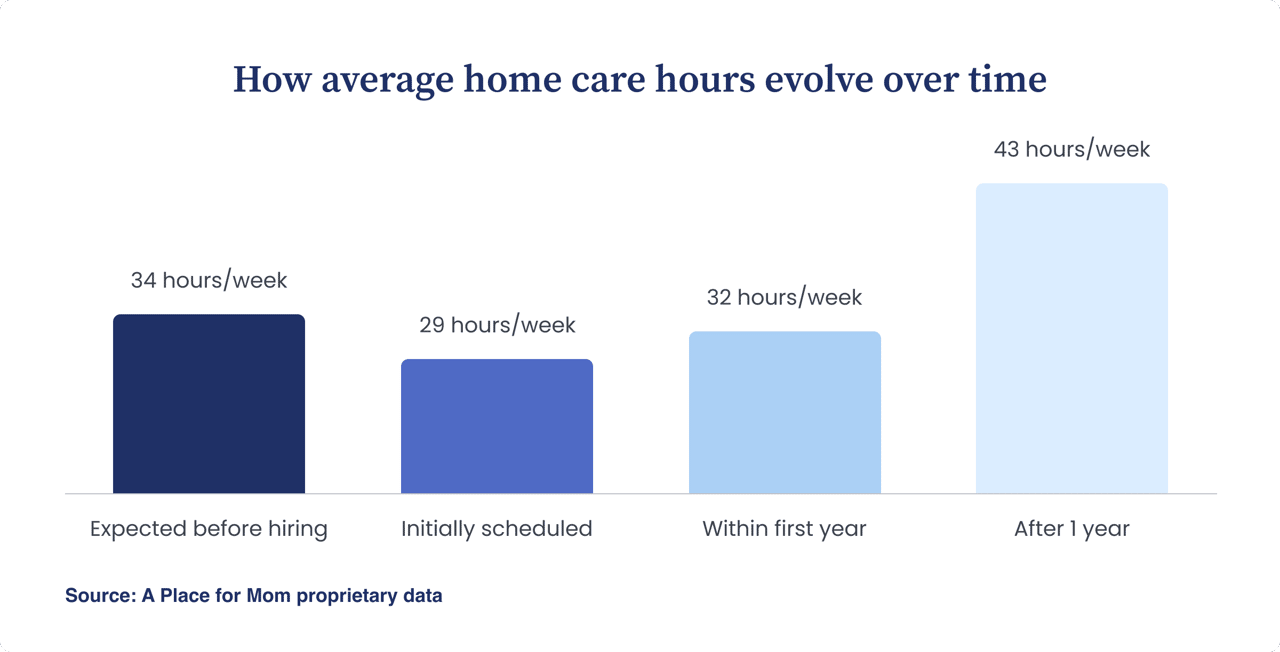
Caregivers who were actively searching for home care estimated that their loved one would need about 34 hours of support per week. Families who recently hired care initially scheduled closer to 29 hours. Among families who had used home care for more than a year, average weekly support increased to 43 hours. These shifts indicate that care needs and the support needed to meet them change over time.
A Place for Mom
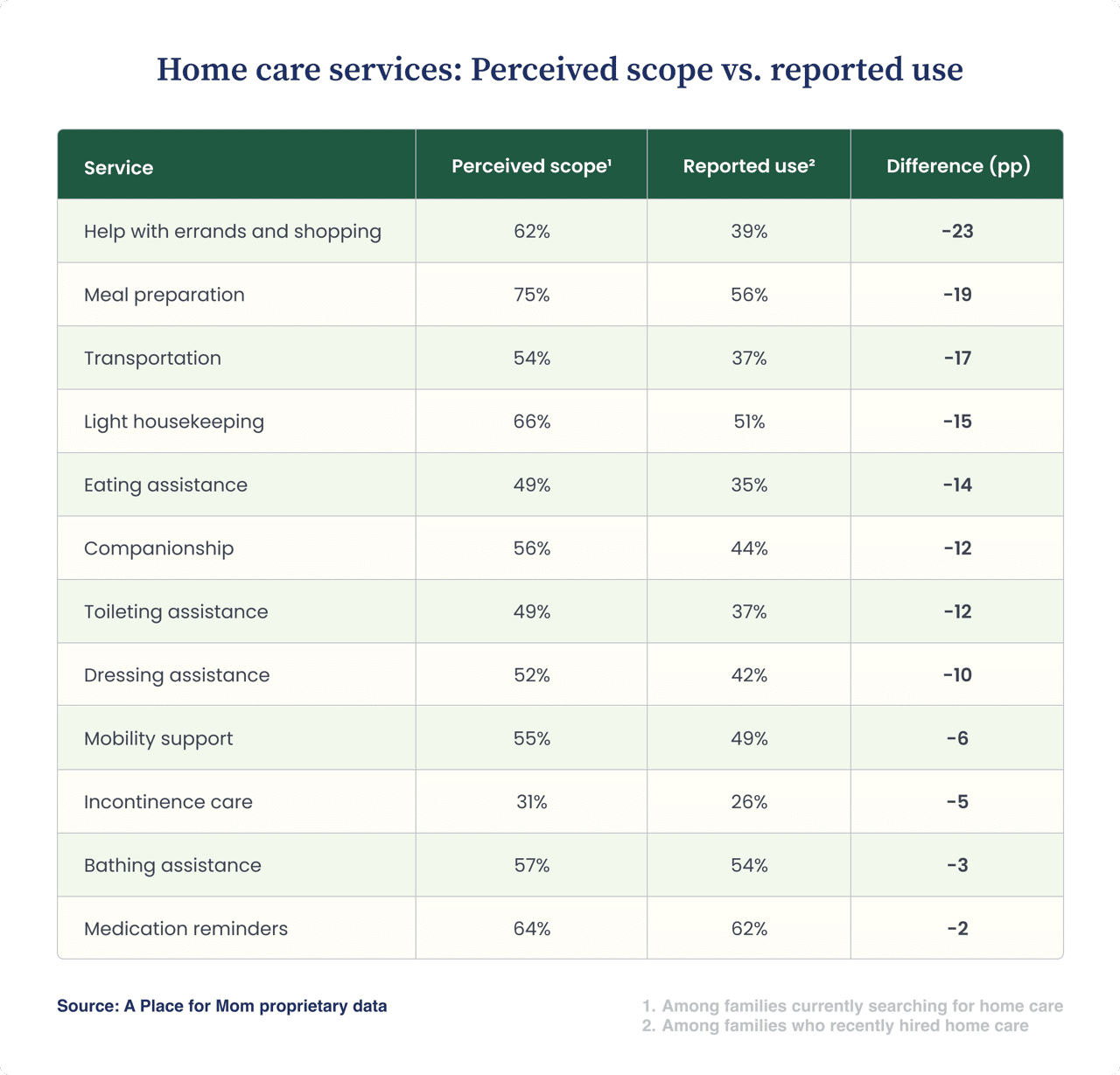
Family caregivers’ expectations around the type of services they imagined they would use compared with what they use once home care is underway also varied. Caregivers who were actively searching for care expected a nonmedical caregiver to help with roughly seven different services on average. Families who had recently hired care reported using closer to five services. The largest gaps appeared in errands and shopping, meal preparation, transportation, and housekeeping.
A Place for Mom
Before care begins, families often imagine a broad range of support that may be useful. Care plans often become more focused as families gain experience with home care.
These findings suggest that home care plans are rarely static. Families often begin with one set of expectations, then refine services and schedules as they learn more about what support is most useful in everyday life.
Care needs often grow after services begin
Changes in care needs are common, but they aren’t driven by a single factor. Nearly half (48%) of family caregivers whose care hours changed said the adjustment was driven by changes in their loved one’s health condition or care needs. However, families were nearly as likely to cite changes in their own availability to help with care (40%), highlighting how professional care and family caregiving remain interconnected over time.
Other common reasons for changing care hours included recovery from a hospitalization or medical event (29%), changes in professional caregiver availability (27%), evolving safety or supervision needs (24%), cognitive or behavioral changes (23%), and financial considerations (21%).
These findings suggest that home care evolves in response to a wide range of circumstances. Changes in care are often driven not only by what is happening with the care recipient, but also by changes in family caregiving capacity, household resources, and other aspects of daily life.
Most families successfully adapt as needs change
Importantly, most families appear able to make adjustments to care needs successfully. Among caregivers whose loved ones had used home care for more than a year, 72% said adjusting care as needs changed was easy, while only 10% described it as difficult.
Families who ultimately discontinued home care reported somewhat greater challenges, but most still described adapting care as manageable. Sixty-three percent said making changes to schedules, services, or caregivers was easy, while 27% described the process as difficult.
The survey also found meaningful differences in how supported families felt during the home care experience. Among current home care users, 83% said professional caregivers provide all or most of the support they need. Among families who had discontinued care, 49% said they received all or most of the support they needed while using home care.
These findings suggest that change itself isn’t unusual. Most families experience evolving care needs, and most report being able to adjust care as circumstances change. Successful home care appears to depend less on avoiding change than on having a care arrangement that can accommodate it over time.
Why some families continue home care — and others don’t
The survey findings suggest that what distinguished successful experiences was the presence of stable, trusted relationships with providers that helped families navigate change.
Continuity builds confidence
The biggest differences between families who continue using home care and those who discontinue it aren’t found in the care needs themselves. Instead, they appear in the quality and consistency of the caregiving experience.
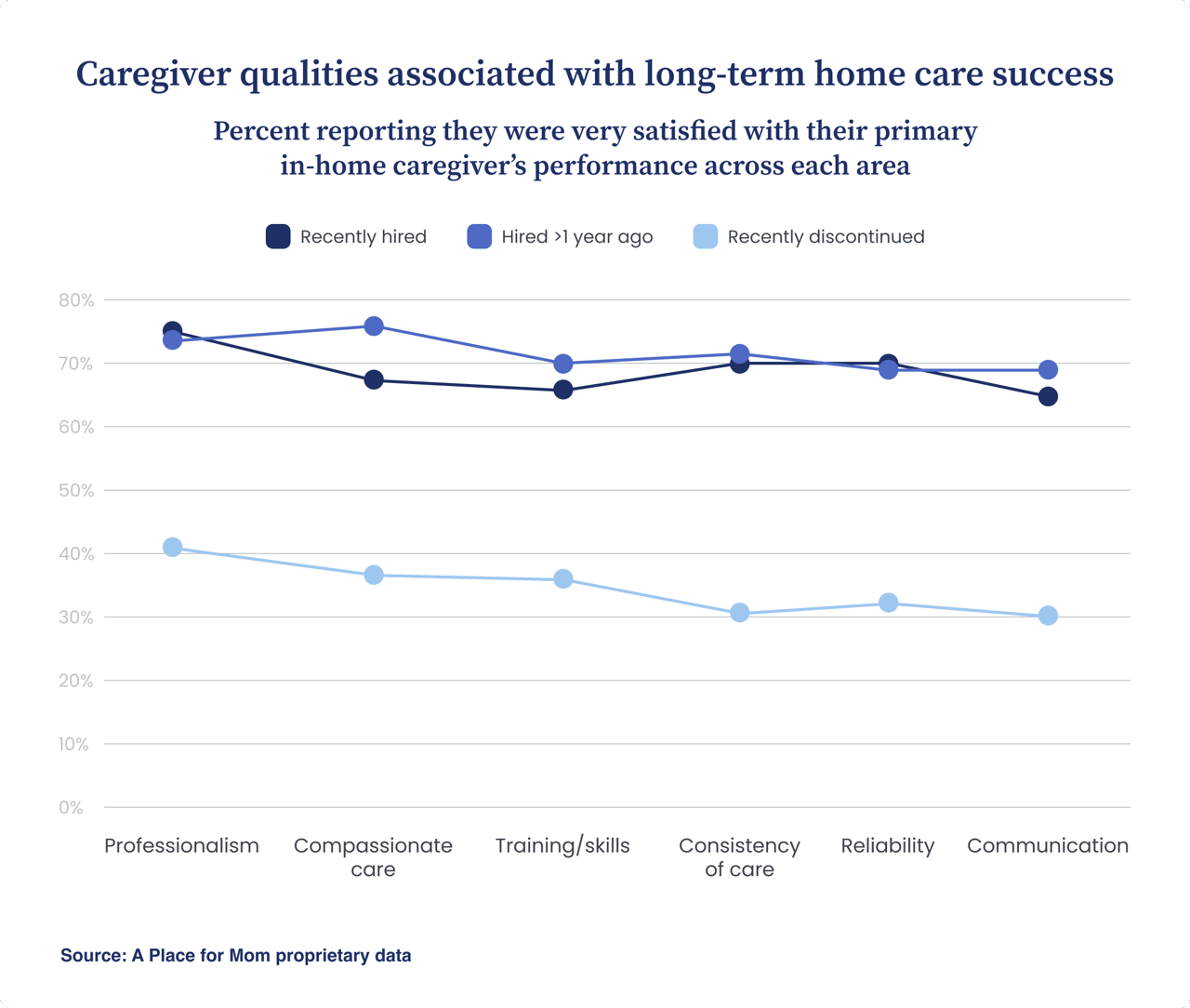
Families who continued using home care reported high levels of satisfaction with the people providing care. More than 70% said they were very satisfied with their primary caregiver’s professionalism, reliability, consistency of care, and compassionate approach. Two-thirds said communication exceeded expectations.
Families who discontinued home care described a different experience. Across every caregiver attribute measured, satisfaction levels were substantially lower. Only 33% were very satisfied with caregiver reliability, compared with 70% among current users. Just 31% were very satisfied with the consistency of care, compared with 71% among families who continued using home care.
A Place for Mom
The differences extend beyond satisfaction ratings. Families who discontinued home care were more likely to experience scheduling disruptions due to caregiver or agency availability. Eighty-one percent reported scheduling adjustments occurring very often or sometimes, compared with 54% of current users. They were also more likely to have multiple caregivers involved in care, averaging 2.2 caregivers compared with 1.9 among current users.
These findings suggest that successful home care depends on more than the services being delivered. Families are navigating changing care needs, shifting schedules, and evolving responsibilities. Consistent caregivers, reliable communication, and predictable routines may help create the stability that allows families to navigate those changes with confidence.
Over time, caregivers learn routines, preferences, and communication styles. Those relationships build trust and can make it easier for families to adapt when circumstances change.
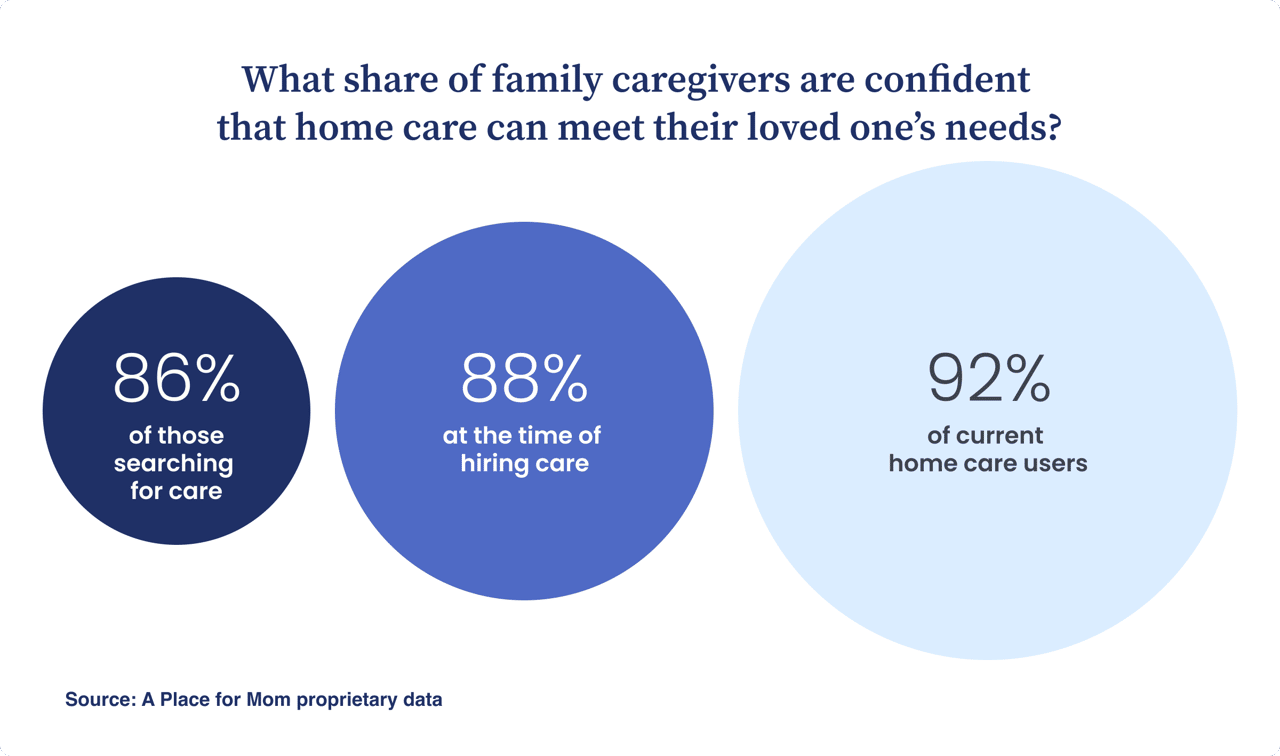
That trust also appears to influence how family caregivers experience home care over time. Families are generally optimistic when they begin the search for home care: 86% said they were confident that it would meet their loved one’s needs. Among current home care users, confidence rose to 92%. Rather than declining as care needs became more complex, confidence increased as families gained experience with the care arrangement and the people supporting it.
A Place for Mom
Cost remains a barrier for some families
While continuity is central to many successful home care experiences, it also depends on a family’s ability to sustain the cost. At the national median rate of $34 per hour, 15 hours of home care per week costs about $2,208 per month.
Among families who discontinued home care, cost was the most cited reason for stopping services. Nearly half (45%) said care became too expensive to continue. Another 18% said they didn’t feel the care they received justified the cost.
Financial considerations also appear throughout the broader home care journey. Families often adjust care hours as needs change, and 21% of caregivers whose care arrangements evolved said financial or budget considerations contributed to those changes.
These findings highlight one of the central tensions families face when using home care. Many begin home care expecting it to be a long-term solution that allows their loved one to remain at home. Yet the amount of care required often increases over time, creating pressure on household budgets as families work to balance evolving needs with available resources.
At the same time, the survey suggests that affordability alone doesn’t determine whether families view home care positively. Many current users report high levels of satisfaction and confidence in home care despite its cost. The challenge for many families is whether they can continue funding the level of support their loved one needs over the long term.
Home care can help make aging at home possible
Families choose home care to help a loved one retain their independence and dignity.
The survey findings suggest that home care can help families make aging at home possible. Before hiring care, 70% of caregivers expected home care would help their loved one remain living at home. Nearly as many expected it would improve quality of life (67%), improve safety (63%), and reduce stress for family members (59%).
Families who have experience with home care largely report that those expectations are being met. Among current users, 64% said home care has helped their loved one remain at home, 60% said it improved quality of life, 57% said it reduced family stress, and 55% said it improved safety.
Notably, families who ultimately discontinued home care reported many of the same benefits. Two-thirds (66%) said home care helped their loved one remain at home, while 51% said it reduced family stress, and 50% said it gave family caregivers time to rest or take breaks. Even when home care wasn’t sustained long-term, many families still reported that it provided meaningful support during its use.
Many families use home care for extended periods of time. Among current home care users in the survey, 38% have been receiving services for more than a year. By contrast, among families who discontinued care, nearly four in five ended services within the first year. Together, these findings suggest that many families can sustain home care long enough to realize meaningful benefits for both care recipients and family caregivers.
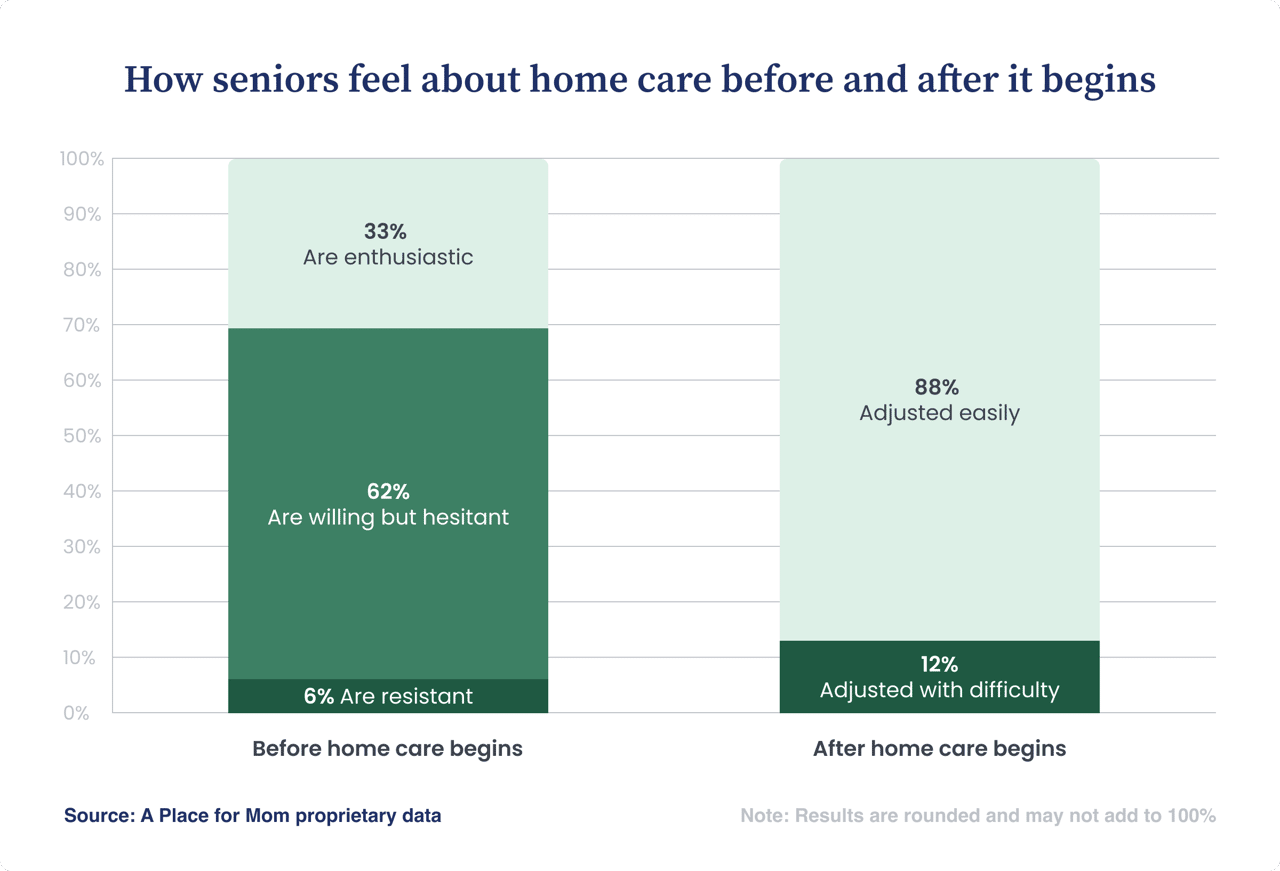
One reason may be that seniors and their families generally adapt to professional support more easily than many expect. Before hiring care, only 6% of caregivers described their loved one as resistant to the idea of home care. After care began, 88% said their loved one adjusted easily to receiving care, and 87% of caregivers said they themselves adjusted easily to having professional support in the home.
A Place for Mom
Throughout the survey, family caregivers described care arrangements that changed over time. The number of care hours their loved one needed increased, and the home care schedule became more tailored. The family used different services than they anticipated, and their responsibilities shifted. These changes were common among both current and former users of home care. What separated successful experiences from unsuccessful ones was whether families felt supported during the changes and whether they could afford long-term home care.
The findings suggest that successful home care depends on balancing two needs. Families need flexibility because change is common. They also need stability because change is easier to navigate in the context of trusted relationships. Reliable caregivers, consistent communication, and predictable routines help families adapt without feeling as though they are constantly starting over.
Based on the survey results, families who sustained home care over time were generally able to adapt as circumstances changed while maintaining confidence in the people providing care. Families who discontinued care were more likely to experience disruptions that made adapting more difficult.
Families who continued using home care reported greater confidence in caregiver reliability, consistency, communication, and professionalism. They were more likely to feel they received the support they needed and less likely to experience disruptions in care. In other words, they were better positioned to adapt when circumstances changed.
That ability to adapt appears to have consequences that extend beyond the practical delivery of care. Many families reported lower stress after home care began, and 69% of current users said their relationship with their loved one improved.
The survey findings also suggest that families recognize this value. Among long-term users, 85% described home care as a good or very good value, relative to its cost, and 93% of all current users said they would recommend home care to others in a similar situation. Even among families who had discontinued care, many still reported meaningful benefits from the experience, including reduced stress, caregiver respite, and the ability to help a loved one remain at home.
Families begin the caregiving process trying to help a loved one remain at home while preserving as much independence, dignity, and continuity as possible. The findings of this survey suggest that successful home care helps them do exactly that. What makes those arrangements successful isn’t simply the support that’s provided, but the development of trusted relationships that allow families to adapt as their loved one’s needs change. When those relationships are strong, aging at home becomes not only possible but sustainable.
Methodology
This report is based on a quantitative survey commissioned by A Place for Mom and conducted by Morning Light Strategy in April 2026. The respondent pool consisted of 708 U.S. adults ages 40 to 85 who provide unpaid care for at least one adult age 55 or older and who have experience with nonmedical in-home care.
Respondents represented four stages of the home care journey: caregivers actively searching for home care (n=140), families who hired care within the previous 12 months (n=252), long-term home care users (n=156), and families who had recently discontinued services (n=160). The study explored motivations for choosing home care, expectations before hiring, experiences after care began, changes in care needs over time, family caregiver involvement, communication with professional caregivers, and perceptions of value, confidence, and quality.
The report also incorporates relevant research on caregiving relationships and home-based care. These sources were used to provide additional context for understanding how families experience professional care in the home.
This story was produced by A Place for Mom and reviewed and distributed by Stacker.

