


Marjan Apostolovic // Shutterstock
Stress may be aging you faster, but you can slow it down
After a stressful day, it’s tempting to crash on the couch, switch on the TV, and scroll through your phone until bedtime. It feels like stress relief because it’s mindless, but that’s exactly why it doesn’t work.
Stress is a top factor impacting mental health, according to a 2026 American Psychiatric Association poll of 2,201 adults. Nearly half of respondents said they feel more anxious now than a year ago, up from 43% in 2025.
Human bodies were built to handle short bursts of pressure. In fact, humans need some stress to respond to challenges, grow, and adapt. But chronic, unmanaged stress speeds up aging in multiple systems in the body the way stop-and-go traffic ages the engine and brakes on a car. A single season of stress can advance your biological age — how well your cells, organs, and systems are actually functioning — by years.
Chronic stress drives the low-grade inflammation linked to heart disease, Type 2 diabetes, and cognitive decline. It shortens telomeres (the protective caps on chromosomes), impairs the mitochondria that power cells, and turns damaged cells into inflammatory “zombie” cells. Chronic stress may even alter how your body reads genes involved in repair. “Stress literally reprograms your DNA,” said Dr. Lanna Cheuck, D.O., a board-certified urologic surgeon and global longevity expert.
Stress isn’t going anywhere, so what matters is finding time and space to recover effectively. “That’s what your body needs to take on a healthy amount of stress and stay protected from cellular damage,” said Michelle Larivee, founder and CEO of WTHN, a holistic wellness studio in New York City.
Hone Health shows how stress can speed up aging and the scientifically backed stress recovery methods that will slow it down.
Hone Health
Unwinding Isn’t the Same as Recovering
Globally, the average person spends more than three hours a day watching TV and more than two hours scrolling social media — nearly six hours of what most people would call “unwinding.” But this kind of passive rest doesn’t actually relieve stress, and it often makes things worse.
A 2025 study in BMC Public Health found that greater binge-watching frequency was associated with higher levels of depression, anxiety, and stress. An analysis of 141 studies found the same consequences for passive social media use. And when scrolling tips into doomscrolling, anxiety compounds — the more you scroll to soothe discomfort, the worse you feel.
What Does Work to Relieve Stress
True stress relief and recovery actively shift your nervous system out of fight-or-flight mode and back into a relaxed state that supports digestion, sleep, immune balance, and cellular repair.
The best recovery tools are ones that reliably change your physical or mental state and that you can build into your regular routine.
These recovery tools are all backed by scientific evidence.
Get moving. Exercise temporarily activates the body’s stress response, but regular physical activity can lower cortisol, boost mood, improve stress resilience, and reduce perceived stress over time. Cardio, strength training, yoga, qigong, and tai chi can all help, but consistency trumps any specific workout. “You can’t brush your teeth once a month and expect results,” said Larivee. “It’s the same with exercise.”
Protect your sleep. Sleep resets cortisol, regulates hormones, and gives the brain and body time to repair. Yet about 1 in 3 U.S. adults gets fewer than seven hours a night. Aim for seven to nine hours in a cool, dark room, keep sleep and wake times consistent, and get sunlight first thing in the morning to reinforce your natural sleep-wake cycle.
Eat a calming diet. No food can switch off stress, but a Mediterranean-style diet built around whole foods, protein, fiber, leafy greens, and omega-3-rich fish, can lower stress-induced inflammation. How you eat matters, too. “Try to make it a moment in your day when you can really relax,” said performance chef Dan Churchill. “Getting away from your desk gives your body a chance to shift into the parasympathetic ‘rest-and-digest’ state.”
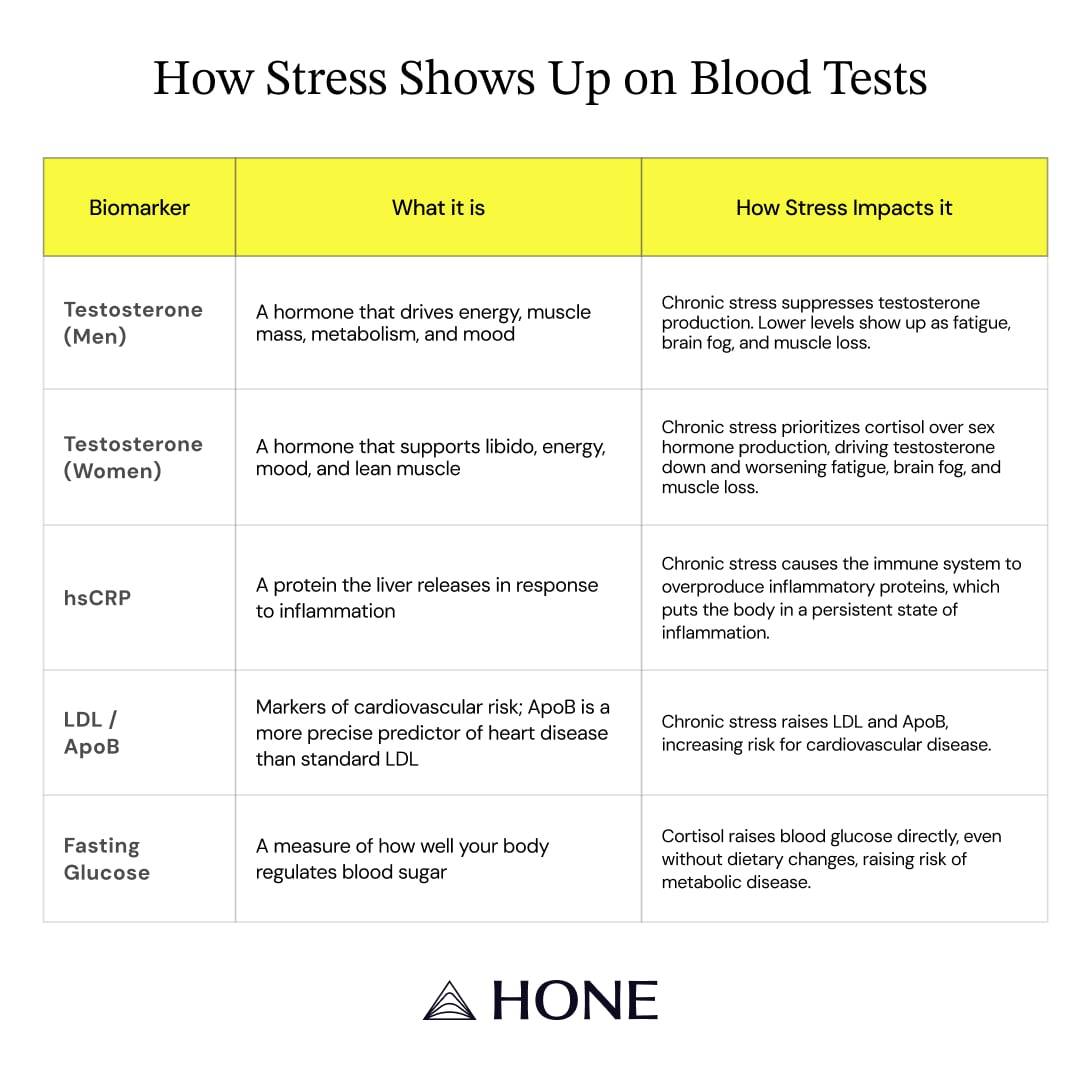
Measure what stress is doing to your body. When stress accelerates biological aging by disrupting reproductive hormones, inflammation, blood sugar, and cardiovascular risk, comprehensive blood work can detect those changes — or uncover other reasons for symptoms like fatigue, poor sleep, or low mood. Reviewing the results with a physician and tracking them over time can show whether your overall health is moving in the right direction.
Meditate and slow your breathing. Meditation and breath work directly interrupt the body’s stress response, lowering cortisol and inflammation and easing anxiety and depression. Slow breathing activates the vagus nerve, which can produce a calming effect within minutes and improve nervous-system regulation over time.
Release tension with acupuncture or cupping. Acupuncture may help shift the nervous system out of fight-or-flight mode, while cupping can improve circulation and ease muscle tension. After starting regular acupuncture to ease chronic pain, Larivee said, “I was sleeping better, I was less stressed, and I was getting sick less often.”
Prioritize social connection. Loneliness hikes cortisol and inflammation, harming your health as much as smoking 15 cigarettes a day. On the flip side, social ties have been linked to longevity. In an analysis of 148 studies, people with stronger relationships had a 50% greater likelihood of survival over time than people with weaker social ties.
This story was produced by Hone Health and reviewed and distributed by Stacker.

