High-Purity Standards Drive Growth in Analytical and Testing Sectors
ROCKVILLE, MD, UNITED STATES, April 21, 2026 /EINPresswire.com/ — According to the latest market analysis by Fact.MR, the Germany Potassium Hydrogen Phthalate (KHP) market is entering a phase of steady, high-value expansion. Valued at USD 96.8 million in 2025, demand is projected to climb to USD 101.9 million by 2026, reaching a forecast valuation of USD 158.7 million by 2036.
Germany is set to grow at a CAGR of 4.7%, outpacing global mature market averages. This growth is underpinned by the nation’s stringent adherence to EU laboratory compliance standards and the presence of global chemical titans like Merck KGaA, which recently expanded its analytical reagent production capacity to meet the rising need for traceable, primary reference standards.
Get detailed market forecasts, competitive benchmarking, and pricing trends:
https://www.factmr.com/connectus/sample?flag=S&rep_id=14761
Quick Stats: Potassium Hydrogen Phthalate Market (Germany Focus)
Metric
Details
Market Size (2026E)
USD 101.9 Million
Forecast Value (2036F)
USD 158.7 Million
Projected CAGR (Germany)
4.7%
Incremental Opportunity
USD 56.8 Million
Leading Segment
Above 99.9% Purity (58% Share)
Leading Application
pH Calibration (41% Share)
Key Regions
Europe (Led by Germany and UK)
Key Players
Merck KGaA, Thermo Fisher Scientific, Avantor, TCI
Executive Insight for Decision Makers
The KHP market is undergoing a structural shift from routine reagent grade chemicals toward Certified Reference Materials (CRMs). As regulatory frameworks like ISO 17025 become more embedded in laboratory workflows, the demand for “traceable” accuracy is non-negotiable.
“In Germany, demand remains aligned with the continued utilization of high-purity analytical standards supporting calibration accuracy and titration reproducibility,” says Shambhu Nath Jha, Principal Consultant at Fact.MR. “For manufacturers and investors, the strategy must pivot toward crystallization and purification process optimization. The risk of not adapting to these higher certification tiers is losing placement in the highly lucrative pharmaceutical validation chain.”
Market Dynamics
Key Growth Drivers:
Rigorous EU Compliance: Ongoing updates from the European Chemicals Agency (ECHA) drive the demand for standardized analytical reagents.
Pharmaceutical Infrastructure: Germany’s status as a global pharma hub necessitates high volumes of KHP for routine quality control and buffer preparation.
Traceability Requirements: Increasing institutional focus on “Primary Standard” reagents for validated laboratory workflows.
Key Restraints:
Budget Sensitivity: Procurement cycles in academic research can be sensitive to the premium pricing of ultra-high purity grades.
Substitution Pressures: Emerging alternative certified reference materials for specific high-end titration applications.
Segment Analysis: The 99.9% Purity Benchmark
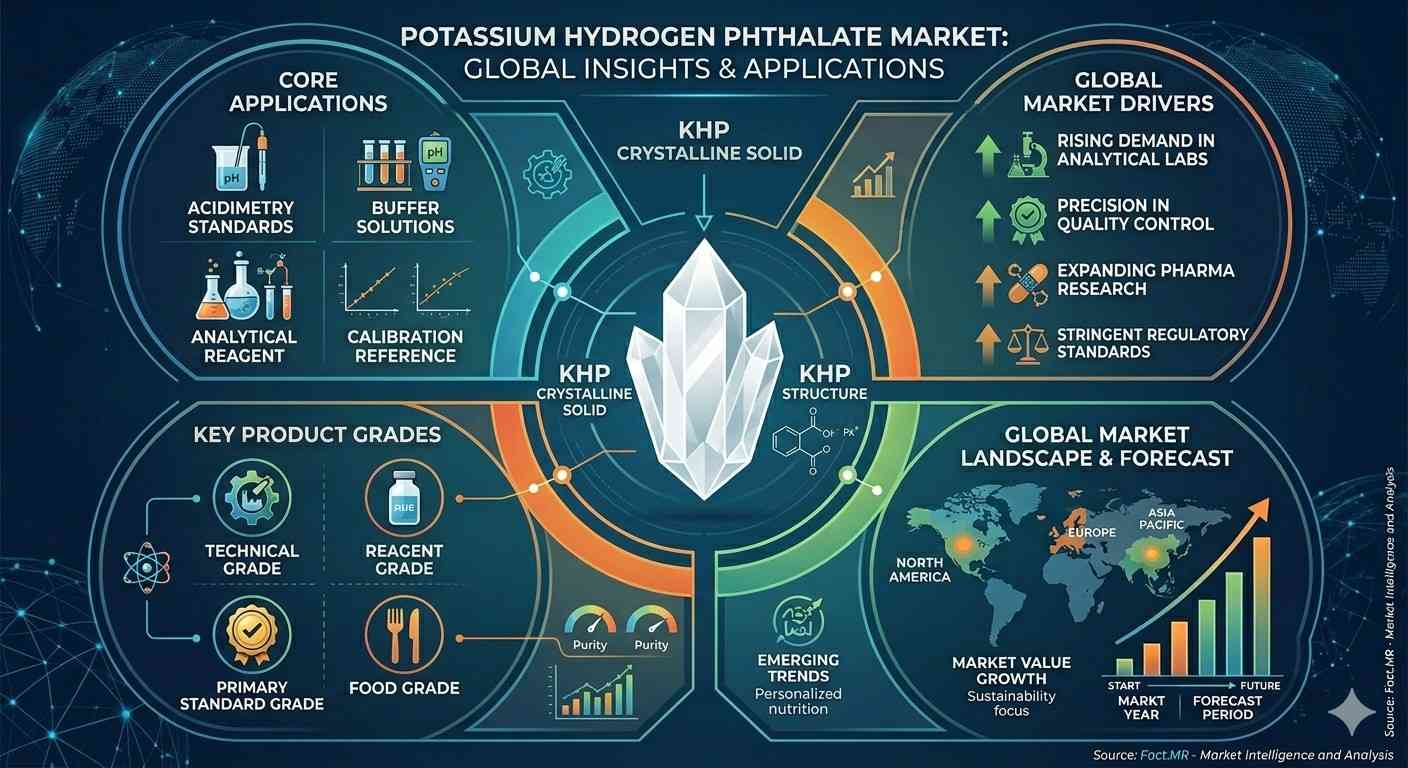
The Above 99.9% Purity segment is projected to dominate the market with a 58% share in 2026. This tier is critical for preparation of standardized reference solutions where minimal impurity interference is essential.
In terms of application, pH Calibration holds a 41% share, as KHP remains the gold standard for stabilizing hydrogen ion concentration in titration and instrumentation standardization. The pharmaceutical and chemical testing laboratories remain the primary end-users, ensuring a recession-resistant demand profile.
Supply Chain Analysis: From Synthesis to Standard
The KHP supply chain is specialized, requiring high-precision chemical engineering:
Raw Material Suppliers: Providers of high-grade phthalic anhydride and potassium hydroxide.
Manufacturers: Companies like Merck KGaA and Thermo Fisher who execute controlled crystallization to achieve analytical grades.
Distributors: Global entities like VWR International and Avantor manage the logistics, ensuring purity is maintained during transit.
End-Users: Pharmaceutical QC labs, environmental agencies, and academic research centers.
“Who Supplies Whom”: Major manufacturers serve as the primary source for certified standards, while regional distributors (e.g., Loba Chemie, Alfa Aesar) cater to the broader academic and technical-grade markets.
Pricing Trends
Pricing in the German KHP market is bifurcated. Commodity Grade KHP follows traditional chemical pricing indexes, while Analytical Grade (CRM) commands a significant premium due to the costs associated with purification, batch-validation, and certification documentation. Margins remain strongest in the ultra-high purity segments (Above 99.95%), where performance is mission-critical.
Regional Analysis: Germany Leads the European Vanguard
Germany’s 4.7% CAGR reflects its role as Europe’s industrial laboratory.
Germany vs. Global: While the UK leads growth slightly at 4.9% due to rapid infrastructure updates, Germany provides the highest absolute volume demand in the EU.
Comparison: Unlike emerging markets in Asia that focus on volume, the German market is value-driven, prioritizing Traceability and Quality Assurance (QA) protocols over bulk procurement.
Competitive Landscape
The market is moderately fragmented but dominated by a core group of quality-leaders.
Strategic Leaders:Merck KGaA and Thermo Fisher Scientific utilize their massive R&D budgets to offer the most comprehensive certification dossiers.
Challengers:Tokyo Chemical Industry (TCI) and Avantor are expanding their “Catalog-Based” distribution to capture smaller, agile research labs.
Strategies: Focus is on multi-year supply agreements and “Batch-Consistency” guarantees to secure long-term contracts with pharmaceutical giants.
Strategic Takeaways
For Manufacturers: Invest in automated crystallization to ensure batch-to-batch molar mass accuracy.
For Investors: Target companies with strong certification pedigrees (ISO, USP, Ph. Eur.) as these are the gatekeepers of the premium market.
For Marketers: Emphasize “Traceability Documentation” as the core value proposition in the German market.
Future Outlook
The future of the KHP market lies in its integration with Automated Titration Systems. As laboratories move toward high-throughput testing, the demand for pre-weighed, ultra-high-purity KHP “singles” or concentrated liquid standards will rise. Sustainability in chemical synthesis will also become a major differentiator for European tenders by 2030.
Conclusion
Germany’s Potassium Hydrogen Phthalate market represents a stable, high-value opportunity for those who can navigate the complexities of analytical certification. As labs shift toward higher validation tiers, the transition from “reagent” to “standard” defines the next decade of market transformation.
Why This Market Matters
Without Potassium Hydrogen Phthalate, the precision of global pharmaceuticals and chemical safety would be compromised. As the “Standard” for acidity, KHP is the silent guardian of measurement accuracy in every lab across Germany—from life-saving drug development to ensuring the safety of our environmental water tables.
Full Report: Unlock 360° insights for strategic decision making and investment planning-
https://www.factmr.com/checkout/14761
To View Related Report:
Potassium Silicate Market https://www.factmr.com/report/potassium-silicate-market
Potassium Cyanide Market https://www.factmr.com/report/potassium-cyanide-market
Potassium Chloride Market https://www.factmr.com/report/potassium-chloride-market
Potassium Sorbate Market https://www.factmr.com/report/potassium-sorbate-market
S. N. Jha
Fact.MR
+1 628-251-1583
email us here
Legal Disclaimer:
EIN Presswire provides this news content “as is” without warranty of any kind. We do not accept any responsibility or liability
for the accuracy, content, images, videos, licenses, completeness, legality, or reliability of the information contained in this
article. If you have any complaints or copyright issues related to this article, kindly contact the author above.

Media gallery