New survey finds 73% of Californians unaware courts use AI to draft rulings; 91% say judges should be required to disclose it
IRVINE, CALIFORNIA, CA, UNITED STATES, April 17, 2026 /EINPresswire.com/ — AI ADOPTION IN CALIFORNIA COURTS
California courts have begun using artificial intelligence to summarize legal filings and draft tentative rulings in civil cases. Los Angeles Superior Court — the largest trial court in the nation — launched a pilot program in March 2026 providing civil court judges with AI software that processes filings and produces draft tentative rulings. Similar programs are now operating in at least ten states. Over 60 percent of surveyed judges nationally report having used AI in their work, according to an April 2026 Washington Post report.
Under California Rules of Court, rule 3.1308, tentative rulings in civil cases are posted the day before a hearing and adopted unless a party specifically requests oral argument. In departments using AI-assisted preparation tools, the software serves as an initial processor of the briefs attorneys file.
A new survey conducted by Kolmogorov Law, P.C. found that the majority of California residents are not aware of this development.
SURVEY RESULTS
A survey of 400 California adults age 25 and older, conducted April 17, 2026, through the Pollfish research platform, found that 73 percent of respondents were not aware that California courts are using AI software to help judges summarize legal filings and draft tentative rulings. (Pollfish survey, Q2; n=400; margin of error ±4.9 percent at 95 percent confidence.) The remaining 27 percent reported awareness.
Among the 34.5 percent of respondents who reported prior involvement in a California lawsuit — as plaintiff, defendant, or both (Pollfish survey, Q1) — awareness levels were comparable to the general population. Respondents with prior court involvement were not more likely to be aware of judicial AI use than those without such experience.
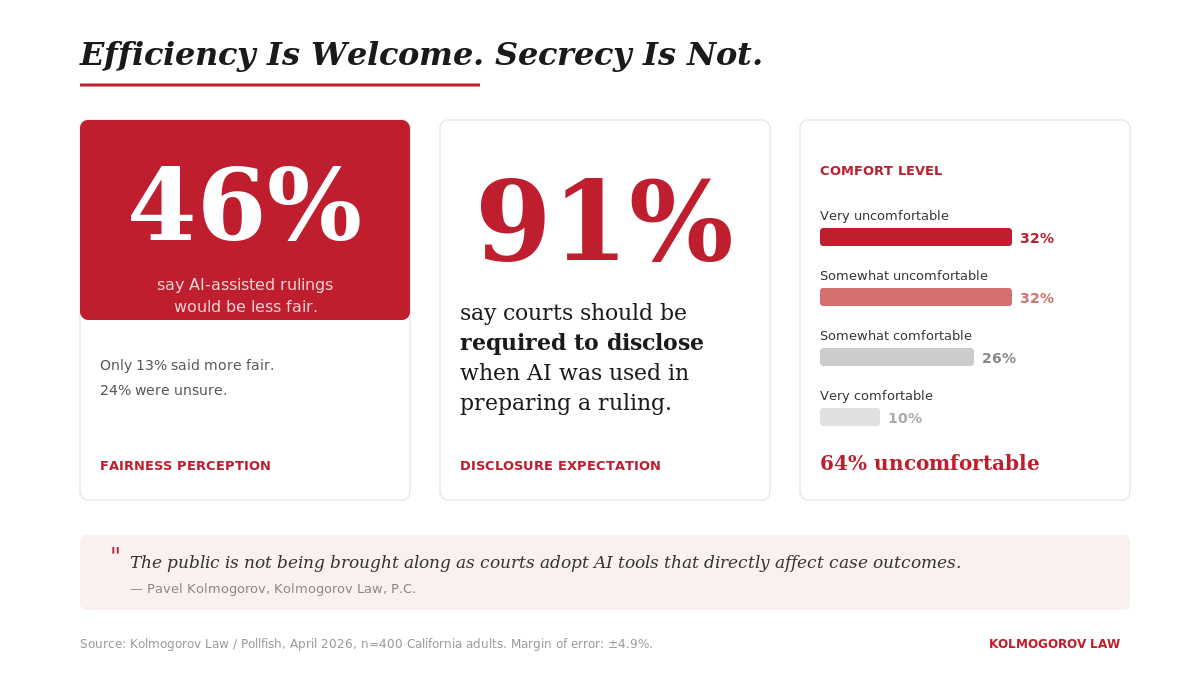
When asked how comfortable they would be if AI software assisted a judge in summarizing filings and drafting a tentative ruling in a lawsuit involving their business, 64 percent of respondents said they would be uncomfortable — 32 percent somewhat uncomfortable, 32 percent very uncomfortable. (Pollfish survey, Q3.) Ten percent reported being very comfortable, and 26 percent said they would be somewhat comfortable.
On disclosure, 91 percent of respondents said courts should be required to disclose to the parties when AI was used in preparing a ruling in their case. (Pollfish survey, Q4.) Four and a half percent said disclosure should not be required, and 4.5 percent were unsure.
Fifty-nine percent said they would trust a human law clerk working for the judge to accurately summarize the facts and legal arguments in a business dispute, compared to 11 percent who said they would trust AI software designed for judicial case preparation. (Pollfish survey, Q5.) Another 19.5 percent said they would trust both equally, and 10.5 percent said they would trust neither.
On fairness, 46 percent of respondents said they believe AI-assisted judicial rulings would be less fair than rulings made entirely by a judge and human staff. (Pollfish survey, Q6.) Thirteen percent said AI rulings would be more fair, 17 percent said equally fair, and 24 percent were unsure.
CALIFORNIA’S REGULATORY FRAMEWORK
The Judicial Council of California adopted California Rules of Court, rule 10.430 on July 18, 2025, effective September 1, 2025. It was the first statewide judicial AI framework in the nation. (Cal. Rules of Court, rule 10.430.) The rule requires courts that permit AI use to adopt local generative AI policies, imposes data privacy protections, and mandates human oversight.
Rule 10.430 provides that judges are not authorized to use AI to “draft legal opinions.” The rule’s disclosure obligation applies when court-generated content is “entirely” AI-produced. Under current pilot program workflows, AI generates a draft that a judge then reviews and edits — a process that may not meet the “entirely” AI-produced threshold.
Under California Rules of Court, rule 3.1308, tentative rulings in civil cases are posted the day before the hearing and adopted unless a party requests oral argument. Whether a tentative ruling drafted by AI and adopted by a judge with edits constitutes a “legal opinion” within the meaning of rule 10.430 remains an open question under the current framework.
No California rule currently requires that a litigant be informed whether AI participated in preparing a ruling in their case. No federal rule addresses this question either. Among the states where court systems have adopted AI judicial preparation tools, none has established a mandatory disclosure requirement triggered by AI use in individual case rulings.
As AI-assisted legal filing tools become more common among self-represented litigants, a growing number of cases may involve AI-generated filings being processed by AI-powered judicial preparation software. In that scenario, the human judge serves as a reviewer of work product generated on both sides by AI — a development that California’s current framework does not specifically address.
ABOUT KOLMOGOROV LAW, P.C.
Kolmogorov Law, P.C. is a California litigation firm based in Irvine. The firm handles breach of contract, fraud, unfair business practices under Business and Professions Code section 17200, computer fraud under Penal Code section 502, trade secret misappropriation, and multi-party commercial litigation across California Superior Courts. The firm is led by Pavel Kolmogorov (LL.M., UC Berkeley School of Law) and is licensed in California, the District of Columbia, and multiple federal districts. Contact: (909) 235-6420 or kolmogorovlaw.com.
SURVEY METHODOLOGY
This article is based on a survey of 400 California adults age 25 and older conducted April 17, 2026, through the Pollfish online research platform. The survey included six substantive questions covering awareness of AI use in California courts, comfort with AI-assisted judicial rulings, disclosure expectations, trust in human versus AI case preparation, and fairness perceptions. The margin of error for the full sample is approximately plus or minus 4.9 percent at a 95 percent confidence level. The survey did not include screening questions; respondents represent the general adult population of California.
SOURCES
Survey data: Kolmogorov Law / Pollfish, April 17, 2026, n=400 California adults. Legal framework: California Rules of Court, rules 3.1308, 10.430; Standards
Pavel Kolmogorov
Kolmogorov Law, P.C.
909-235-6116
info@kolmogorovlaw.com
Visit us on social media:
LinkedIn
Instagram
Facebook
YouTube
X
Other
Legal Disclaimer:
EIN Presswire provides this news content “as is” without warranty of any kind. We do not accept any responsibility or liability
for the accuracy, content, images, videos, licenses, completeness, legality, or reliability of the information contained in this
article. If you have any complaints or copyright issues related to this article, kindly contact the author above.

Media gallery