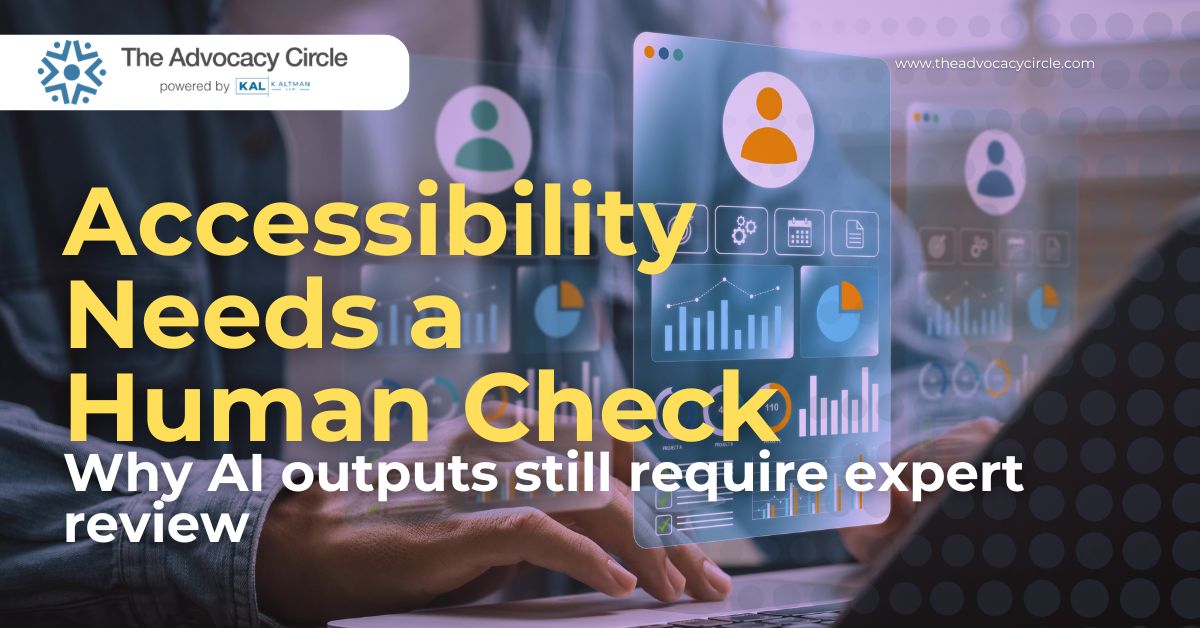
AI can speed accessibility work, but human validation remains essential to ensure real, usable access for students.
FARMINGTON HILLS, MI, UNITED STATES, April 16, 2026 /EINPresswire.com/ — As colleges and universities work to make digital learning environments more accessible, a practical message is coming into sharper focus: artificial intelligence may help institutions move faster, but it does not remove the need for human validation.
A recent article from Every Learner Everywhere explores how higher education professionals are using AI to support document conversion, captioning, and accessibility remediation while emphasizing that outputs still require qualified review before students rely on them. You can read more about it here.
For The Advocacy Circle, that message resonates beyond higher education. Inclusive technology is not only about deploying tools that promise efficiency. It is about ensuring that the learning experience on the other side is usable, understandable, and genuinely accessible for the people who need it most.
“Accessibility is not just a technical checklist. It is a human experience,” said Dan Rothfeld, Co-Founder and COO of The Advocacy Circle. “AI can support scale and speed, but students and families still need systems that are reviewed carefully, designed responsibly, and accountable to real-world needs.”
The article’s emphasis on treating AI outputs as first drafts rather than finished products offers an important framework for education leaders, nonprofits, and support organizations. When institutions face large volumes of legacy content, urgent timelines, and limited staffing, AI may reduce workload. But if those systems are treated as fully reliable without oversight, accessibility barriers can remain hidden until a learner encounters them.
TAC believes the strongest EdTech strategies combine innovation with structured human review. That includes clear workflows, accountable ownership, staff training, and a willingness to judge success not by tool adoption alone, but by whether access actually improves for learners and families.
What institutions and advocates should do now
• Treat AI-generated accessibility outputs as drafts, not final products.
• Build review workflows with designated human oversight.
• Prioritize learner experience, not only remediation speed.
• Support staff with vetted tools and practical training.
• Measure whether technology is improving access in practice.
The Advocacy Circle helps families navigate special education and related school systems with practical tools, step-by-step guidance, and accessible support. TAC’s mission is to help parents prepare, communicate, and advocate with greater clarity and confidence before challenges escalate. Through expert-informed resources, community support, and technology-enabled guidance, TAC works to make advocacy more understandable, proactive, and accessible for families. www.theadvocacycircle.com
This content is provided for general informational purposes only and is not legal advice. Every student situation is fact-specific, and laws, policies, and procedures vary by state, district, school, and institution. Use of TAC resources or contact with TAC does not create an attorney-client relationship.
Dan Rothfeld
The Advocacy Circle
+1 947-366-0021
danrothfeld@theadvocacycircle.com
Visit us on social media:
LinkedIn
Instagram
Facebook
Legal Disclaimer:
EIN Presswire provides this news content “as is” without warranty of any kind. We do not accept any responsibility or liability
for the accuracy, content, images, videos, licenses, completeness, legality, or reliability of the information contained in this
article. If you have any complaints or copyright issues related to this article, kindly contact the author above.

Media gallery