South Korea’s UAV ecosystem expands with K-Drone and commercial use.
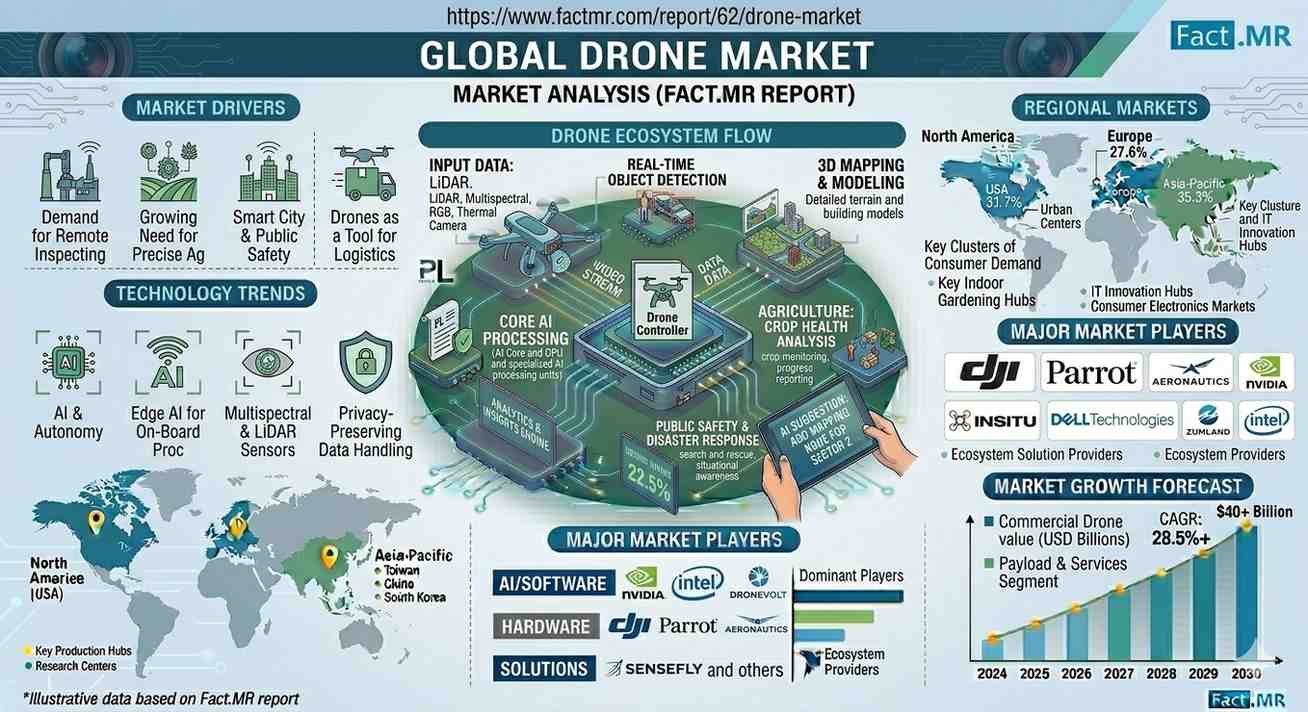
ROCKVILLE, MD, UNITED STATES, April 10, 2026 /EINPresswire.com/ — According to Fact.MR’s latest analysis, the South Korea drone market is entering a high-growth phase supported by regulatory clarity, urban air mobility initiatives, and expanding commercial drone deployment. The global drone industry is valued at USD 44.59 billion in 2026 and projected to reach USD 325.73 billion by 2036, with South Korea emerging as one of the fastest-growing country-level markets at a CAGR of 16.3% (2026–2036).
South Korea’s drone ecosystem is expected to generate strong incremental opportunity as the government’s K-Drone system, urban air mobility roadmap, and commercial delivery corridors enable scalable deployment across logistics, infrastructure inspection, and agriculture. The transformation is shifting drones from niche aerial tools to critical industrial automation platforms.
Get detailed market forecasts, competitive benchmarking, and pricing trends:
https://www.factmr.com/connectus/sample?flag=S&rep_id=62
Quick Stats
Market Size (2026 – Global Reference): USD 44.59 Billion
Market Size (2027 – Estimated Growth Phase): Accelerating double-digit expansion
Forecast Value (2036 – Global Reference): USD 325.73 Billion
South Korea CAGR (2026–2036): 16.3%
Incremental Opportunity: Rapid commercial and logistics deployment
Leading Segment: Commercial Drones (~70% share)
Leading Design: Fixed-Wing Drones (~65% share)
Leading Region: South Korea (Country-focused analysis)
Key Players: DJI Technology, AeroVironment, Parrot SA, Skydio, Yuneec
Executive Insight for Decision Makers
South Korea’s drone market is transitioning from pilot-scale testing to commercial deployment. Logistics providers, infrastructure operators, and public sector agencies are integrating drones into core operations.
Strategic priorities:
Invest in BVLOS (Beyond Visual Line of Sight) capabilities
Develop AI-enabled autonomous navigation
Expand drone fleet management platforms
Align with government UAM and K-Drone infrastructure
Organizations failing to adapt risk losing automation efficiency gains, missing regulatory-first deployment opportunities, and falling behind in logistics innovation.
Market Dynamics
Key Growth Drivers
Government-led K-Drone infrastructure development
Urban air mobility and smart city initiatives
Rising demand for drone-based logistics and delivery
Adoption in infrastructure inspection and agriculture
Key Restraints
High upfront drone fleet investment
Airspace regulation and operational compliance complexity
Limited payload capacity for heavy logistics
Emerging Trends
Autonomous drone delivery corridors
AI-powered flight management systems
Integration with smart city infrastructure
Expansion of drone-as-a-service business models
Segment Analysis
By Type
Commercial drones dominate with ~70% share
Used across logistics, construction, agriculture, inspection
By Design
Fixed-wing drones lead with ~65% share
Preferred for long-range mapping and surveillance
Fastest Growing Segment
Logistics and last-mile delivery drones
Strategic Importance
Commercial drones drive enterprise adoption
Fixed-wing platforms support infrastructure monitoring
Autonomous delivery enabling cost reduction
Supply Chain Analysis
Raw Material Suppliers
Semiconductor and sensor manufacturers
Battery and power system providers
Composite material suppliers
Camera and imaging technology vendors
Manufacturers / Producers
Drone OEMs
UAV system integrators
Autonomous software developers
Distributors
Defense procurement agencies
Industrial automation integrators
Telecom and smart city solution providers
End Users
Logistics companies
Construction and infrastructure firms
Agriculture operators
Government agencies
Defense and security organizations
Who Supplies Whom
Component suppliers provide sensors, batteries, and cameras to drone OEMs
OEMs integrate hardware and software platforms
System integrators deploy drones for enterprise clients
Enterprises use drones for inspection, delivery, and monitoring
Pricing Trends
Entry-level drones follow commodity pricing
Industrial drones command premium pricing
Pricing influenced by:
Flight endurance
Payload capacity
AI autonomy features
Regulatory certification
Enterprise drone solutions deliver higher margins through software subscriptions
Regional Analysis (South Korea Focus)
South Korea – CAGR 16.3%
Government UAM roadmap supporting drone delivery
K-Drone system establishing regulated corridors
Smart city infrastructure adoption
Industrial automation demand across sectors
Developed vs Emerging Market Comparison
South Korea shows advanced infrastructure-driven adoption
Enterprise automation focus vs consumer hobbyist demand
Regulatory clarity accelerating commercial deployment
Competitive Landscape
The South Korea drone market shows moderate concentration with global OEMs and specialized UAV technology providers competing across commercial and defense applications.
Key Players
DJI Technology Co. Ltd.
Parrot SA
Yuneec International Co. Ltd.
AeroVironment Inc.
Skydio Inc.
Zipline International Inc.
Wing Aviation LLC
Teledyne FLIR LLC
General Atomics Aeronautical Systems
Lockheed Martin Corporation
Competitive Strategies
Autonomous flight technology development
Strategic government partnerships
Logistics delivery pilot programs
AI-enabled analytics integration
Vertical-specific drone solutions
Strategic Takeaways
For Manufacturers
Focus on autonomous drone platforms
Align with government infrastructure initiatives
Develop long-endurance drones
For Investors
Strong growth in logistics and inspection drones
Drone-as-a-service models offer recurring revenue
Smart city integration creates long-term demand
For Marketers / Distributors
Target logistics and infrastructure sectors
Highlight compliance and automation benefits
Partner with telecom and smart city providers
Future Outlook
South Korea’s drone market is expected to evolve into autonomous aerial mobility ecosystems integrating logistics, surveillance, and smart city infrastructure.
Expansion of drone delivery corridors
Increased adoption of AI navigation
Integration with 5G and smart infrastructure
Growth in industrial automation use cases
Long-term opportunities lie in urban air mobility, logistics automation, and infrastructure inspection.
Conclusion
The South Korea drone market is transitioning from experimentation to large-scale commercial deployment. Government initiatives, strong connectivity infrastructure, and enterprise automation demand are creating favorable conditions for rapid growth. Companies investing in autonomous capabilities, compliance readiness, and scalable fleet deployment will capture significant market share.
Why This Market Matters
South Korea’s advanced digital infrastructure and proactive drone regulations position it as a key innovation hub for commercial UAV deployment. As logistics, smart cities, and industrial automation expand, the market offers substantial opportunities for technology providers, investors, and ecosystem partners.
Full Report: Unlock 360° insights for strategic decision making and investment planning-
https://www.factmr.com/checkout/62
To View Related Report:
Drone Industry Analysis in United States https://www.factmr.com/report/us-drone-market
Drone Industry Analysis in Europe https://www.factmr.com/report/europe-drones-market
8K Drones Market https://www.factmr.com/report/8k-drones-market
Toy Drone Market https://www.factmr.com/report/toy-drone-market
S. N. Jha
Fact.MR
+1 628-251-1583
email us here
Legal Disclaimer:
EIN Presswire provides this news content “as is” without warranty of any kind. We do not accept any responsibility or liability
for the accuracy, content, images, videos, licenses, completeness, legality, or reliability of the information contained in this
article. If you have any complaints or copyright issues related to this article, kindly contact the author above.

Media gallery