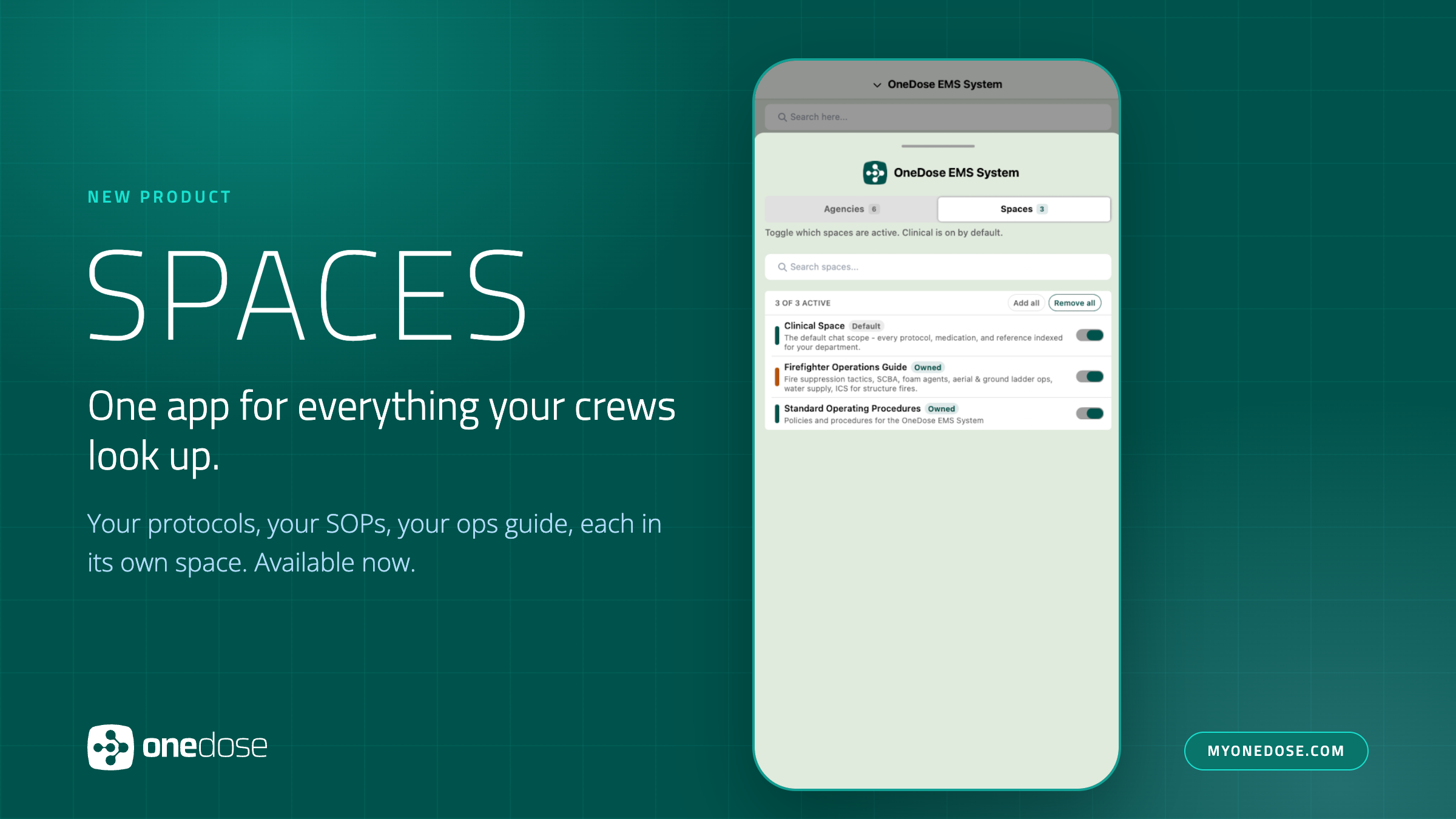

Protocols, SOPs, and ops guides each get their own library in the OneDose app, and crews choose which ones the AI Assistant reads.
BLOOMINGTON, MN, UNITED STATES, September 23, 2026 /EINPresswire.com/ — OneDose® today launched Spaces, a new product that lets EMS and fire agencies keep their clinical protocols, standard operating procedures, operations guides, and training material in the OneDose platform as separate libraries, each shared with exactly the crews that need it, and each one the OneDose AI Assistant can be pointed at or steered away from for any given question.
Every agency runs on several kinds of documents. There are the clinical protocols, which OneDose has always handled. Then there is everything else: the SOP binder, the fire operations guide, the infectious-disease transport procedure, and more. Those additional policies and files usually live on a shared drive, in a three-ring binder, or on an intranet nobody opens on a call. Spaces brings it into the app crews already have open, without mixing it into the clinical protocol list.
How Spaces Works
A space is a named library with its own folders and documents. Every department starts with a Clinical Space that holds everything OneDose has always contained. Any additional space an agency creates, such as “Standard Operating Procedures” or “Firefighter Operations Guide,” works exactly the same way: same folder tree, same document viewer, same draft-to-publish-to-archive lifecycle, same review process. Administrators have nothing new to learn, and a medic who never turns on a second space sees the same app they use today.
What Administrators Get
In the OneDose admin console, a space switcher sits at the top of the sidebar, in the same place administrators already use to move between agencies. Whatever space is selected governs everything beneath it: Folders, Database, Notifications, Archive, Protocol Sets, and Review all follow the active space. A Manage Spaces view lists every space with its type, how much it holds, and who can reach it. Each space carries its own audience. It can stay private to the owning agency or be shared across an organization, either to every agency or only to named ones, with per-person access where a single individual needs it. A space shared to another agency is read-only for that agency.
What Field Crews Get
On the phone, the switcher crews already use to change agencies gains a second tab for spaces. Clinical is on by default. Turn on more, and the Protocols tab sections the folder list by space so a medic can jump straight to the SOPs or the ops guide. Content from the medic’s own agency is stored on the device and available offline, the same as protocols.
OneDose AI Assistant reads the spaces the user has switched on for that conversation, and only those. A medic can ask a question of the SOPs alone, the protocols alone, or everything at once. The answer is organized by the space each finding came from, and medication references return as live dose cards.
Why It Matters
OneDose ships new capability every month, and Spaces is the step that turns a protocol app into the single place an agency keeps everything its people need to look up. A medic searching for a cardiac protocol should not be wading through personnel policy, and an operations manager editing SOPs should not be able to disturb clinical content. Spaces gives each body of knowledge its own container, its own audience, and its own place in the app, while the AI Assistant lets the user decide the scope of every answer.
“Agencies have been asking us to hold more than protocols for a long time, and the honest answer was that a flat list would make the app worse for the medic on a call,” said Colton Hazlett, Co-founder and CTO of OneDose. “Spaces solves that. Your SOPs and your protocols live in the same app without getting in each other’s way, and when you ask the Assistant a question, you choose which libraries it reads and you can see where the answer came from.”
Availability
Spaces is available now to OneDose agencies as a separately purchased product. Agencies can contact their OneDose representative for pricing. Crews need the OneDose mobile app version 1.15.17 or newer. Sharing works within an organization, across a main agency and its sub-agencies; sharing between separate organizations is not part of this release. Medications, infusions, electrical therapy, and equipment remain department-wide reference data and are not divided by space. Spaces is an organizing and distribution control for agency documents; it does not change how OneDose analytics are reported, which remain at the agency level. The OneDose AI Assistant requires an internet connection, although Spaces files can be viewed while offline.
About OneDose
OneDose® is an AI-driven EMS platform that seamlessly connects clinical point-of-care solutions—from pre-scene to hospital handoff. By unifying protocols, dosing support, documentation, and real-time clinical tools into a single workflow, OneDose empowers emergency clinicians to deliver faster, safer, and more accurate care, even in the most unpredictable conditions. Learn more at https://myonedose.com/.
Michael Elsbernd
OneDose
+1 651-212-5437
sales@myonedose.com
Visit us on social media:
LinkedIn
Instagram
Facebook
YouTube
Legal Disclaimer:
EIN Presswire provides this news content “as is” without warranty of any kind. We do not accept any responsibility or liability
for the accuracy, content, images, videos, licenses, completeness, legality, or reliability of the information contained in this
article. If you have any complaints or copyright issues related to this article, kindly contact the author above.

Media gallery