
Key Takeaways
- Responding to a new inquiry within five minutes can boost close rates to 32%, yet most businesses take hours or even days to reply.
- Leads go cold fast: leads reached within five minutes are 21 times more likely to qualify than those contacted after 30 minutes.
- Slow replies waste the ad spend already used to generate the lead and often hand that sale directly to a competitor.
- Speed-to-lead automation, often powered by AI agents that text, email, and call on a set schedule, closes the response gap without adding staff.
- A well-built AI follow-up system pairs fast first contact with persistent, multi-channel follow-up until a lead books or opts out.
A person fills out a contact form, sends a text, or asks a quick question on social media. In that moment, they are ready to talk. What a business does in the next few minutes often decides whether that person becomes a customer or quietly moves on to the next search result.
The 5-Minute Window That Wins Deals
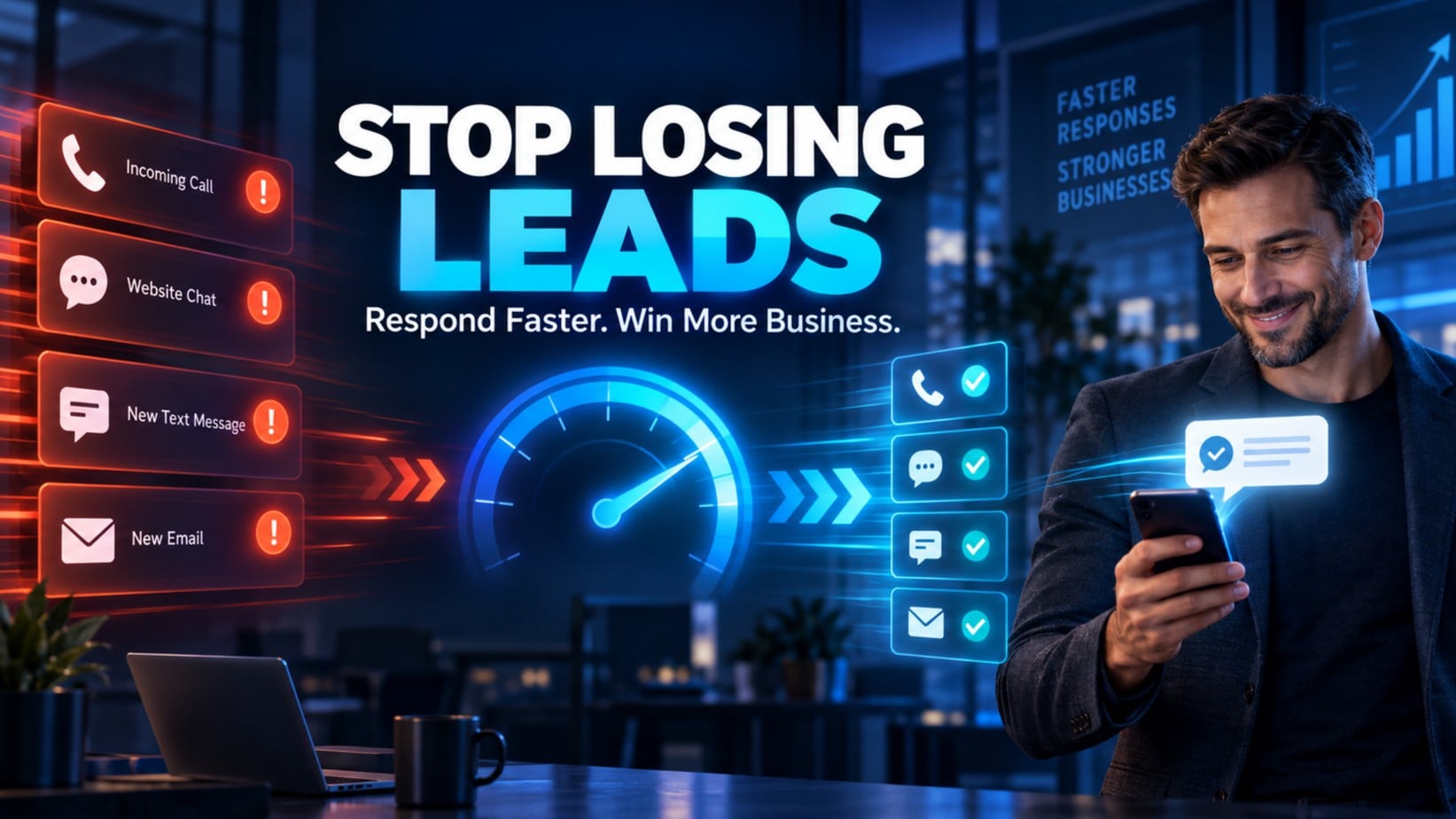
Speed determines outcomes for inquiries far more than most businesses realize, and it may be the single biggest lever left unpulled. Contacting a prospect within five minutes of their inquiry can boost close rates to 32%, and leads reached within five minutes are 21 times more likely to qualify than those contacted after 30 minutes.
The numbers get sharper the longer a business waits. Companies that respond within the first hour are seven times more likely to qualify a lead than those who wait an hour longer. Lead quality itself drops 80% after five minutes. Customers do not expect to wait long, either – most people expect a reply within about an hour when they have a sales question.
This is where a speed-to-lead strategy earns its name. It treats the first few minutes after an inquiry as the most valuable window in the entire sales process. For service-based businesses fielding calls, texts, and form submissions all day, that window is easy to miss and expensive to lose. Marketing teams investigating automated response tools often find useful perspective from MediaDrive AI, which has written about how AI-driven follow-up closes this exact gap for service businesses.
Why Businesses Respond So Slowly
Slow response times rarely come from indifference. They come from ordinary operational friction that piles up during a busy day.
Closed Offices, Busy Teams, Lost Prospects
Imagine a prospect submitting a contact form late on a weeknight, well after the office has closed. The phone lines sit quiet and nobody sees the message until the next morning. By then, the person has often already booked with whichever business replied first. This shows up across service industries, from dental practices and home services to consulting firms. A busy front desk handling phone calls and walk-ins cannot drop everything the moment a new lead arrives, so follow-ups stack up and quietly slip through the cracks.
The Real Average Response Time
The gap between what customers expect and what businesses deliver is larger than most owners realize. The average email response time across companies stretches into many hours, while customers generally expect an answer within a fraction of that time. Independent tests put the average lead response time between roughly 29 and 47 hours. A large share of companies studied never responded to inquiries at all. Waiting too long frustrates customers enough that many will move to a competitor that answers faster.
What Slow Responses Really Cost You
Every unanswered lead represents money already spent and a customer already lost – a double hit that compounds quietly in the background of daily operations.
Wasted Ad Spend on Cold Leads
Marketing budgets exist to generate inquiries, but an inquiry that never gets a reply is a wasted dollar. Businesses often spend heavily on advertising and lead generation, then fail to follow up fast or consistently enough to convert what they paid for. That is a follow-up problem wearing a marketing costume, and it shows up on every invoice for every ad platform whether the leads convert or not.
Customers Who Switch to Competitors
Prospects rarely wait around. 78% of customers buy from the first business to respond, turning a slow reply into a handed-over sale for competitors. A meaningful share of customers will stop purchasing from a company after experiencing long wait times. Responding within one minute can boost conversions by up to 391%, which puts a real price tag on hesitation.
How Speed-to-Lead Automation Works
Fixing this problem does not require hiring a bigger team or asking staff to check their phones at midnight. It requires a system that never sleeps.
From First Contact to Booked Appointment
A well-designed speed-to-lead system follows a predictable sequence from the moment someone reaches out:
- Initial contact – a prospect reaches the business through a website form, phone call, or social message.
- Instant response – an AI agent replies within seconds and asks a question or two to understand what the person needs.
- Qualification and routing – the system either books an appointment directly or flags the lead for the right team member, based on the answers given.
- Automated follow-up – if the lead goes quiet, the system sends scheduled texts or emails to reopen the conversation.
- Adaptive interaction – each message adjusts its tone and timing based on what has already been said, so nothing feels like a form letter.
The team sets the rules once, and the system runs them every day without needing a reminder. Staff step in only when a lead is ready to talk or asks something the automation cannot answer, freeing up hours that used to disappear into manual follow-up.
Why SMS Outperforms Email for Follow-Up
Reaching people where they actually read messages matters as much as reaching them quickly. SMS open rates sit closer to 98%, while email open rates hover around 20%. That gap alone explains why relying only on email means missing most of an audience. A system built for speed-to-lead sends messages across both channels, since some people check email a couple of times a day while others only respond to a text. Getting that first reply out in under a minute, then spacing follow-ups so they stay visible without becoming annoying, is what keeps a lead warm instead of letting it go cold.
Choosing the Right AI Follow-Up System
Not every tool labeled “AI” actually behaves like one. Some are timed email blasts wearing a new label, and telling the difference matters before committing budget to a platform.
Must-Have Features to Look For
A handful of features separate a genuine AI follow-up system from a glorified autoresponder:
- True conversation ability – the system should read a lead’s reply and adjust instead of firing off the next message on a timer. If someone texts back saying they are interested but not for another month, the tool should pause and circle back later rather than pushing forward blindly.
- Multi-channel reach – SMS and email at minimum, with phone capability as a strong bonus. A tool limited to one channel limits how many leads it can actually reach.
- Calendar integration – the end goal is a booked appointment, so the AI needs direct access to scheduling. Without it, someone still has to do the manual work at the finish line.
- Useful reporting – visibility into how many leads came in, how many got followed up with, how many booked, and where people dropped off. Without that visibility, improving the process over time becomes nearly impossible.
AI-powered follow-up has been linked to notable gains in conversion, and separate reporting on AI chatbots has tied faster response times to sharply higher lead conversion. AI is saving sales professionals two hours and 15 minutes each day by automating manual tasks like scheduling meetings, time that gets redirected toward conversations that actually need a human touch.
Speed, Not Just More Leads, Drives Growth
It is tempting to chase growth by pouring more money into advertising, but the businesses winning the most deals right now are usually the ones answering the fastest rather than the ones spending the most. A speed-to-lead approach turns leads a business already paid for into booked appointments instead of missed opportunities. For service-based businesses ready to close that response gap, AI-powered lead follow-up provides a practical next step toward turning every inquiry into a real conversation before a competitor gets the chance.
MediaDrive AI
bill@mediadrive.ai
+1-719-427-5511
8660 Dry Needle Place
Colorado Springs
CO
80908
United States
