

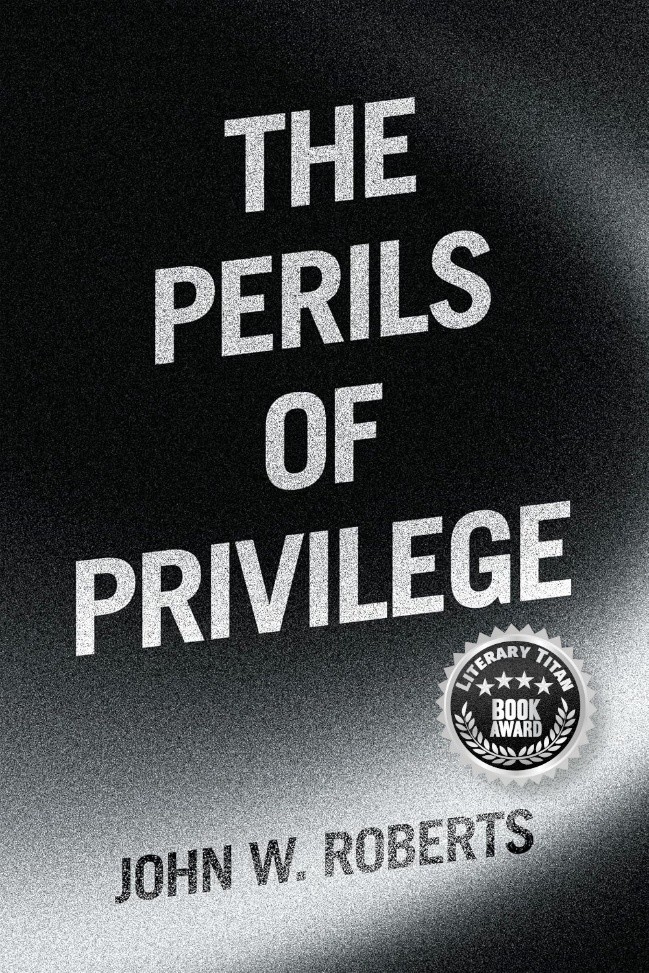
United States – September 15, 2026 – John W. Roberts’ thought-provoking novel, The Perils of Privilege, has received the Literary Titan Book Award, recognizing a work that examines how White privilege shapes opportunity, professional identity, racial expectations, and relationships in American life.
At the center of the novel is Damon Richardson, a young, Ivy League-educated African American man raised in a comfortable, integrated suburb. Damon believes that education, discipline, professional polish, and achievement have positioned him to succeed on their own merits. When he joins a predominantly White advertising firm, however, he enters a workplace in which success is influenced by assumptions he does not yet understand.
One of the novel’s most important figures in exposing those assumptions is Ms. Norton, Damon’s White supervisor. Her early interest in Damon and her manipulation of his professional advancement are central to the novel’s exploration of privilege. Through her, Roberts examines a familiar feature of White-dominated workplace culture: the power to determine not only who advances, but what a “good” Black employee is expected to look like, sound like, and become in order to be regarded as acceptable at higher levels of an organization.
Damon’s privilege, therefore, cannot be understood apart from White privilege. His education, upbringing, manner, and familiarity with elite institutions make him legible to those who control professional opportunity. Yet the novel refuses to treat those advantages as protection from racism. Instead, Damon gradually discovers that some of what he has understood as personal achievement exists within a system that continues to attach racial meaning to behavior, appearance, class background, and cultural identity.
That history also shapes Damon’s friendship with Josh Ford, his Black colleague and closest friend. Josh grew up in the projects, attended a historically Black college, and moves through the world with experiences very different from Damon’s. Their conflict is not simply a clash of personalities or backgrounds. It reflects a much older American history in which White racial hierarchies have influenced distinctions within the Black community itself.
Those distinctions have deep historical roots. During slavery, differences in skin tone, proximity to White households, labor assignments, and perceived relationships to White slaveholding families helped create divisions whose cultural consequences survived emancipation. Over time, those distinctions became intertwined with colorism, class, education, language, social mobility, and ideas about respectability. The Perils of Privilege brings that history into the modern workplace, where judgments about who appears polished, nonthreatening, assimilated, or professionally acceptable can reproduce older racial hierarchies in contemporary form.
Roberts does not present Damon and Josh as representatives of simple opposing camps. Rather, he uses their friendship to reveal how White privilege can influence the way Black Americans understand one another, measure success, and navigate institutions whose standards were not created by them.
Literary Titan praised the novel as a workplace drama and social novel that examines race, class, friendship, corporate ambition, and the complicated ways privilege operates both across racial lines and within Black communities. The review emphasizes that Damon’s professional crisis ultimately forces him to reconsider advantages he has taken for granted, people he has failed to understand, and assumptions that once seemed unquestionable.
For Roberts, the larger question is not merely who possesses privilege, but who has the power to define it. The Perils of Privilege asks readers to consider how White privilege can establish the standards by which success is recognized and rewarded, while simultaneously influencing divisions among those required to navigate those standards.
Readers interested in a character-driven exploration of ambition, friendship, race, workplace culture, and the hidden consequences of privilege can purchase The Perils of Privilege through Amazon and Barnes & Noble. Discover John W. Roberts’ provocative story of professional advancement, personal reckoning, and the difficult work of learning to see oneself and others more clearly.
About the Author
John W. Roberts is an author, scholar, and academic whose career has combined literary study, African American cultural scholarship, university leadership, public service, and fiction. He earned his bachelor’s degree in English with honors from Tusculum College, a master’s degree in English from Columbia University, and a Ph.D. in English from The Ohio State University.
Roberts has held faculty and leadership positions at the University of Missouri, the University of Pennsylvania, The Ohio State University, and the University of Houston. At Penn, he served as Faculty Master of the W.E.B. DuBois College House and Director of the Afro-American Studies Program. At Ohio State, he served as Professor of English, Chair of the Department of African and African American Studies, and Dean of Arts and Humanities. He later became Dean of the College of Liberal Arts and Social Sciences at the University of Houston. Roberts was also invited by the Clinton White House to serve as Deputy Chairman of the National Endowment for the Humanities, where he served as the agency’s chief administrative officer.
His novels include Redemption: The Story of Bert and His Boys, With Eyes Wide Open: The Execution of Quentin Marshall, Chasing His Destiny, and The Perils of Privilege. Through his fiction, Roberts brings decades of scholarship and observation to stories that examine identity, relationships, social institutions, and the complexities of the human experience.
Media Contact
Company Name: Literary Titan
Contact Person: John Roberts
Email: Send Email
Country: United States
Website: https://amzn.to/4xnpgTE
